

Last Updated: August 2026
Your scoreboard can tell you that you went 12–18. It cannot tell you why the same opening death keeps happening, why your utility arrives after the entry is already dead, or why your “good rotate” keeps leaving the bombsite open.
Good CS2 coaching finds the first repeatable decision behind those results. This guide shows what a useful coach should fix, when demo review beats live feedback, how to prepare for a session, and how to turn one hour of advice into something you can actually use in Premier.
This article is current for Premier Season Five. Valve added Cache to Active Duty, removed Overpass, and reworked C4 explosion damage when the season began on July 8; the official CS2 update log lists the latest update on August 24, 2026.
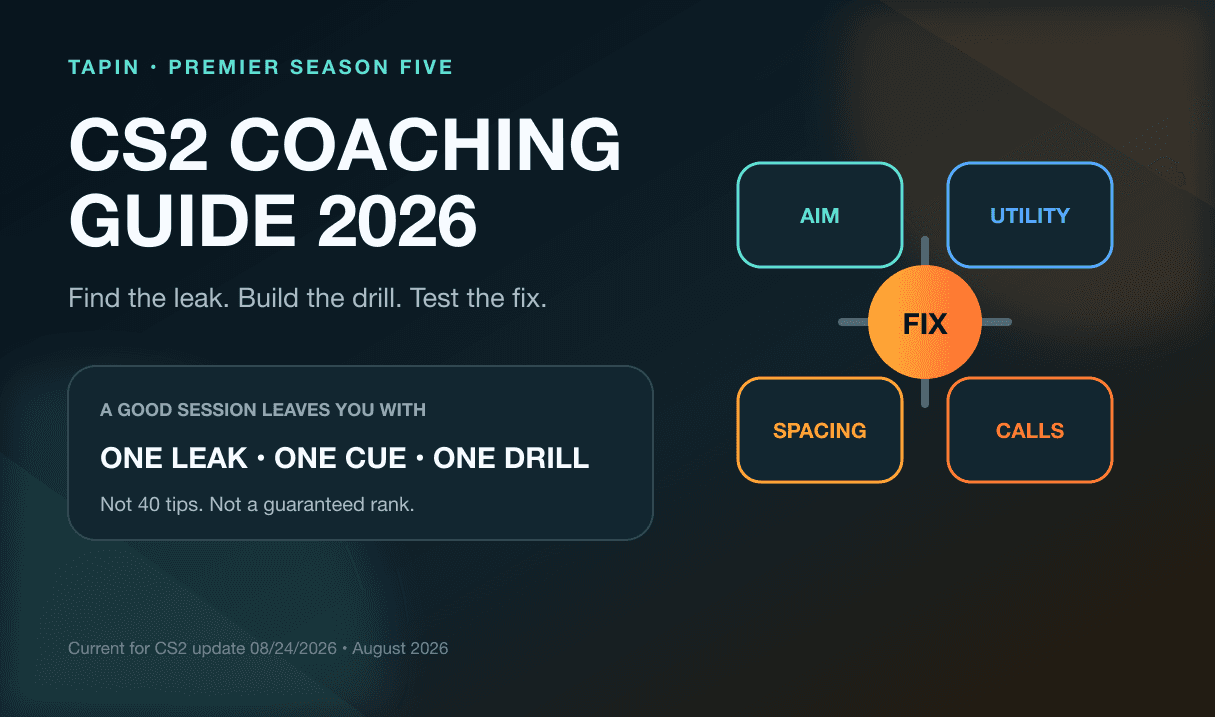
⚡ Quick answer: A good CS2 coach should leave you with one repeated leak, one short in-game cue, one drill, and one metric. If the session produces 40 disconnected tips or a guaranteed-rank promise, it did not produce a usable plan.
Table of Contents
- What CS2 coaching should fix
- Choose the right coaching format
- How a CS2 demo review works
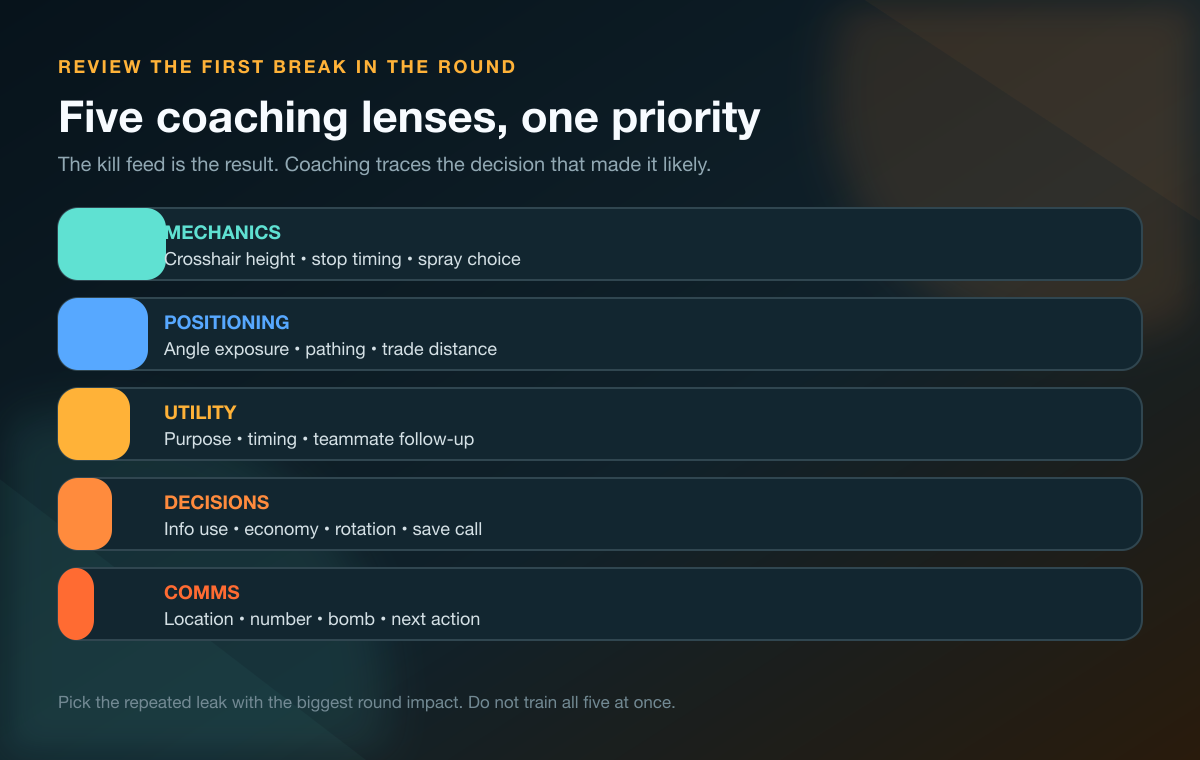
- The five leaks a coach should check
- What a 60-minute session looks like
- How to choose a CS2 coach
- Is CS2 coaching worth it?
- Seven-day practice plan
- FAQ
What Good CS2 Coaching Should Actually Fix
The kill feed shows the result. Coaching should rewind far enough to find the decision that made that result likely.
Maybe the missed shot was mechanical. Maybe you exposed two angles before the duel, arrived too far from your entry to trade, used the flash without telling anyone, or rotated on information that was already five seconds old. Telling every one of those players to “aim better” is lazy.
A useful diagnosis has five parts:
- Evidence: The leak appears in multiple rounds or demos.
- Cause: The coach identifies the first choice that narrowed your options.
- Cue: You get a phrase short enough to remember mid-round.
- Drill: The practice recreates the decision instead of filling time.
- Measure: You can count whether the problem improved in your next three games.
“Crosshair placement” is a category, not a cue. “Clear one head-height angle before exposing the next” is usable. “Better utility” is a category. “Name who follows this flash before you throw it” is usable.
I believe this is the cleanest test for coaching quality: can the coach turn replay evidence into a decision you can recognize before the mistake happens again?
Choose the Right CS2 Coaching Format
Most CS2 coaching fits into four formats. Pick the one that matches the problem instead of buying whatever sounds most intense.
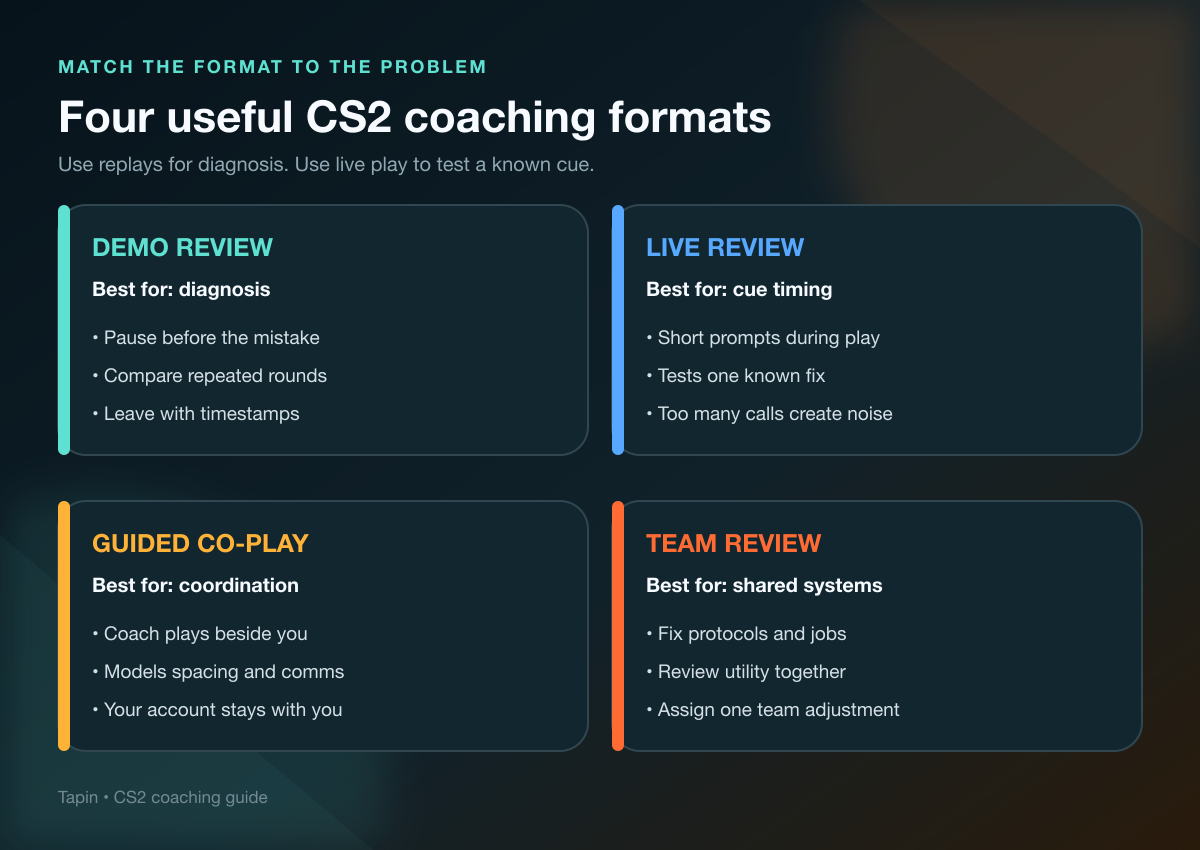
Demo review: best for diagnosis
A CS2 demo review lets the coach pause, rewind, change perspective, and compare repeated rounds. It is the strongest starting point for pathing, angle exposure, trade spacing, utility timing, rotations, economy decisions, and communication gaps.
Bring one close loss and one normal win. A loss shows what breaks under pressure; a win shows whether the same leak was hidden by better teammates or easier fights.
Live review: best for testing one known cue
Live review works after the main problem is already clear. The coach watches whether you apply the cue under real pressure and corrects it while the context is fresh.
The danger is call overload. A voice feeding you every target, rotate, buy, and grenade can play the round through you. Ask for short prompts, then quiet space to make the next decision yourself.
Guided co-play: best for spacing and communication
In guided co-play, the coach queues beside you on a separate account. That makes the format useful for trade distance, entry timing, utility follow-up, economy calls, and calm mid-round communication.
Your account stays with you. The coach should model the habit, not take control of your login or promise to manufacture a result.
Team review: best for shared protocols
A team can review defaults, site holds, retakes, utility ownership, buy rules, and who makes the late-round call. This is where “everyone knew the plan” gets tested against what five people actually did.
Keep one team adjustment per practice block. Rebuilding the full playbook after one bad scrim usually hides the original problem under fresh confusion.
How a Useful CS2 Demo Review Works
Do not start at the death screen. Rewind until the decision tree is still open.
The useful window may begin 10–15 seconds before contact: when you chose the route, separated from a trader, ignored information, spent utility, or committed to an angle with no exit. The death is often the receipt, not the purchase.
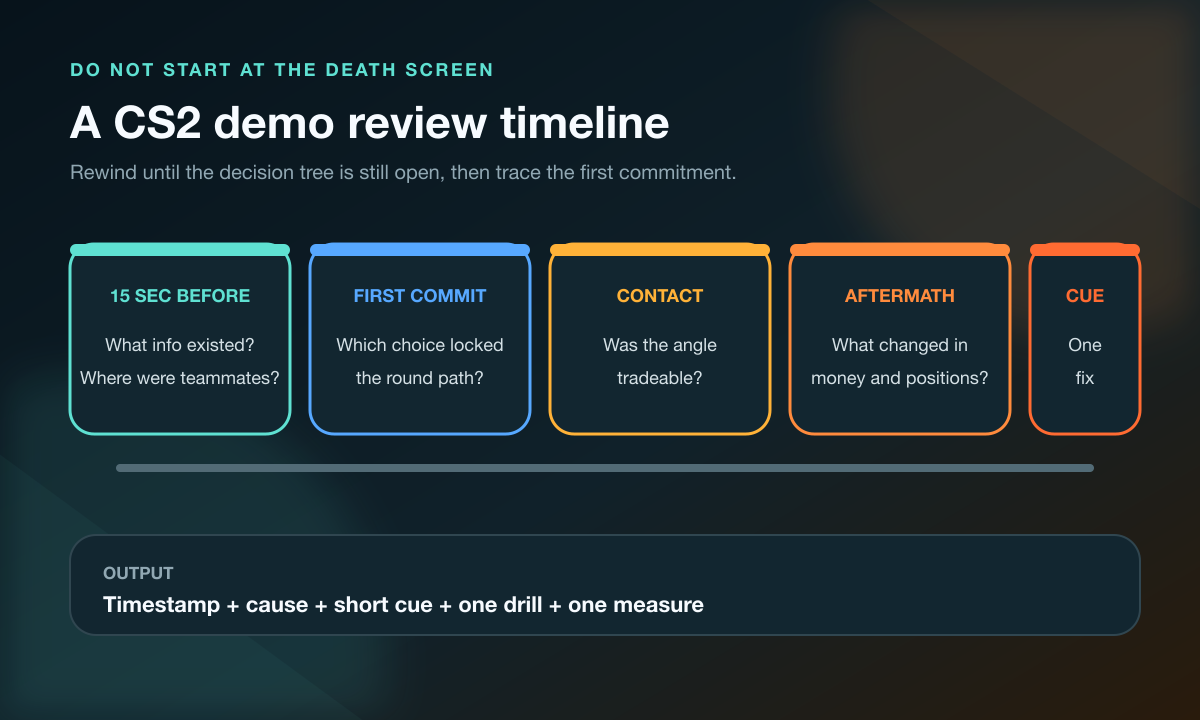
For each selected round, ask:
- What did I know? Teammate calls, minimap positions, utility heard, bomb location, and time.
- What did I assume? Separate confirmed information from the story you invented.
- What choice locked the path? The route, peek, grenade, rotation, or buy that removed safer options.
- Was the contact tradeable? Check distance, line of sight, timing, and whether your teammate knew you were committing.
- What changed afterward? Player count, weapons, utility, map control, bomb state, and money next round.
- What is the cue? Write one sentence you can recall before the same spot appears again.
Review three to five meaningful rounds, not every bullet of a 24-round match. Pick repeated first deaths, lost advantages, failed site entries, bad saves, or expensive rounds where the plan disappeared.
⚡ Pro Tip: Ask the coach to timestamp every reviewed round. Your notes should say “Round 9, 0:42 — waited for the flash call, then swung,” not “be more patient.”
The Five Leaks a CS2 Coach Should Check
You may have problems in all five categories. A good coach still chooses one priority.
1. Mechanics: was the duel prepared properly?
Mechanics review is not just counting headshots. Check crosshair height, how many angles were exposed, whether movement stopped before the shot, when the spray continued past its useful point, and whether the weapon matched the distance.
The drill should match the evidence. A wide pathing problem needs head-height clearing through the actual route. A first-bullet problem needs controlled stop-and-shoot reps. Generic deathmatch cannot prove every mechanical leak is fixed.
2. Positioning: could the team trade the fight?
The official Steam page describes Counter-Strike as a team-based competitive experience. In review, that means asking whether your positioning created a connected fight or five isolated attempts.
Measure the gap between entry and trader, whether both players could see the same contact, and whether utility landed before or after the commit. “I was right behind him” does not matter if a corner blocked the trade.
If your larger problem is finding players who accept clear jobs, our CS2 LFG guide has a copy-ready post and a three-game teammate trial.
3. Utility: what did the grenade enable?
Every grenade needs a job: deny space, isolate an angle, force movement, break a hold, support a plant, or buy time. Review whether the teammate who needed it knew it was coming and could act while its value existed.
Lineup knowledge is only one layer. Timing, communication, and follow-up decide whether a technically perfect smoke helps the round or decorates it.
4. Decisions: did you use the available information?
Decision review connects the clock, player count, bomb state, utility, economy, and map control. Ask what changed after each call and whether the next decision noticed that change.
Season Five’s C4 rework makes post-plant review especially concrete. Valve’s July 8 update changed bomb damage to a simulated shockwave, and the July 20 update changed when the health preview appears. A coach reviewing saves and exits should use the live rules, not old CS:GO assumptions.
5. Communication: did the call change a teammate’s action?
Useful calls are short: location, number seen, bomb status, useful damage, utility used, and your next action. “He’s there” burns time because the listener still has to decode the map, threat, and plan.
Review the comm next to the teammate response. If nobody could act on it, shorten it. If the call arrived after you were already committed, move it earlier.
What a Useful 60-Minute CS2 Coaching Session Looks Like
Arrive with demos, timestamps, and one question. You should not spend the first 20 minutes searching your download folder or explaining your entire ranked history.
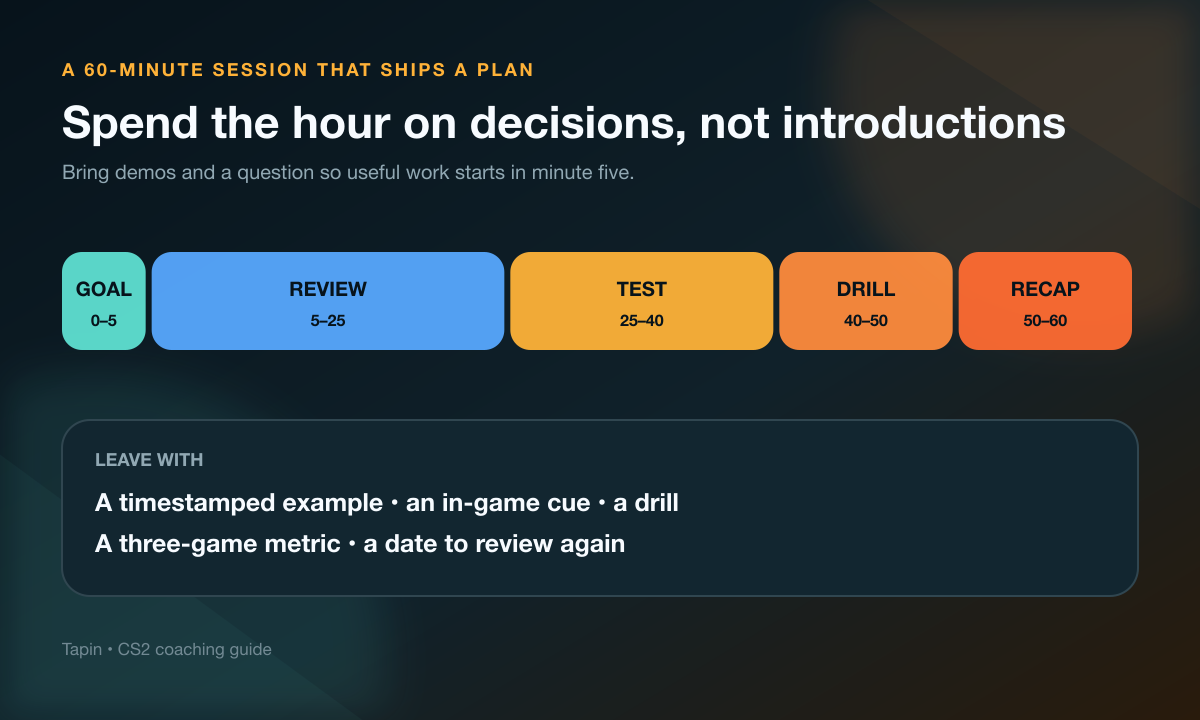
Minutes 0–5: set one outcome
Name the queue, rating, role, maps, and repeated frustration. Pick one outcome such as “die less often before my team can trade” or “make utility arrive before the entry.”
Minutes 5–25: review evidence
Compare three to five rounds across both demos. The coach should test competing explanations instead of forcing the first theory onto every clip.
Minutes 25–40: test the cue
Use a practice server, live match, or additional replay to check whether the cue fits. If it is too long to remember while clearing a site, rewrite it.
Minutes 40–50: build the drill
Define the map, route, repetition count, failure condition, and stopping point. “Practice aim for an hour” is not a drill. “Clear this route without exposing two angles, 10 clean reps each side” is.
Minutes 50–60: write the plan
Leave with timestamps, the cue, the drill, a three-game metric, and a date to review again. Get the plan in writing while both of you still remember what each line means.
How to Choose a CS2 Coach
Rank and team history can establish game experience. They do not automatically establish teaching skill.
Ask a prospective coach these questions:
- Which formats do you offer? Demo review, live review, guided co-play, or team review?
- What do I receive afterward? Timestamps, notes, drills, metrics, or a recording?
- How do you choose the first priority? Listen for evidence and repeated patterns, not a canned aim routine.
- Can you teach my role and map pool? A strong AWPer may not be the right fit for an entry rifler’s exact problem.
- How do follow-ups work? Improvement needs a check on transfer, not another fresh lecture.
- What access do you need? The safe answer does not include your Steam password, recovery code, or account handoff.
Red flags are simple: guaranteed rating gains, pressure to buy a large package before one trial session, vague deliverables, account-login requests, cheat recommendations, and a coach who talks through every live decision.
If you want to book without auditioning random profiles, find CS2 coaching on Tapin. Use the first session to test diagnosis quality and leave with a written plan.
Is CS2 Coaching Worth It?
CS2 coaching is worth considering when you have a repeated problem, limited practice time, and the willingness to work on one uncomfortable habit for several games. It is poor value when you only want a guaranteed rank, refuse replay review, or will not practice after the call.
Use this three-part test:
- You can name the goal: not “get better,” but “stop giving untradeable opening deaths on T side.”
- The coach can show evidence: repeated timestamps, not a personality verdict based on one round.
- You can apply the plan: enough practice time and games to test whether the cue transfers.
You can improve without paying for a coach. Start with the fundamentals in our beginner’s guide to CS2, review your own demos, and learn how CS2 ranks and ratings differ before you set the goal.
Coaching earns its price when it shortens the distance between “something keeps going wrong” and a fix you can test.
Turn CS2 Coaching Into a Seven-Day Practice Loop
The session ends. The learning does not.
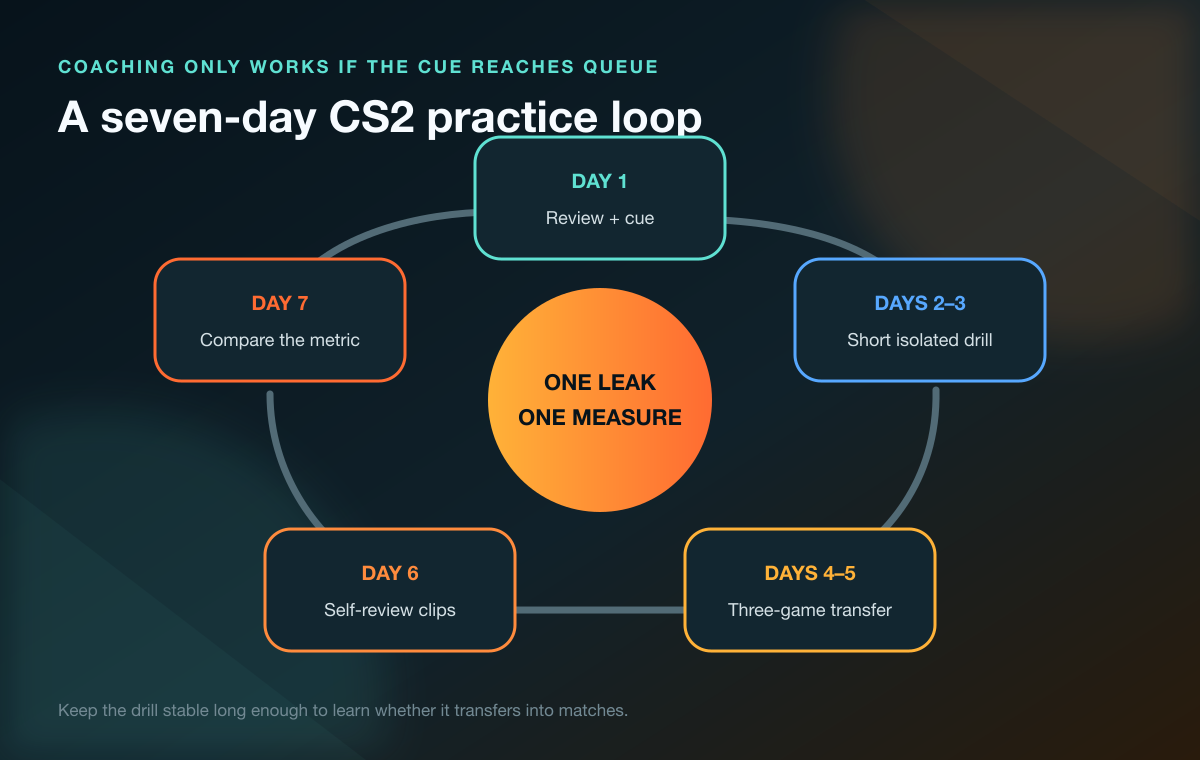
Use this simple loop:
- Day one: Review the timestamps and write the cue in your own words.
- Days two and three: Run a short isolated drill. Stop when quality drops.
- Days four and five: Play three-game blocks with the cue as your only focus.
- Day six: Clip three successes and three failures. Label the first decision in each.
- Day seven: Compare the metric with your baseline and decide whether to keep, narrow, or replace the drill.
Do not add a second coaching priority because day two felt boring. Repetition is how the cue becomes available when the round gets loud.
CS2 Coaching FAQ
Is CS2 coaching worth it for beginners?
Yes, if the session focuses on fundamentals and gives you a small plan. Beginners usually need clear habits around crosshair placement, movement, trading, economy, utility purpose, and communication—not an advanced team playbook delivered all at once.
Is demo review better than live CS2 coaching?
Demo review is usually better for diagnosis because the coach can pause, rewind, and compare repeated rounds. Live coaching is better for testing one known cue, provided the coach leaves enough silence for you to make your own decisions.
What should I send a CS2 coach before the session?
Send one close loss, one normal win, your queue and rating, preferred role, map pool, and one question. Add timestamps for repeated first deaths, failed entries, lost advantages, or confusing economy decisions.
How many CS2 coaching sessions do I need?
Start with one session and judge the output: evidence, cue, drill, and metric. Book a follow-up after you have enough games to test the plan; buying several sessions before you know the coach can diagnose your play adds risk without adding evidence.
Can a CS2 coach guarantee I rank up?
No honest coach can guarantee match outcomes or a specific rating. Coaching can improve your feedback loop, decision quality, and practice structure; you still have to execute the plan across real games.
Does a CS2 coach need my Steam login?
No. Demo review, live review, and guided co-play do not require your password or recovery codes. Keep control of your account and leave any service that pressures you to share access or use cheats.
Leave With One Fix You Can Use
Good CS2 coaching gets narrower: one repeated leak, one cue you can remember, one drill you will run, and one number that tells you whether it worked.
Bring honest demos, choose the format that matches the problem, and judge the session by what you can execute after the call ends. When you are ready for that review, book a CS2 coach on Tapin and make the hour ship a plan.