

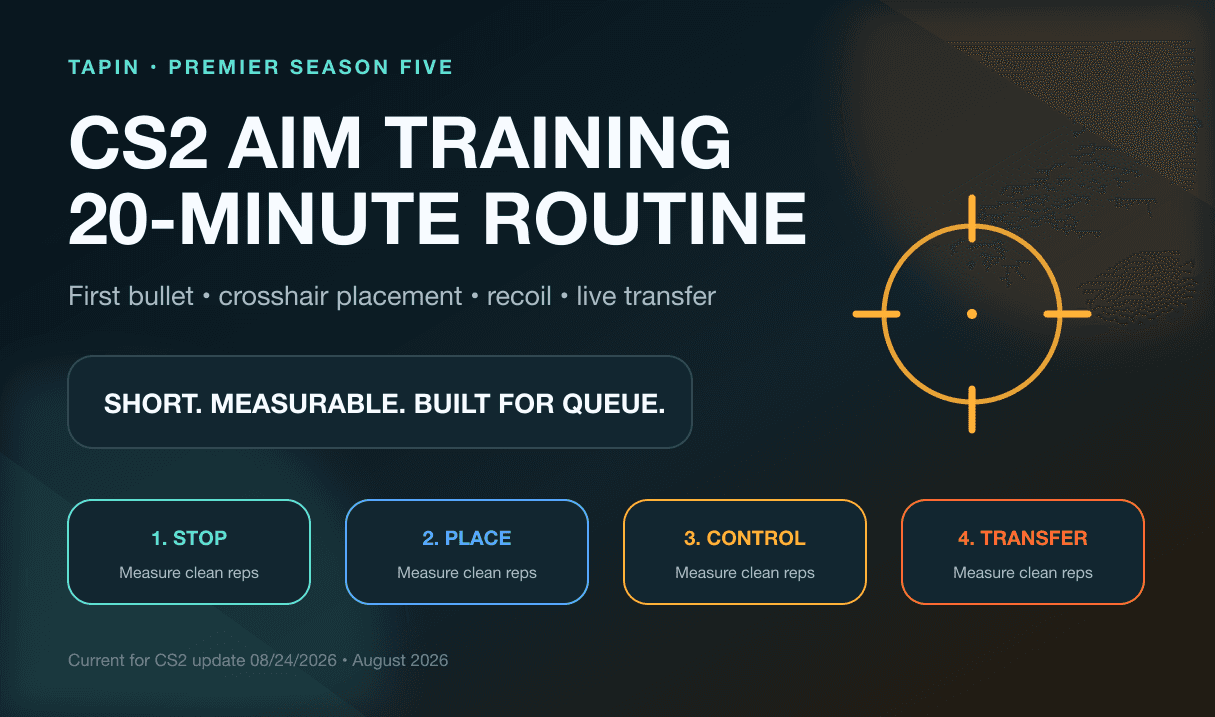
Last Updated: October 2026
Your spray does not need to look perfect for 30 bullets. It needs to stay useful long enough to finish the duel, stop when control is gone, and move cleanly when a second target appears.
This CS2 spray control guide builds that skill in layers: movement first, then the opening 10 bullets, then reset timing, then a live spray transfer. You will leave with one routine and one number to track—not another pattern image you forget when somebody shoots back.
Valve's September 22 CS2 update added new crosshair options and made Dynamic Quad the default accuracy-feedback style. Premier remains in Season Five after the July 8 update, so this guide reflects the live October 2026 game rather than an old CS:GO setup.
⚡ Quick answer: Pick one rifle. Fire 10-bullet groups at one fixed distance, record the first bullet where the group escapes, reset completely, and repeat. Once the opening group is stable, add movement and a second target. Do not grind full magazines before the first 10 bullets obey you.
Give a teammate one job while you practice: call the first repeated failure—early shot, broken group, late release, or panic transfer. Another set of eyes turns “my spray felt bad” into a cue you can carry into the next round.
Table of Contents
- How recoil and inaccuracy differ
- Set up one repeatable test
- Run the 15-minute routine
- Learn the AK and M4 separately
- Add movement and spray transfers
- Use a teammate as feedback
- Fix common mistakes
- FAQ
How CS2 Recoil Control Actually Breaks
Two errors can ruin the same spray. Recoil moves the weapon through a repeatable path; inaccuracy adds spread that you cannot cancel by drawing a cleaner mouse line. The practical distinction is covered clearly in this recoil-versus-inaccuracy breakdown.
That means a tight mouse path cannot rescue a shot fired while moving. It also means a wild group does not always prove you forgot the pattern. Diagnose the first failure instead of yanking harder on the next attempt.
Use this order:
- Stop moving.
- Place the crosshair on the intended starting point.
- Fire the planned number of bullets.
- Read where the group first leaves the target area.
- Release, wait for the reset, and repeat from the same position.

If the first bullet is already wrong, do not study bullets eight through 10. Fix the stop and starting point first.
Use dynamic feedback without chasing it
The current crosshair system can show accuracy changing as you move and fire. Our CS2 crosshair setup guide explains the September 2026 controls and how to test them without copying a random pro code.
Use Dynamic Quad during deliberate practice if the visual feedback helps you catch an early shot. Do not stare at the crosshair while spraying; check it between repetitions, then keep your eyes on the target during the next group.
Set Up One Repeatable CS2 Spray Pattern Test
Subscribe to Recoil Master for CS2 through the Steam Workshop. Its current listing includes ghosthair patterns for the AK-47, M4A4, M4A1-S, Galil AR, FAMAS, SMGs, and other automatic weapons, plus range controls, automatic resets, bullet time, and a no-spread toggle.
Keep the first session boring on purpose:
- Weapon: one rifle only
- Distance: one fixed marker
- Stance: standing still
- Group: 10 bullets
- Feedback: pattern guide on for learning, off for testing
- Score: first bullet where the group clearly escapes your target area
I believe consistency matters more than raw rep count here. If you change weapon, range, stance, sensitivity, and feedback together, a tighter group cannot tell you what improved.
⚠️ Watch Out: Turning off spread can help isolate the recoil path, but it does not represent a live fight. Use it to learn the mouse movement, then turn normal weapon behavior back on before you score the session.
Build the inverse movement, not the wall picture
The bullet marks show what the gun did. Your hand has to make the opposite correction.
Start slowly with the ghosthair visible. Once the shape feels familiar, hide the guide and reproduce the same group. Then compare the first escape point—not whether one lucky bullet landed in the center.
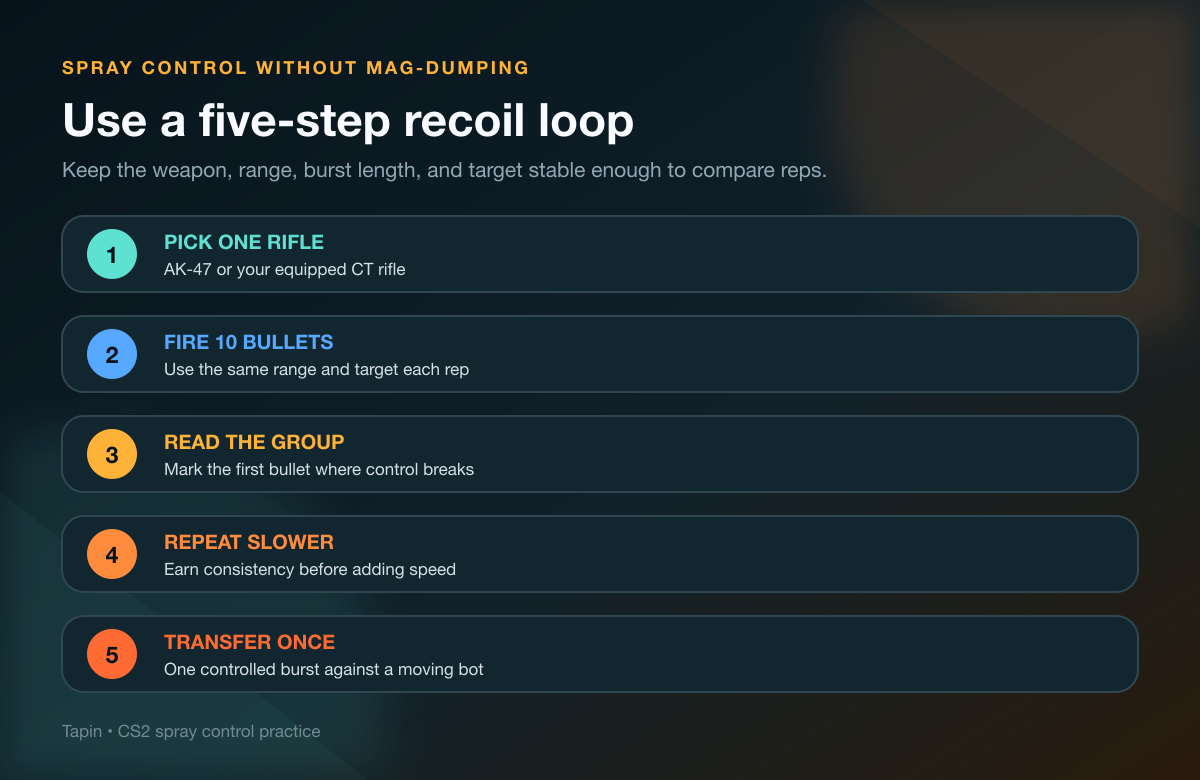
CS2 Spray Control: The 15-Minute Routine
This routine progresses only when the previous layer stays clean. Run it for seven sessions before changing the timer.
| Time | Drill | Pass condition |
|---|---|---|
| 0–3 min | Pattern read | Name the first break direction |
| 3–7 min | 10-bullet groups | Stable opening group without the guide |
| 7–10 min | Reset test | Next burst starts from a settled state |
| 10–13 min | Strafe-stop-spray | Movement ends before bullet one |
| 13–15 min | Two-target transfer | Control survives one deliberate switch |
Minutes 0–3: read before correcting
Fire three groups with no compensation. Let the weapon draw its path on the wall. You are building a visual reference, not trying to win the drill immediately.
Turn on the ghosthair and make three slow compensated groups. Say the correction in plain language as it changes. Keep the description short enough to remember while your hand moves.
Minutes 3–7: own the opening 10 bullets
Hide the guide and fire 10-bullet groups. Reset fully after every attempt.
Mark the first bullet where the cluster escapes. If it breaks at bullet six, your next goal is seven—not a pretty full-magazine spray. Small wins are measurable; vague “muscle memory” is not.
Minutes 7–10: test recoil reset timing
Fire a short burst, release, then fire again after the weapon settles. Vary the pause until you can tell the difference between a clean reset and a second burst that inherits the first mistake.
Do not turn this into frantic clicking. The goal is to recognize when another burst is available, not to manufacture the shortest possible gap in a practice map.
Minutes 10–13: add the stop
Strafe a short distance, stop, then begin the same 10-bullet group. If bullet one misses because you fired early, the rep fails even if the later spray looks good.
This is where isolated recoil practice becomes Counter-Strike. Your hand can know the pattern and still lose because your feet never gave it a clean start.
Minutes 13–15: transfer once
Place two targets close enough that one controlled mouse switch can reach the second. Start on target one, move only after the planned opening bullets, and finish on target two.
Judge the transfer by three checkpoints: the first group stayed controlled, the switch happened once, and the first bullet after the switch arrived on the second target. Speed comes later.
Learn AK-47, M4A4, and M4A1-S Recoil Separately
Do not alternate rifles every 60 seconds. Each weapon has its own pattern and timing, and fast switching gives you fewer comparable reps with each one.
Use a simple rotation:
- T-side day: AK-47 only
- CT-side day: your equipped M4 only
- Review day: compare both at the same distance, then keep separate scores
If you use both M4s, train them on different days. “M4 recoil” is too vague for a useful notebook entry.
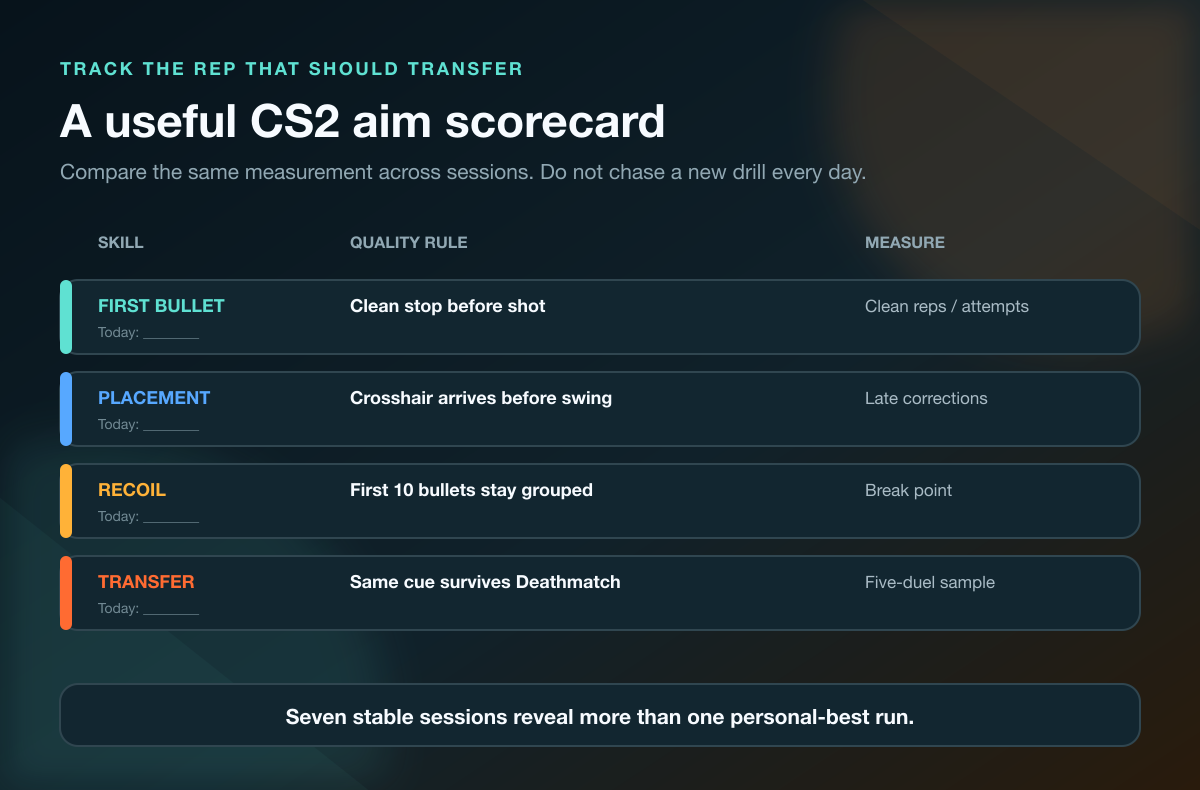
Your score can look like this:
| Session | Rifle | First escape | Movement errors |
|---|---|---:|---:|
| 1 | AK-47 | Bullet 6 | 4/10 reps |
| 2 | AK-47 | Bullet 7 | 2/10 reps |
| 3 | M4A1-S | Bullet 8 | 3/10 reps |
The numbers are examples, not benchmarks. Compare your own identical setup across sessions.
Move Before You Spray Transfer
A clean wall spray proves you can reproduce a mouse path. It does not prove you can enter the spray from a peek, choose the right firing mode, or stop after the first target drops.
Add one constraint at a time:
- Strafe in, stop, spray. Fail every moving first bullet.
- Change target distance. Keep the weapon and bullet count fixed.
- Add one transfer. Never bounce between targets.
- Move into Deathmatch. Carry one cue into five deliberate rifle duels.
- Review the first failure. Label it movement, starting point, recoil, reset, or transfer.
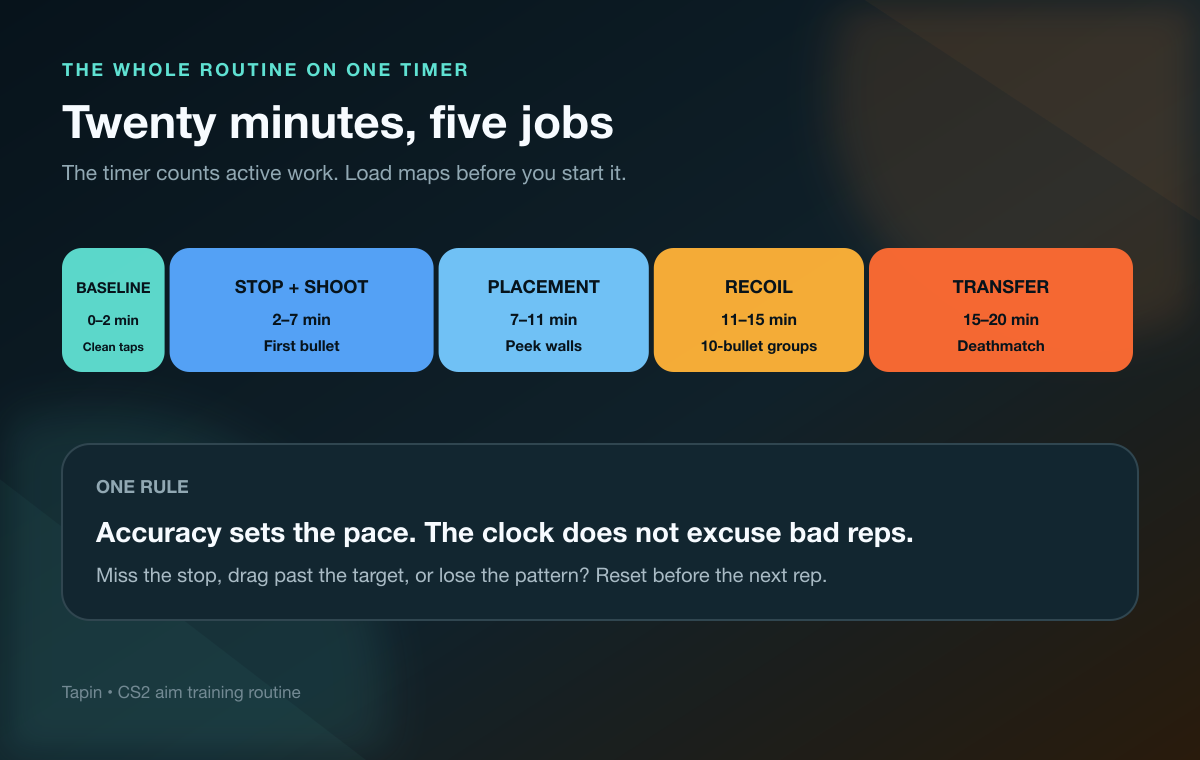
Our 20-minute CS2 aim training routine connects this recoil block to first-bullet accuracy, crosshair placement, and Deathmatch transfer. Use that broader routine when the spray itself is not the only leak.
Decide when not to spray
Spray control includes releasing the mouse. If the target disengages, your group breaks early, or the angle is too long for the attempt you practiced, reset instead of dragging a bad magazine across the screen.
That decision is hard to train on a static wall. In Deathmatch, label each duel before reviewing the result: tap, short burst, or committed spray. The goal is not to prove spraying works everywhere; it is to choose it on purpose.
Turn a Teammate Into a Recoil Reviewer
A useful practice partner watches one error, not every pixel of your mouse path. Give them a tiny scorecard:
- Did movement stop before bullet one?
- Where did the group first escape?
- Did you release when control broke?
- Did the transfer happen once or turn into panic tracking?
- Did the same error appear in a real duel?
Review five clips after the session. One person calls the first repeated mistake; the other chooses tomorrow's cue.
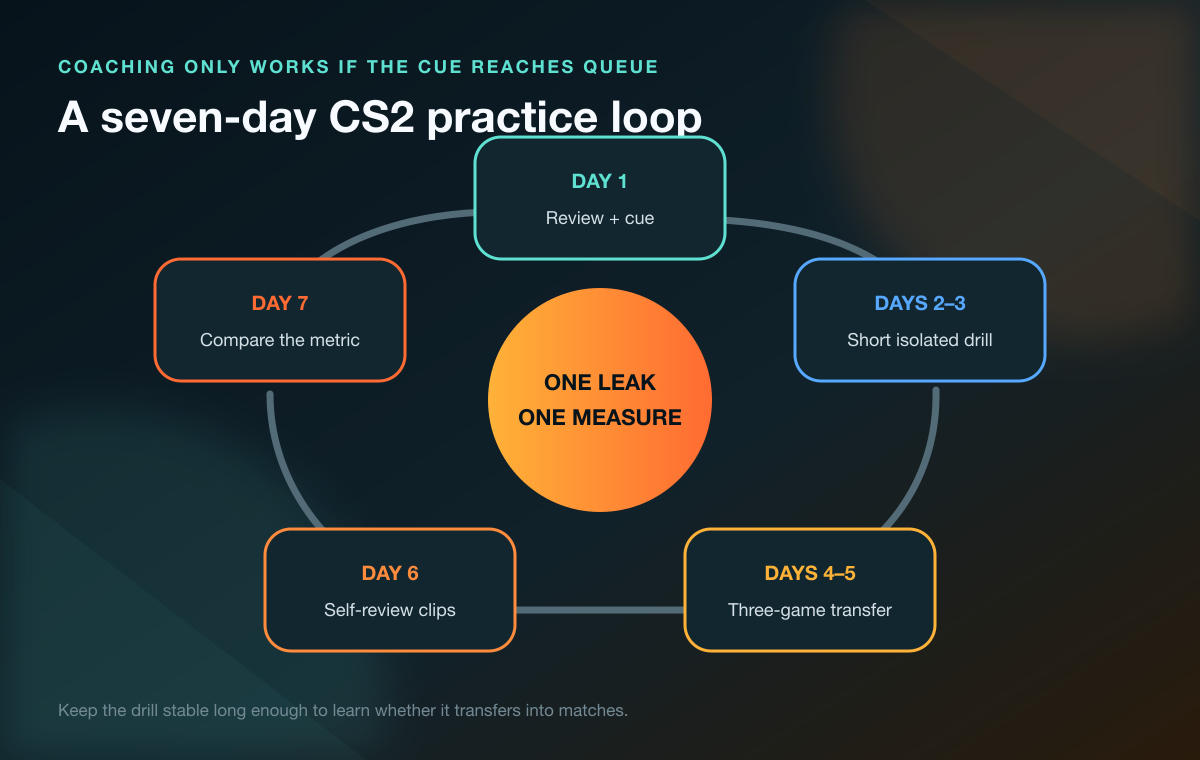
If nobody on your list wants to run a focused block, find a CS2 teammate or coach on Tapin. Ask them to observe one rifle, one distance, and one transfer cue before you queue.
For a deeper review, our CS2 coaching guide shows how to turn repeated evidence into one cue, one drill, and one metric instead of collecting 40 disconnected tips.
Five CS2 Recoil Control Mistakes
1. Practicing full magazines first
The back half gives you more motion before the opening group is stable. Master a smaller repeatable block, then extend it.
2. Ignoring movement errors
If bullet one leaves from a moving state, later correction data is contaminated. Reset the feet before judging the hand.
3. Changing distance every rep
Different ranges make the same angular error look different on the wall. Hold distance stable while scoring progress.
4. Leaving visual feedback on forever
The ghosthair teaches the path. Testing requires hiding it and reproducing the correction without tracing a guide.
5. Measuring kills instead of execution
A bot can die during a sloppy rep. Count the first escape point, early shots, clean resets, and successful transfers instead.
CS2 Spray Control FAQ
What is the fastest way to improve CS2 spray control?
Use one rifle, one distance, and 10-bullet groups. Record the first escape point, then add movement only after the stationary group becomes repeatable.
Should I learn the full CS2 spray pattern?
Eventually, if your roles and fights demand it. Start with the opening group because it gives you a smaller target to measure; extend the spray only after those bullets stay controlled without a guide.
What is the best CS2 recoil practice map?
Recoil Master is built specifically for pattern practice and includes ghosthairs, range controls, automatic reset, bullet time, and multiple automatic weapons. Aim Botz is useful when you want to add movement and targets around the recoil block.
Should I practice AK-47 and M4 recoil together?
Keep them on separate days at first. The patterns and timing differ, so separate sessions produce cleaner feedback and make progress easier to compare.
How long should I practice spray control each day?
Start with 15 focused minutes. Stop when the reps become rushed or when you can no longer name the first error; more bad repetitions only make the mistake familiar.
How do I know the drill is reaching real matches?
Take one cue into five Deathmatch duels or one Premier block. Review whether movement stopped before the first bullet, whether you released when control broke, and whether a transfer stayed deliberate.
Make the First Break Point Move Later
Good CS2 spray control is not a perfect wall drawing. It is a stable start, a correction you can reproduce, a reset you can recognize, and a release decision that survives pressure.
Run the 15-minute block for seven sessions. Then take the same cue into queue with a CS2 teammate on Tapin and see whether the first break point moves later when the target finally shoots back.