

Last Updated: September 2026
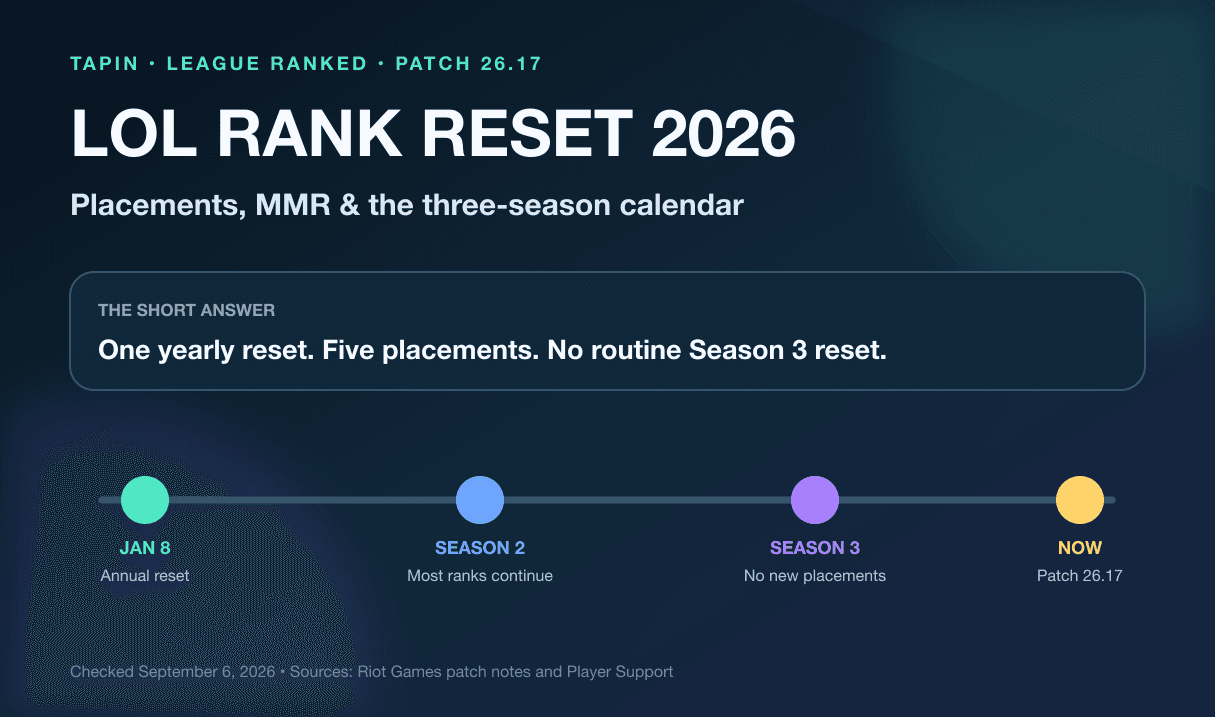
The 2026 LoL rank reset already happened. Riot closed the 2025 ladder on January 7, opened Season 1 at noon local server time on January 8, reset player ranks, and required five provisional games.
For most players, that was the only ladder reset of 2026. Season 2 and Season 3 changed themes and refreshed Ranked rewards, but they did not send ordinary players back into placements. The one big exception was a hard midyear reset for certain Master+ ladders.
| Question | 2026 answer | What you should do |
|---|---|---|
| Did every season reset rank? | No | Keep climbing on your existing rank |
| How many placements are there? | Five per Ranked queue | Treat Solo/Duo and Flex separately |
| Can a placement loss cost LP? | No; it awards 0 LP | Play it out unless the game is unsafe to continue |
| Did MMR become a blank slate? | No public zeroed value is shown | Judge the trend after placements, not one game |
| Was there a midyear exception? | Yes, for Master+ in six regions | Check the Apex section below |
If you are running placements with a duo, settle your roles and comms before game one. A partner does not override matchmaking, but one steady voice is a lot easier to learn with than five completely different solo-queue lobbies.
Table of contents
- When did the LoL rank reset happen in 2026?
- What actually resets: rank, LP, or MMR?
- How LoL placement games work in 2026
- Did Season 2 or Season 3 reset rank?
- What rank will you get after placements?
- A five-game placement plan
- LoL rank reset FAQ
When did the LoL rank reset happen in 2026?
Patch 26.1 set the exact handoff{:target="_blank"}: the 2025 Season 3 ladder ended at 11:59:59 p.m. local server time on January 7, and 2026 Season 1 began at noon local server time on January 8. Solo/Duo and Flex briefly went offline between those points.
That season start reset visible ranks and opened a five-game provisional set. Riot had already moved away from repeated resets, explaining that the ladder would get one reset at the start of the year rather than another reset every season{:target="_blank"}.
The naming still trips people up. League has one Ranked year with multiple thematic seasons inside it. Players often call those periods “splits,” but a new theme or Victorious mission does not automatically mean a new ladder.
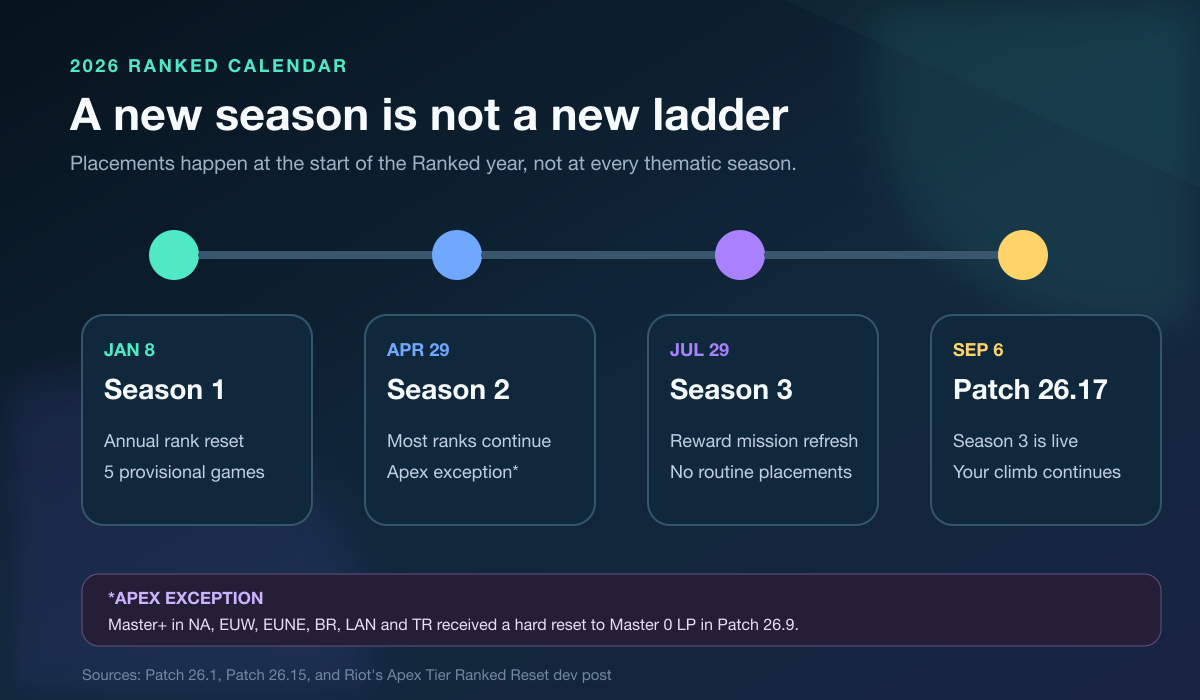
As of this update, League is in Season 3 on live Patch 26.17{:target="_blank"}. If your account is already ranked, there is no routine September placement set waiting for you.
What actually resets: rank, LP, or MMR?
Your visible rank and LP position reset at the start of the Ranked year. Five games then establish the tier, division, and LP number you continue climbing from.
That does not mean Riot forgets everything about the account. Its current placement rules{:target="_blank"} say the starting rank depends on three things: your placement results, the difficulty of the opponents you faced, and your rank from the previous year.
So no, there is no universal “everyone drops exactly one full tier” rule. Two players who ended at the same badge can receive different starts because their matchmaking context and five games were different.
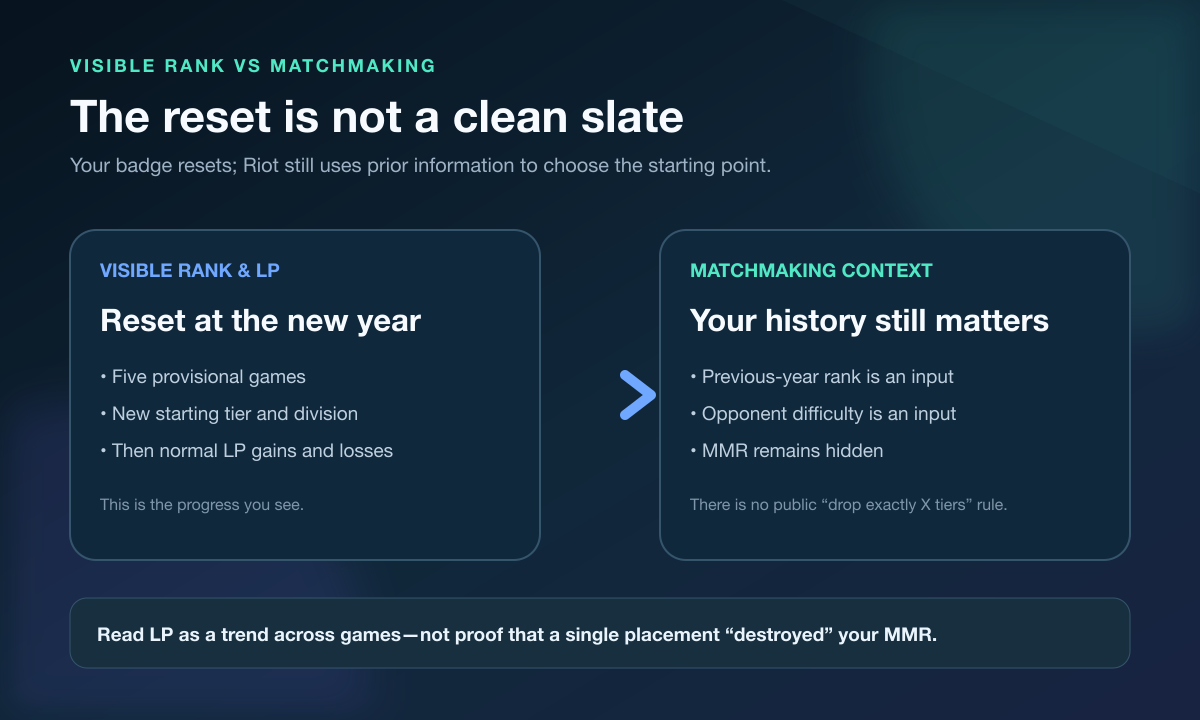
MMR stays hidden. Riot does not publish your exact rating, the reset formula, or a guaranteed conversion from last year's rank to this year's starting rank. A third-party calculator can estimate lobby strength; it cannot read Riot's internal number.
The clean way to think about it is this:
- Rank is the badge and LP you can see.
- MMR is the hidden matchmaking signal.
- Placements rebuild your visible starting point using results and account context.
- LP gains after placements gradually move visible rank toward the system's estimate.
Our LoL ranking system guide maps that relationship onto the full ladder without pretending an unofficial checker knows Riot's secret formula.
How LoL placement games work in 2026
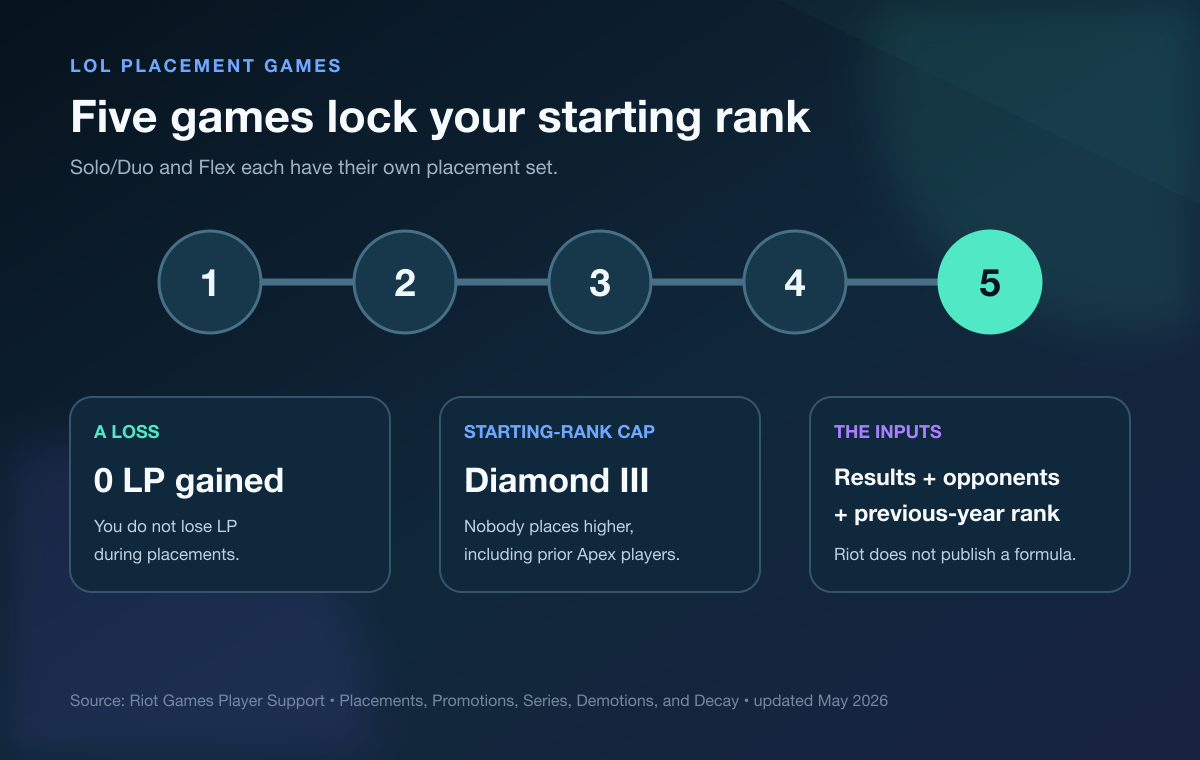
You play five placement matches in each Ranked queue. Solo/Duo has one set; Flex has another because the two queues keep independent ranks.
Riot's rules are unusually forgiving during those five games: a win adds LP, while a loss adds 0 LP instead of subtracting LP. Going AFK still counts as a placement loss, so a disconnect is not a free remake of the result.
There are two more rules worth knowing:
- Diamond III is the highest possible placement. Even a player who finished in an Apex tier cannot lock a starting rank above it through the normal annual placements.
- New Ranked accounts use other queue history. If you have never played Ranked, Riot says Swiftplay and Normal Draft MMR can inform the initial placement process.
Wins matter, but there is no official “game three is worth double” or “go 5–0 to preserve MMR” rule. Those claims show up in reset guides every January because they sound precise. Riot does not publish them.
Once game five ends, the provisional protection ends too. Normal promotions, demotions, LP gains, and LP losses take over from your assigned starting point.
Did Season 2 or Season 3 reset rank?
Not for the ordinary ladder. Riot's current support page says placements happen when you are unranked—either because you have never played Ranked or because it is the start of a new year.
When Season 3 launched in Patch 26.15{:target="_blank"}, Riot refreshed the 15-win Victorious mission. Existing players kept their Ranked progress and did not receive five new provisionals.
The 2026 Master+ hard-reset exception
This is why a flat “there was only one reset” answer is incomplete. At the start of Season 2, Riot performed a rare hard reset for current Master, Grandmaster, and Challenger players in:
- North America
- EU West
- EU Nordic & East
- Brazil
- Latin America North
- Turkey
In Riot's Apex reset announcement{:target="_blank"}, those affected players had both visible rank and MMR reset to Master 0 LP when Patch 26.9 went live. Riot said the listed ladders had become too volatile after the January changes and that no other regions had reached the same threshold for intervention.
That was not the normal split system. It was a targeted integrity repair, and it came with rougher early matchmaking because the hard reset deliberately removed memory of prior Apex standings.
If you were below Master, played on another region, or started after that intervention, Season 2 did not create a second standard placement set. Season 3 did not create one either.
What rank will you get after placements?
Nobody outside Riot can calculate the exact answer before the five games finish. The official inputs are broad, and the weighting is private.
Your best expectation is a starting range, not a promised division. Use last year's finish as context, then let the opponents in your placement lobbies and the final visible result tell you where the system landed.
Do not panic if the badge looks lower than the lobby. Riot added a Climb Indicator in 2026 for accounts whose visible rank trails their MMR, precisely because a late starter can look out of place while still belonging in the match.
Old rank-conversion charts also miss a 2026 change: Riot adjusted the MMR-to-rank distribution{:target="_blank"}, moving more experienced players out of Iron toward Bronze and shifting the high end of Diamond toward Master. That is another reason to distrust a fixed conversion chart from 2024.
A five-game placement plan
You cannot control Riot's formula. You can control how many random variables you bring into the five games.
- Lock one role and two practiced champions. Placements are a bad time to learn a counterpick you have played twice. If you need a simple pool, start with the picks in our beginner champion guide.
- Queue in blocks of two or three. Take a real reset after a rough game instead of dragging the same argument into champion select.
- Keep one review target. Track your first death, first objective setup, or first bad recall—not 12 different stats.
- Use the same duo plan. Decide who calls resets, objective timers, and lane-state warnings before the queue pops.
- Judge the result after game five. Then track LP gains and losses across a larger block instead of diagnosing the account from one screen.
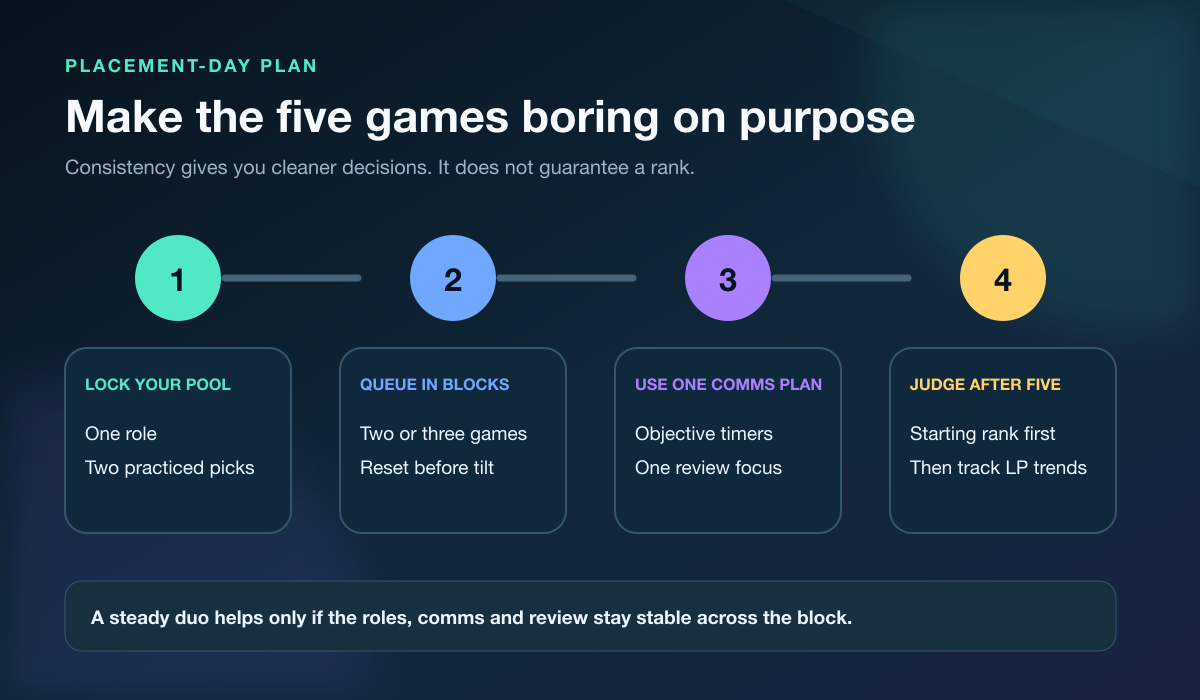
A duo is useful because the roles, language, and review stay consistent—not because Riot gives premades free rating. Check Riot's current Solo/Duo restrictions{:target="_blank"} before you build the plan, especially around Diamond and Master. Our duo queue guide covers the role pairs and comms that make a steady partnership useful.
If your old duo stopped playing or you want someone calm enough to review the block with you, find a League coach or duo on Tapin. Pick for role fit and communication style first. The person you can actually debrief with after a loss is more useful than a random high-rank badge.
LoL rank reset FAQ
How many LoL placement games are there in 2026?
There are five placement games per Ranked queue. Solo/Duo and Flex each require their own five-game set when the new Ranked year begins.
Do you lose LP for losing a placement game?
No. Riot's current rules say a placement loss awards 0 LP rather than subtracting LP. An AFK still counts as a loss in the placement record.
Does League reset rank every split or season?
No. Routine placements happen at the start of the Ranked year, not at every thematic season. Season 3 refreshed its Victorious mission without resetting the ordinary ladder.
Does MMR completely reset in League placements?
The normal annual reset is not a clean-slate account wipe. Riot says previous-year rank and opponent difficulty help determine the new starting rank, while the exact MMR and formula remain hidden. The 2026 Master+ intervention in six regions was explicitly different: Riot called it a hard reset of both rank and MMR.
What is the highest rank you can place in League?
Diamond III is the highest starting rank available through the normal five-game placement process. After that, you can continue climbing under standard LP rules.
The 2026 reset is simpler once you separate the Ranked year from its three themes: one normal January reset, five placements per queue, and one rare regional Apex exception. Lock a small pool, keep your comms steady, and treat the first five games as the start of the climb—not a final verdict on the account.