

Last Updated: August 2026
Grinding 20 more games will not show you why the same first death keeps happening. Good Marvel Rivals coaching turns the replay into one clear decision you can recognize, practice, and measure.
This guide is current for Season 9.5 and the live Version 20260820. You’ll learn which format fits, what a useful session fixes, how to screen a coach, and how to carry the feedback into your next queue.
⚡ Quick answer: A good Marvel Rivals coach should leave you with one priority, one short in-game cue, one drill, and one metric. If you leave with 40 disconnected tips or a guaranteed-rank promise, you did not get a usable plan.
Table of Contents
- What Marvel Rivals coaching should do
- Choose the right coaching format
- What a good coach fixes first
- What coaching cannot fix
- How to choose a coach
- How to prepare for a session
- A useful 60-minute session
- Turn feedback into a practice plan
- FAQ
What Marvel Rivals Coaching Should Actually Do
The scoreboard tells you what happened: deaths, damage, healing, assists, and the final result. Coaching should explain why the same bad result keeps repeating.
Rewind before the death; do not stare at the death screen. Your Strategist may have lost line of sight around a corner, your Vanguard may have committed without resources, or the team may have spent three ultimates after the fight was won.
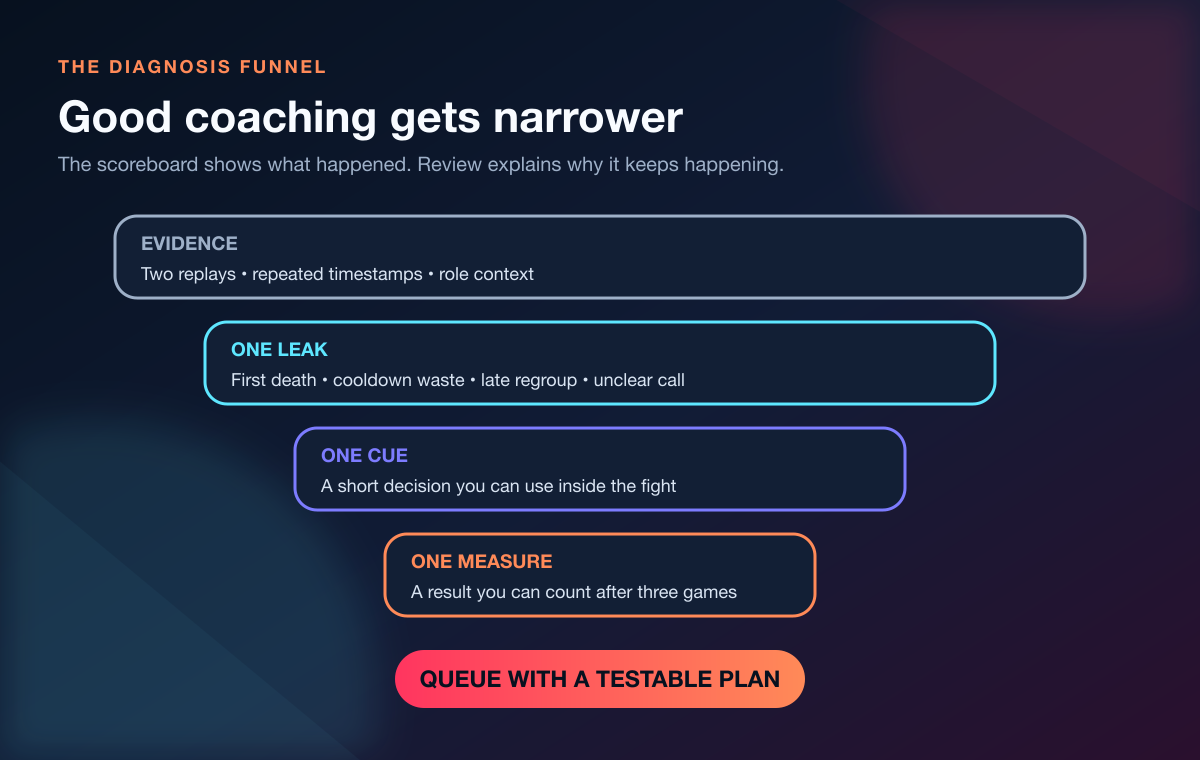
A useful diagnosis has four parts:
- Evidence: The mistake appears in more than one fight or replay.
- Cause: The coach identifies the first decision that made the later mistake likely.
- Cue: You get a short phrase you can remember while the fight is moving.
- Measure: You can count whether the problem improved over the next few games.
“Position better” is not a cue. “Keep one corner between you and your Strategist” is. “Use ults smarter” is not a measure. “Count ults used after a fight became unwinnable” is.
I believe this is the difference between advice and coaching: advice names a good habit; coaching proves which habit is costing you games.
Choose the Right Marvel Rivals Coaching Format
Most coaching offers fall into four useful formats. The right one depends on what you need to learn.
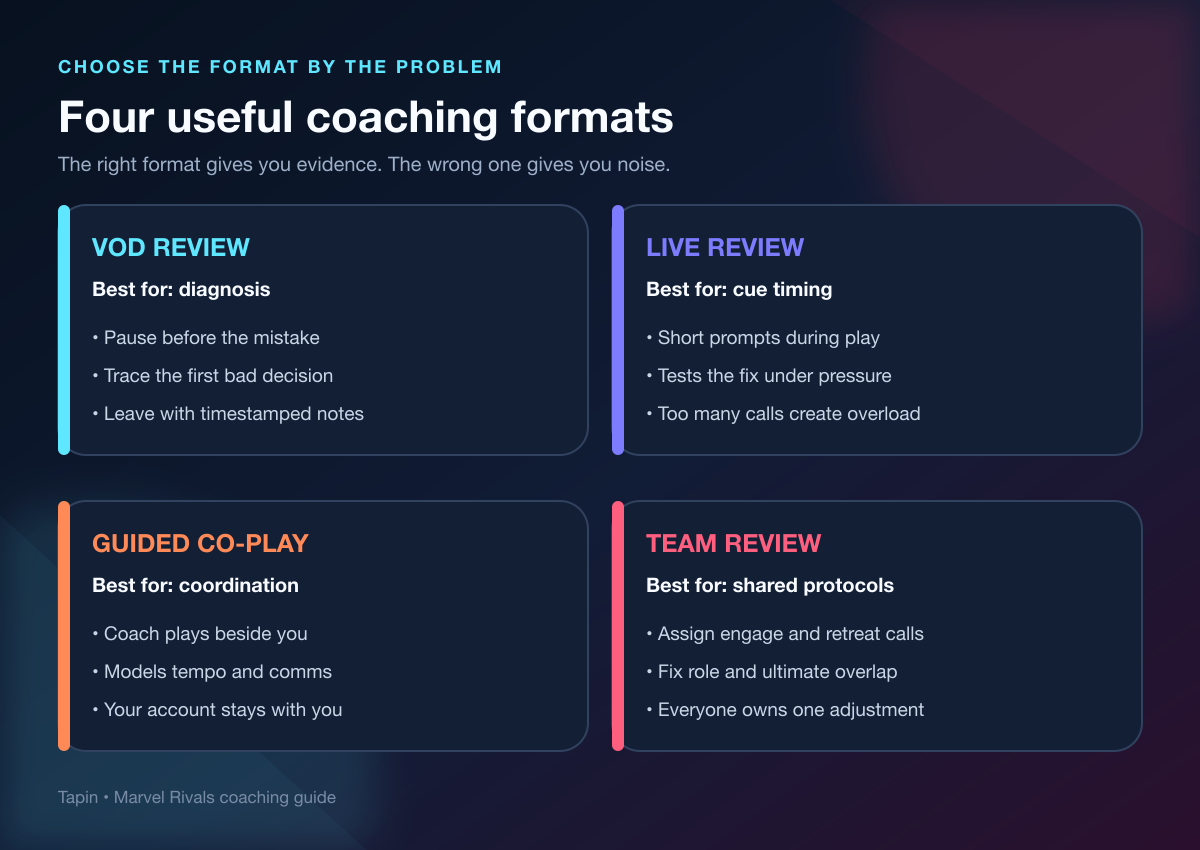
VOD review: best for finding the real mistake
A Marvel Rivals VOD review lets the coach pause, rewind, and compare fights. It is the strongest format for positioning, target priority, ultimate economy, hero swaps, and missed information.
Bring a close loss and a normal win. The loss shows where pressure breaks your decisions; the win shows whether the same leak was hidden by a better team or easier matchup.
Live review: best for testing a short cue
Live feedback works after the main problem is already known. The coach can watch whether you use the new cue under real pressure and correct it while the context is fresh.
The danger is overload. A voice feeding you every target, cooldown, and route can make the coach play through you. Ask for short prompts and quiet space between fights.
Guided co-play: best for coordination
In guided co-play, the experienced player joins on their own account and models useful comms, regroup timing, target calls, and role interaction beside you. You still make your own decisions and keep control of your account.
This format is especially useful when your problem only appears around another player: following a Vanguard engage, peeling a Strategist, timing a dive, or deciding when a Team-Up is worth changing the composition.
Team review: best for shared rules
Team coaching should create protocols, not six separate lectures. Assign who owns the engage, target, retreat, and ultimate-count calls. Then review the first moment two players followed different plans.
If your whole group needs a better recruiting and trial process first, use the Marvel Rivals LFG guide before paying someone to solve chemistry with a whiteboard.
What a Good Marvel Rivals Coach Fixes First
The first session should target the leak with the biggest repeat cost—not the flashiest mechanic.
1. First-death patterns
The useful question is not “Why did I die?” It is “What decision removed my safe exit, healing line, or teammate follow-up before I died?”
A coach should tag repeated triggers: crossing open space without resources, chasing beyond cover, using mobility to enter with no exit, or standing where one enemy angle becomes three.
2. Cooldown and ultimate economy
Good Marvel Rivals coaching separates a mechanical miss from a resource decision. Missing an ability is one problem; using it before the enemy commits is another.
Track ults spent in already-won fights, ults held through the final fight, and defensive resources used after the save window closed. One corrected ultimate cycle can matter across several objectives.
3. Target priority and engage timing
“Focus support” is usually too vague. The real call depends on reach, cover, enemy cooldowns, and whether your team can follow without crossing a kill zone.
A coach should help you define a go condition: enemy escape used, Vanguard isolated, Strategist line broken, or your own engage resources ready. That turns six opinions into one shared trigger.
4. Role spacing and map positioning
Vanguards, Duelists, and Strategists need different sight lines, but all three roles must understand the same fight geometry. Review where your healing line broke, where the retreat path disappeared, and which corner should have staged the next push.
Do not accept generic map advice. The coach should pause at a real timestamp and show the safer position before the fight collapses.
5. Hero pool and patch adaptation
Season 9.5 changed 18 heroes in the official August 7 balance update. Peni Parker’s Cyber-Web Snare, for example, now applies a Web-Tracer and slow on the first hit; the next Snare immobilizes a traced target.
If a coach still describes it as an instant first-hit immobilize, their notes are stale. A good coach timestamps meta advice and separates patch-specific details from durable fundamentals.
The Season 9.5 hero tracker can provide current win, pick, and ban context, but a moving tier list is not a personal diagnosis. Comfort, role coverage, and the reason you lose fights matter more than chasing a new hero every week.
6. Communication and reset discipline
Strong comms are short, timed, and actionable: target, engage, retreat, ultimate status. Narrating everything you see can bury the one call that matters.
A coach should also review the 15 seconds after a loss. Fast regroup language, no blame, and one adjustment preserve more games than a perfect speech delivered while teammates are still respawning.
What Marvel Rivals Coaching Cannot Fix
Coaching can shorten the feedback loop. It cannot play the reps for you.
Be skeptical of anyone promising:
- A guaranteed rank: Match results depend on more than one player and one session.
- Instant mechanics: Aim, movement, and ability timing need deliberate repetitions.
- A permanent meta answer: Patches change hero values and Team-Up interactions.
- Control over random teammates: You can improve calls and decisions, not another person’s behavior.
- Safe account takeover: A coach does not need your password, recovery code, or account access.
The goal is not to borrow someone else’s rank. It is to make your own decisions easier to recognize and repeat.
⚠️ Watch out: “Guaranteed wins,” pressure to share an account, vague credentials, and no written follow-up are red flags. Legitimate coaching keeps you in control of your account and sells a learning process—not an outcome it cannot guarantee.
How to Choose a Marvel Rivals Coach
High rank matters, but it is only the first filter. Playing well and explaining well are different skills.
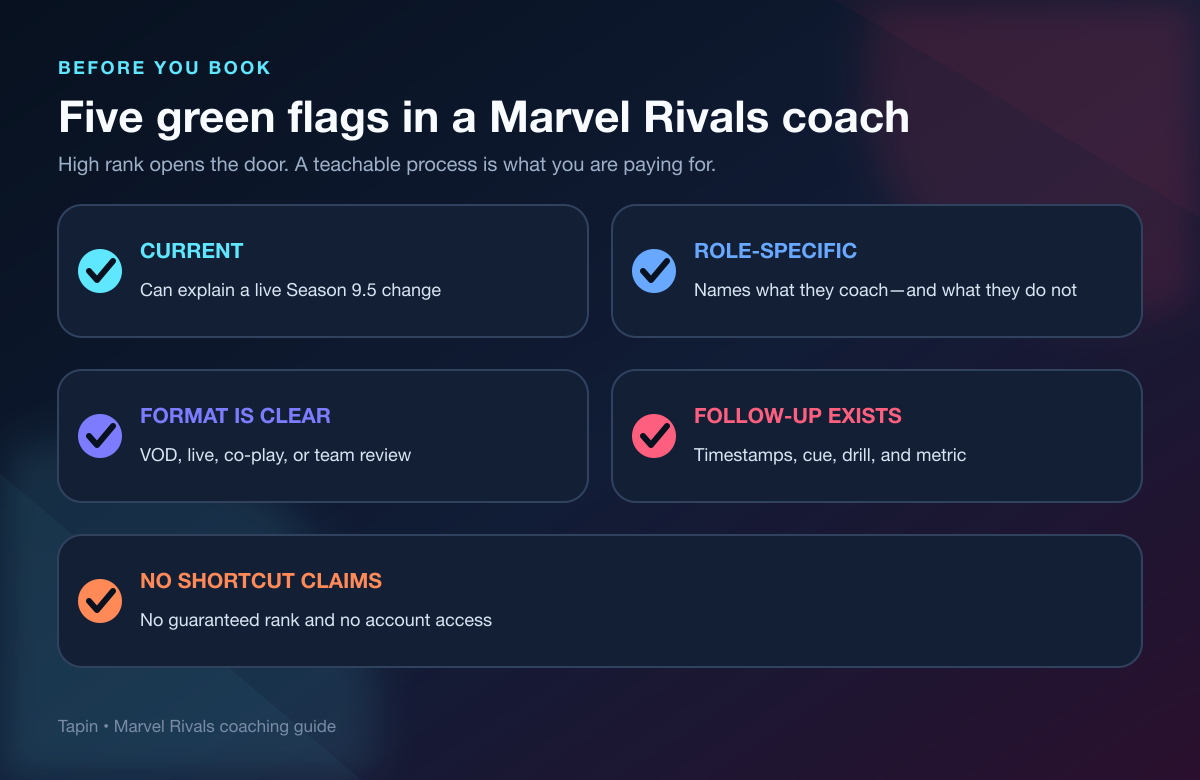
Ask these questions before booking:
- Which roles and heroes do you coach best? A specialist should be honest about their limits.
- Is the session VOD review, live review, co-play, or a mix? Match the format to your problem.
- What should I send beforehand? “Nothing” often means the paid clock starts with setup.
- Will I receive timestamps, notes, or a practice plan? You need something usable after the call ends.
- How current is your Season 9.5 knowledge? Ask for one recent change relevant to your role.
- How do you measure progress? Look for decision metrics, not only wins and losses.
Also check how the coach talks about mistakes. Clear and direct is useful. Humiliation is not a teaching method.
If you mainly want someone to play beside you while you test the advice, choose a Marvel Rivals teammate on Tapin and confirm the session goal up front. Guided play works best when both people agree on one focus before queueing.
How to Prepare for Marvel Rivals VOD Review
Preparation buys back paid minutes. Send the coach a compact brief before the session:
- Current rank, platform, region, main role, and two or three most-played heroes
- One close loss where you felt confused—not a complete stomp
- One normal win to test whether the same mistake still appears
- One question, such as “Why do our pushes collapse after I engage?”
- Any constraints: limited hero pool, no voice chat, controller input, or fixed duo role
Do not curate only your best games. You are paying for diagnosis, not an audition.
Write down what you think the problem is, then let the replay challenge it. “My aim is bad” may turn into “I take fights after losing my healing line.” That is good news: decisions are often faster to change than raw mechanics.
What a Useful 60-Minute Coaching Session Looks Like
A full hour disappears fast when the first 15 minutes go to introductions, file hunting, and a hero-history monologue. Arrive ready to work.
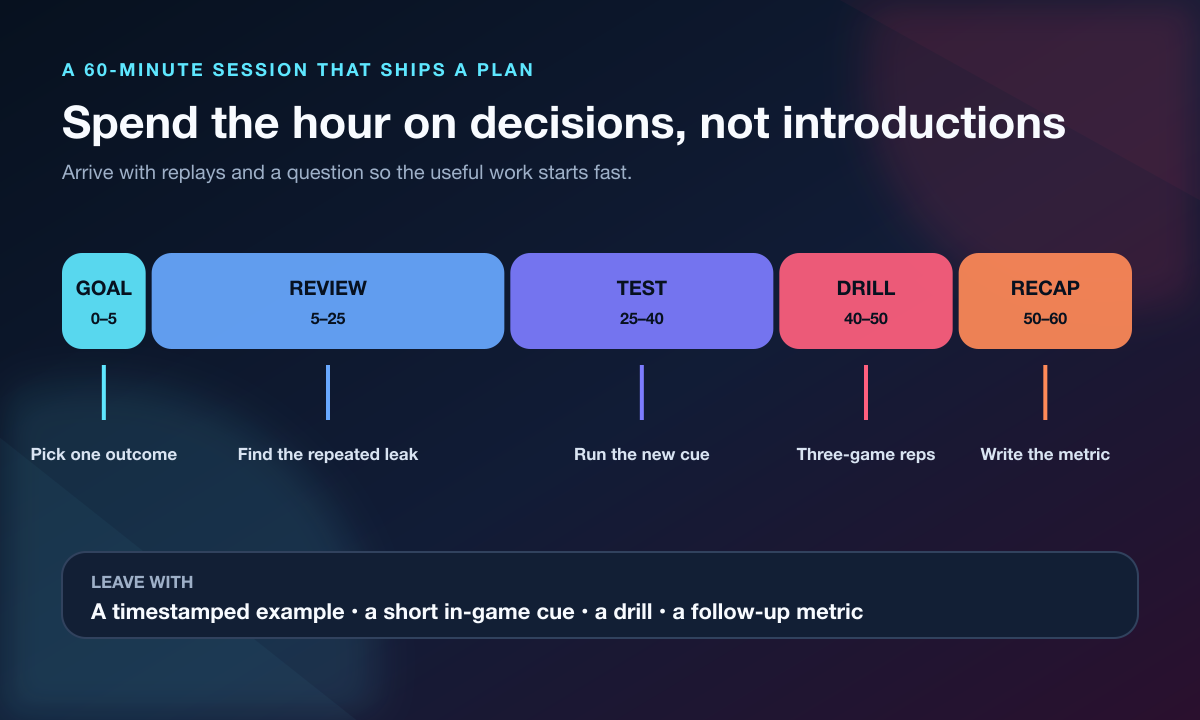
A practical structure is:
- Minutes 0–5: Agree on one outcome and one replay question.
- Minutes 5–25: Review repeated moments and identify the first costly decision.
- Minutes 25–40: Test the new cue in a replay, custom setup, or live game.
- Minutes 40–50: Build a drill that fits your normal queue routine.
- Minutes 50–60: Recap timestamps, cue, metric, and the next review date.
You should leave able to finish this sentence: “For my next three games, when X happens, I will do Y, and I will count Z.”
If neither you nor the coach can fill that in, the session produced conversation—not a training plan.
Turn Coaching Feedback Into a Seven-Day Plan
The first week should be narrow enough to remember during a fight.
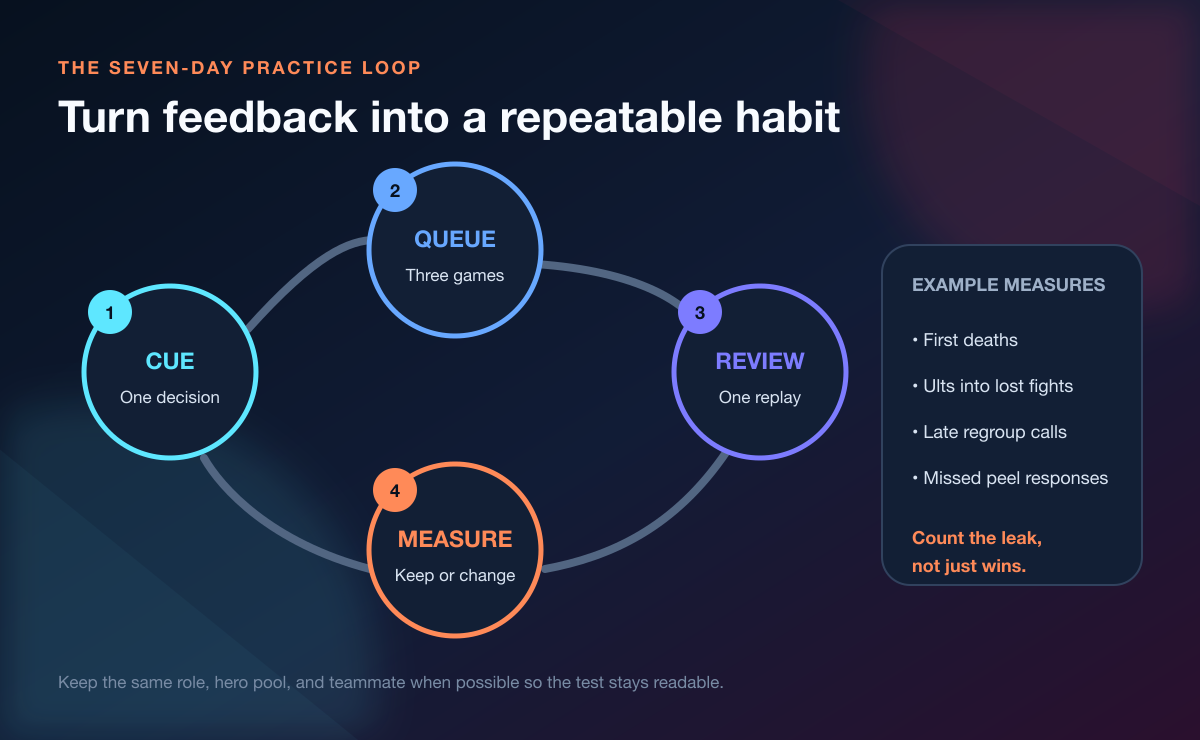
Use this loop:
- Write one cue. Keep it under eight words: “See my Strategist before I commit.”
- Play three focused games. Keep the same role and hero pool when possible.
- Review one replay. Check the first two moments where the cue mattered.
- Count one metric. First deaths, ults into lost fights, late regroup calls, or missed peel responses all work.
- Keep or change the cue. If the metric improves, repeat it. If not, revisit the diagnosis.
Wins are useful context, but they are noisy. You can make the correct decision and lose; you can repeat a bad habit and get carried through it.
For rank context without pretending the badge explains everything, use the Marvel Rivals rank distribution guide. Then use our seven practical ranked tips to connect the coaching cue to a broader climb routine.
Marvel Rivals Coaching FAQ
Is Marvel Rivals coaching worth it?
It can be worth it when you have a repeated problem, limited practice time, and a coach who provides a specific plan. It is poor value when you only want a rank promise or arrive without replays, questions, or time to practice afterward.
Is VOD review better than live coaching?
VOD review is usually better for diagnosis because the coach can pause and rewind before the mistake. Live coaching is better for testing one known cue, as long as the prompts stay short enough for you to keep making your own decisions.
What should I send a Marvel Rivals coach?
Send one close loss, one normal win, your rank and role, your main heroes, and one clear question. Add platform or controller constraints that change how you play.
Can a coach guarantee I rank up?
No honest coach can guarantee match outcomes or a specific rank. Coaching can improve your feedback loop, decision quality, and practice structure; you still need to play and adapt.
Does a Marvel Rivals coach need my account login?
No. VOD review, live review, and guided co-play do not require your password or recovery codes. Keep control of your account and leave any service that pressures you to share access.
Leave With One Fix You Can Use
Good Marvel Rivals coaching gets specific: one repeated leak, one cue you can remember, one drill you will actually run, and one number that tells you whether it worked.
Bring honest replays, choose the format that matches the problem, and judge the session by the plan you can execute after the call ends—not by how many tips fit into the hour.