

Last Updated: August 2026
Typing “Marvel Rivals LFG” takes five seconds. Finding someone who matches your rank, covers a useful role, joins voice, and stays normal after a bad round is the actual work.
This guide gives you a faster filter for Season 9.5 and the live Version 20260820 release. You’ll get a copy-ready LFG post, a neutral look at where to search, a three-game teammate trial, and the red flags worth taking seriously.
⚡ Quick answer: Put six things in your post: goal, rank, main and backup role, region and platform, play window, and comms style. Trial the teammate for three games before treating one win—or one loss—as proof of anything.
Table of Contents
- What a Marvel Rivals LFG post needs
- Where to find Marvel Rivals teammates
- How to write a post people can answer
- Build for role coverage, not a frozen tier list
- Run a three-game teammate trial
- Screen for safety and behavior
- FAQ
What a Marvel Rivals LFG Post Needs
Marvel Rivals is still a 6v6 team shooter, and the official site groups heroes into Vanguard, Duelist, and Strategist roles. “Need good players” tells nobody which hole you’re trying to fill.
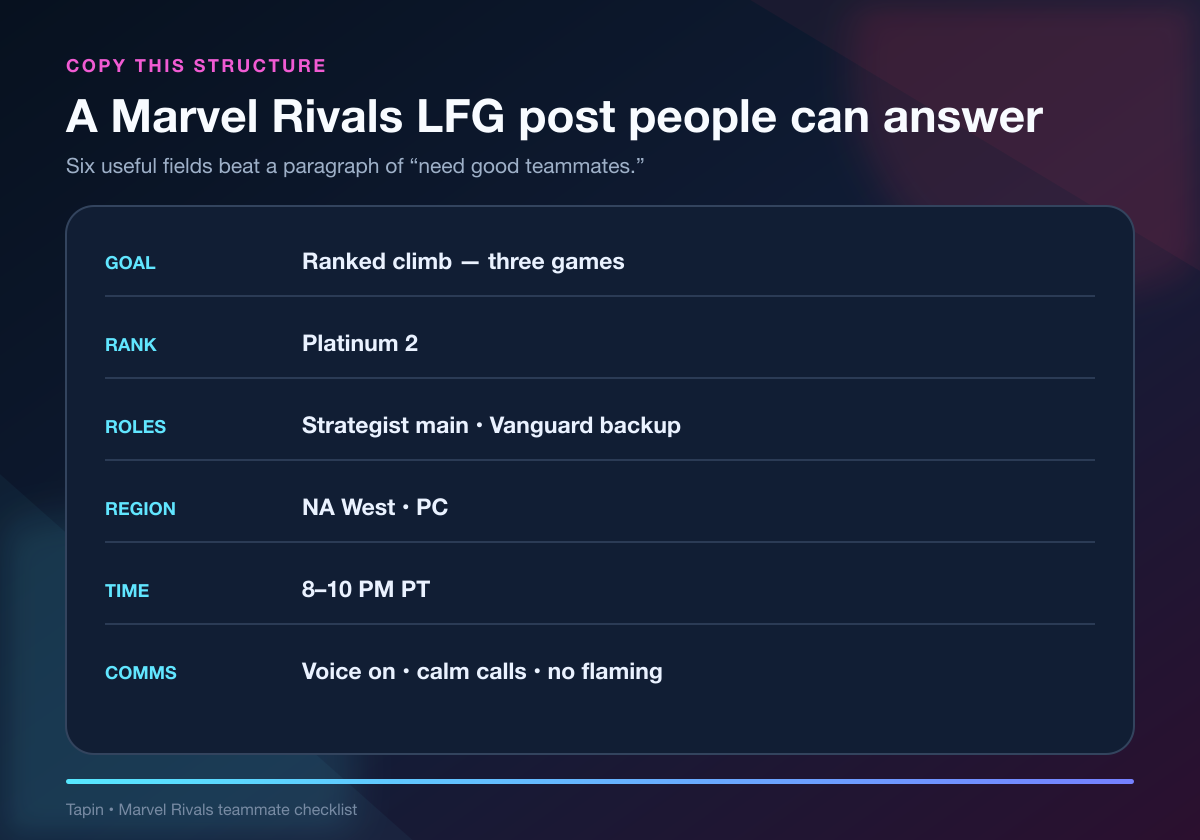
A useful Marvel Rivals team finder post answers these questions:
- Goal: Competitive climb, Quick Match, scrims, coaching, or a chill session?
- Rank: Where are you now, and are you protecting a promotion game or testing a new role?
- Role pool: What do you main, what can you cover, and what do you refuse to play?
- Region and platform: Where are you queuing, and what device are you on?
- Schedule: Are you playing now, for three games, or every Tuesday and Thursday?
- Comms: Voice required, optional, or off? Short target calls or full conversation?
The backup role matters as much as the main. If two people both advertise “flex” but neither will leave Duelist, you did not find flexibility—you found a future argument in hero select.
If the acronym itself is new, our plain-English guide to what LFG means covers the common shorthand without turning it into gamer homework.
Where to Find Marvel Rivals Teammates
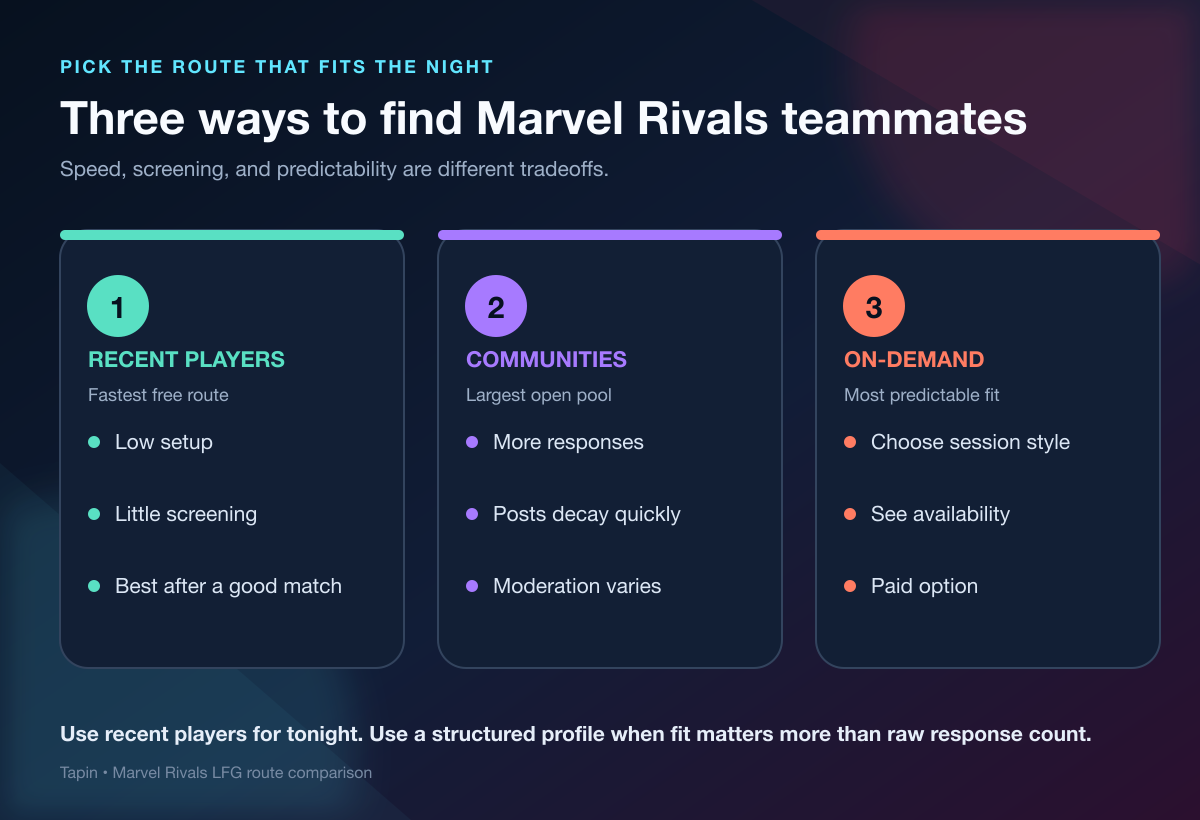
There is no single best route for every session. Pick based on how fast you need a player, how much screening you want, and whether you’re willing to pay for predictability.
| Route | Best when | Main tradeoff |
|---|---|---|
| Recent-player adds | You just had a good match | Almost no pre-screening |
| Discord and open communities | You want a large free pool | Posts move fast; moderation varies |
| Dedicated LFG directories | You want filters and profiles | Activity changes by region and time |
| Tapin | You want an on-demand teammate | It is a paid option |
Start with recent players when tonight is the only goal
After a clean match, send a short message: “Good comms. Want to run two more?” You already saw their role choice, pacing, and behavior under pressure, which is more useful than a profile full of claims.
The weakness is obvious: one good game can be luck, and you have not tested how they handle a loss. That is why the three-game trial below matters.
Use open communities when you can filter responses yourself
Discord servers and public LFG boards can produce a lot of replies. They also produce dead posts, vague “any rank” offers, and people who never checked your region or schedule.
Write a structured post, ignore responses that skip your hard requirements, and move the rest into a short pre-queue chat. More replies are not automatically better replies.
Use Tapin when wait time and fit need to be predictable
Tapin is the on-demand, paid route. The current Marvel Rivals teammate page lets you choose a duo or squad-style session, see live availability, and queue with an experienced teammate without handing over your account.
I believe that option makes the most sense when you have a fixed play window or want guided play—not when you enjoy recruiting and already have an active community. The honest comparison is paid predictability versus free searching.
How to Write a Marvel Rivals LFG Post People Can Answer
Lead with the fit, not a life story. A stranger should know in 10 seconds whether to reply.
Use this format:
NA West | PC | Platinum 2
Goal: Three Competitive games tonight, 8–10 PM PT
Roles: Strategist main, Vanguard backup
Looking for: Vanguard or flexible Duelist
Comms: Voice on, short calls, calm after losses
Hard no: Flaming, account sharing, or quitting mid-block
That post works because every line changes the match. Your age, favorite skin, and 14-hero wishlist can wait until after the basic fit is clear.
Separate hard requirements from preferences
A hard requirement ends the match before it starts: wrong region, incompatible schedule, no voice when voice is required, or behavior you will not accept. A preference can bend: exact hero, slightly different rank, or someone who talks more than you do.
Keep the hard list short. If every detail is mandatory, you are not building a team—you are waiting for a clone.
⚡ Pro Tip: Ask one direct question in the post: “What is your main role and backup?” Specific questions make copy-paste replies easy to spot.
Build for Role Coverage, Not a Frozen Tier List
The official Season 9.5 update added The Hood and shipped another wave of hero and Team-Up changes. The later Version 20260820 notes fixed hero interactions again.
That is the problem with recruiting around “the best comp” from one screenshot: patches move. Role coverage, hero comfort, and a backup plan survive longer.
For a duo, look for one complementary job:
- A Vanguard who calls the engage needs someone ready to follow or sustain it.
- A Duelist diving the backline needs a clear go/no-go call, not five seconds of narration.
- A Strategist needs peel language the team understands before the fight starts.
For a larger squad, assign three calls before queueing: engage, target, and disengage. Everyone can share information, but one clear voice should own each final decision.
You can get more specific once the group has a stable base. Our Marvel Rivals Team-Up combo guide is useful after you know who can play together without tilting—not before.
Run a Three-Game Teammate Trial
One stomp proves almost nothing. One ugly loss proves only slightly more.
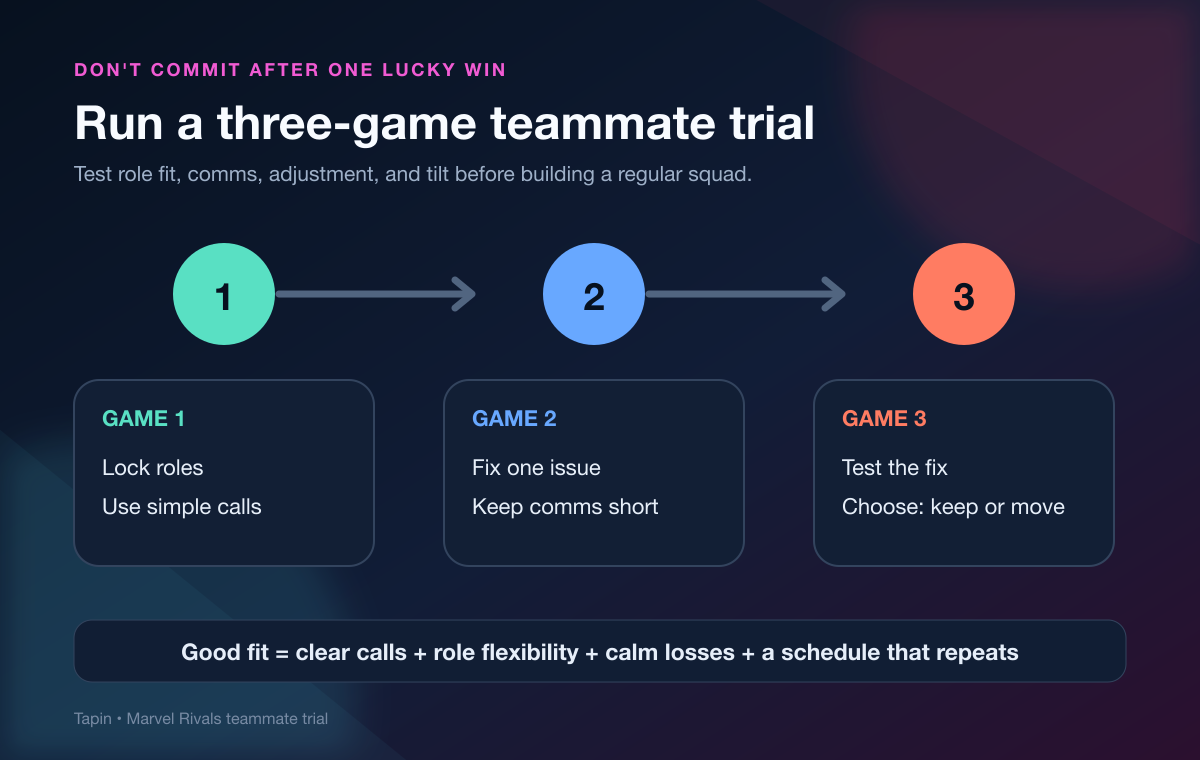
Use a three-game block to test whether the player can coordinate, adjust, and stay decent when the scoreboard stops being friendly.
Game one: keep the calls simple
Lock the role plan and use only high-value calls: target, engage, retreat, and ultimate status. Do not coach a stranger through every cooldown in their first five minutes with you.
After the game, name one thing that worked and one thing to change. Keep it under a minute.
Game two: test the adjustment
Run the same role split if possible. You are testing whether both players can act on one agreed change, not whether a new composition hides the old problem.
Watch what happens after the first lost fight. Calm reset language is a stronger teammate signal than loud confidence during a stomp.
Game three: decide without overthinking it
Ask four questions:
- Did the roles fit without constant bargaining?
- Did the calls get clearer by game three?
- Could both people own a mistake without spiraling?
- Can this schedule happen again?
Four yeses means add them and set the next block. Two or more noes means move on politely; chemistry is not a moral judgment.
For a broader climb plan, use our seven practical Marvel Rivals ranked tips before treating a badge as a personality test. Rank can set expectations, but it cannot tell you who communicates well.
Screen for Safety and Behavior
The fastest way to ruin an LFG search is ignoring a red flag because the player has a shiny badge. Skill does not make pressure, harassment, cheats, or account sharing acceptable.
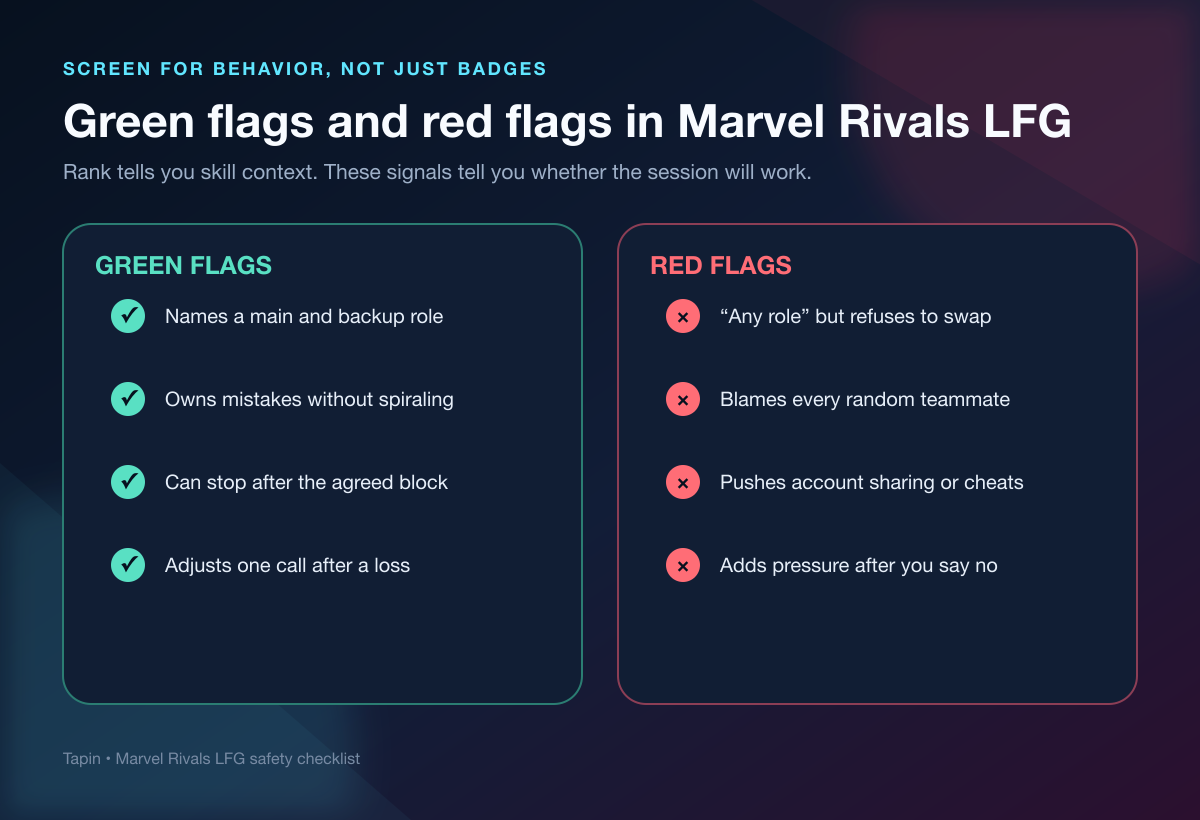
Keep your account credentials, recovery codes, payment details, and private information private. A real teammate needs your in-game name and session details; they do not need to log into your account.
Leave if someone pushes cheats, asks to take over the account, ignores a clear boundary, or turns the first loss into abuse. Block and report through the platform or community tools where the contact happened.
Green flags are quieter: they name a main and backup role, show up when they said they would, adjust one call, and stop after the agreed block. Reliability is a pattern, so give it three games—not blind trust.
Marvel Rivals LFG FAQ
What does LFG mean in Marvel Rivals?
LFG means looking for group. Players use it when they want a duo, a full squad, a scrim team, or simply someone to queue with.
What is the best place to find Marvel Rivals teammates?
Use recent-player adds for the fastest free option, open communities for a larger pool, and a structured LFG directory when you want filters. Use Tapin when you want an on-demand paid teammate and less time spent recruiting.
What should I put in a Marvel Rivals LFG post?
Include your goal, current rank, main and backup role, region and platform, exact play window, and comms style. Add one or two hard boundaries so mismatched players can filter themselves out.
Do I need a full six-stack for ranked?
No. One consistent teammate can stabilize a role pair and give you one reliable voice for engage or retreat calls. Add more players only when each addition makes the plan clearer.
How do I know if an LFG teammate is a good fit?
Run a three-game trial. Check role fit, call quality, behavior after losses, willingness to adjust, and whether your schedules can repeat.
Find the Fit, Then Queue
A strong Marvel Rivals LFG post is not complicated: state the goal, rank, roles, region, time, comms, and boundaries. Then test the fit across three games instead of betting the whole squad on one scoreboard.
Want to skip the open-call chaos? Choose a Marvel Rivals teammate on Tapin, set the session you want, and get into queue.