

Last Updated: September 2026
That rank moving after every early Competitive game is a prediction, not a verdict. Marvel Rivals placement matches take 10 completed games, and the badge you see during that run can differ from the actual rank awarded at the end.
For a new Competitive player, NetEase’s published baseline is Silver III as the initial predicted rank. Returning players normally begin from a prediction tied to their previous finish. Wins and losses move that estimate, then the newer performance system can adjust the result after game 10.
⚡ Quick answer: Complete 10 placement matches. New players start from a Silver III prediction; returning players usually start three divisions below their last final rank. Season 7 added a personal-performance adjustment of -100 to +100 Competitive points after the set. Your predicted rank is not your final rank.
The useful edge is not trying to trick a hidden formula. It is removing chaos: one stable role plan, one teammate who makes clear calls, and one mistake to fix across the set. Placements get much easier to read when every queue is not a brand-new social experiment.
Marvel Rivals is live on Season 9.5, and the current Version 20260903 notes do not list a Competitive-system change. The placement rules below combine NetEase’s original Season 5 framework with its official Season 7 scoring update.
Table of Contents
- How Marvel Rivals placement matches work
- What is your starting rank?
- Can you play placements with friends?
- What happens after a disconnect?
- Do placements reset at midseason?
- A practical 10-match plan
- FAQ
How Marvel Rivals Placement Matches Work
NetEase introduced the current 10-game structure in the official Season 5 patch notes. While placements are active, the game displays a predicted rank and uses it for matchmaking and party formation. That number updates as results come in, but it is still an estimate until all 10 matches are done.
The original rules made wins and losses the main driver. NetEase said a 5-5 record should finish close to the initial predicted rank, while the possible floor and ceiling depend on the player’s tier and history.
Season 7 added another layer. The official Season 7 update says each placement now tracks individual performance independently from teammates. Once all 10 are complete, personal results and tier can move the outcome between -100 and +100 Competitive points.
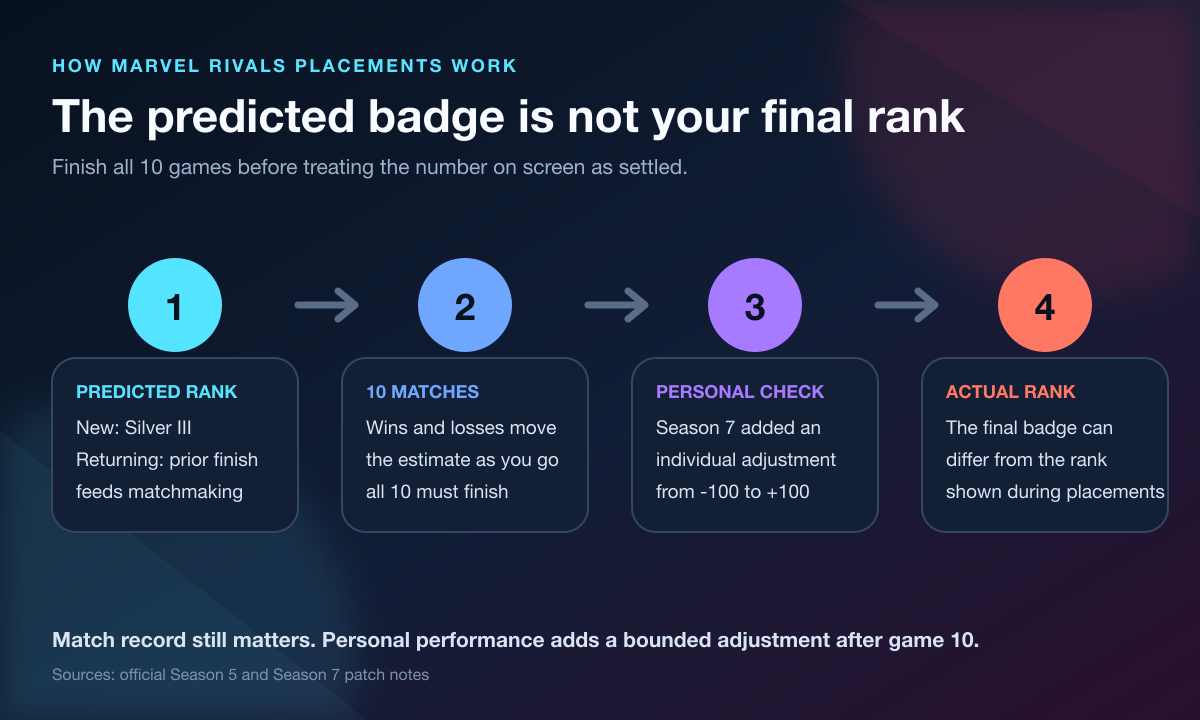
That does not make the scoreboard the only thing that matters. Match record still moves the prediction, and the official update describes personal performance as a bounded adjustment after the set. Play to win the objective first; padding damage while your team loses space is not a placement strategy.
⚠️ Watch Out: Do not treat one early prediction jump as proof that a single match has a secret multiplier. NetEase publishes the overall rules, not a per-game formula you can reverse-engineer from one account.
What Is Your Marvel Rivals Starting Rank?
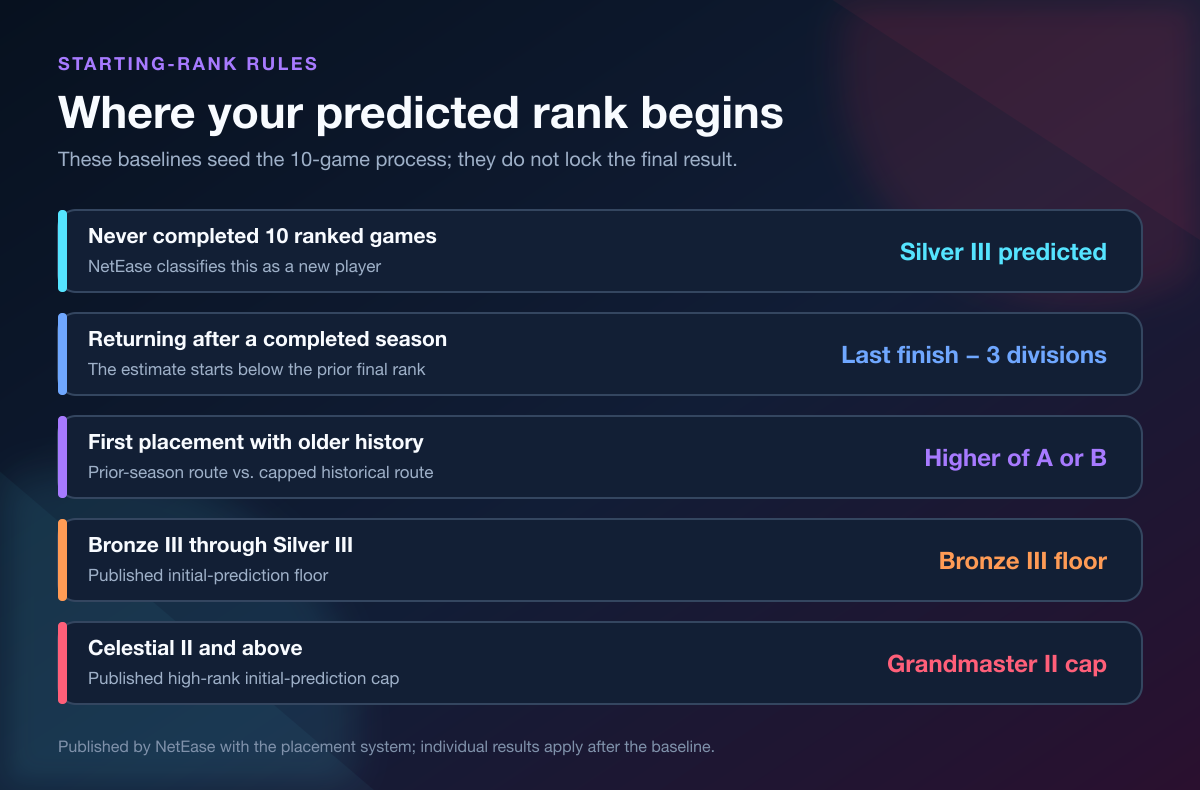
There is no universal final starting rank. There is an initial prediction, then a 10-match result.
| Account history | Initial predicted rank rule |
|---|---|
| Never completed 10 ranked matches in a season | Silver III |
| Completed placements in the previous season | Previous final rank minus three divisions |
| First placement set with qualifying older history | Higher of the previous-season route or historical route |
| Previous finish from Bronze III through Silver III | Bronze III floor |
| Previous finish at Celestial II or higher | Grandmaster II prediction cap |
New Competitive players begin from Silver III
NetEase defines a new placement player as someone who has never completed 10 ranked matches in a season. Their first prediction begins at Silver III. It is not a free Silver finish—the next 10 results still determine the actual placement.
Competitive itself has a separate access gate. The Season 2 patch raised the new-player requirement to account level 15. Account level gets you into the queue; placements determine where your ranked season begins.
Returning players start from prior results
If you already completed a placement set and received a true rank in a previous season, the published baseline is your last final rank minus three divisions. A Gold I finish, for example, points to a Silver I initial prediction before the new games move it.
The original first-time framework could also compare that route with a capped historical-high route and take the higher result. Once a player has completed a proper placement set, NetEase says future seasons use the previous final rank instead of the historical peak.
The high and low clamps stop the initial prediction from running forever in either direction. Bronze III is the published floor, while players ending at Celestial II, Celestial I, Eternity, or One Above All receive a Grandmaster II initial prediction under the published framework.
Your final rank can land somewhere else. NetEase says placement can finish up to one or two divisions above the previous season’s final rank, capped at Celestial I, while the lower bound varies by tier and never drops below Bronze III.
Once your badge settles, our Marvel Rivals rank distribution guide gives it context without pretending a tracker sample is an official population census.
Can You Play Marvel Rivals Placement Matches With Friends?
Yes, but placement parties have tighter limits than ordinary low-rank Competitive groups.
If anyone in the party is still completing placements:
- The group can contain up to three players.
- The gap between the highest and lowest ranked players must be less than three divisions.
- Matchmaking uses the highest-ranked party member as its search anchor.
- Any stricter high-rank restriction still takes priority.
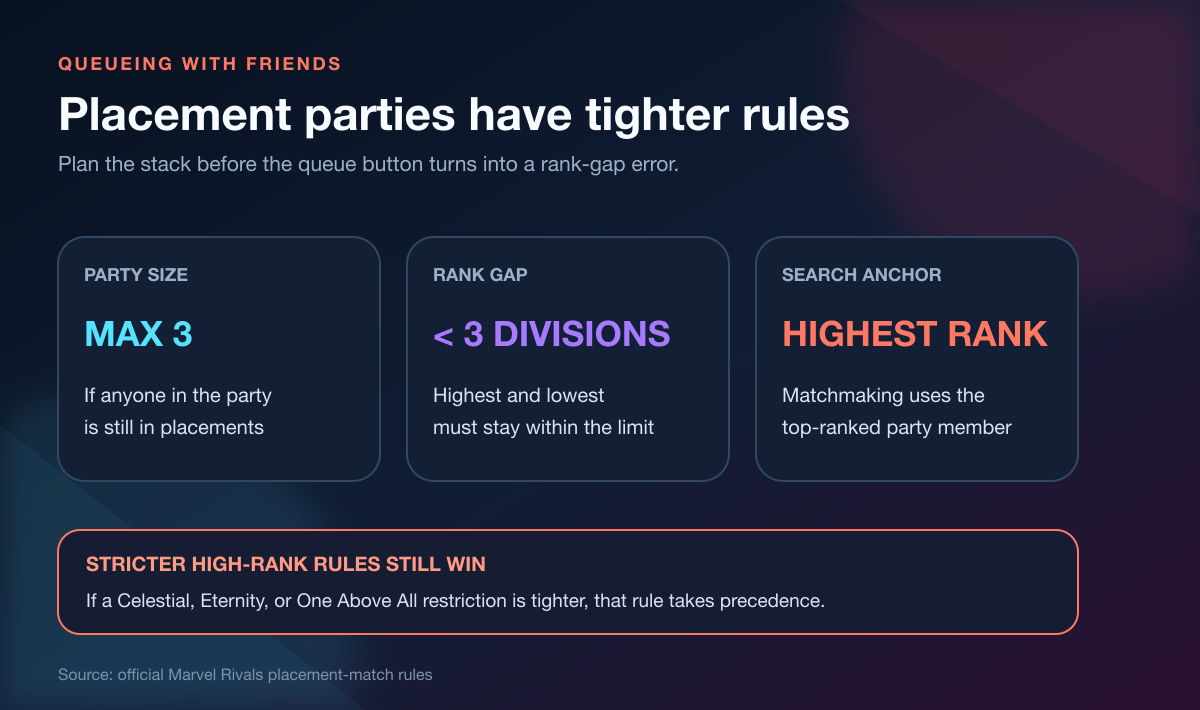
This is where “we are basically the same rank” can still fail. Silver I and Gold I are three divisions apart, so they miss a rule that requires the gap to be less than three. Party eligibility follows exact divisions, not the color of the badge.
For the games themselves, enter with a boringly clear plan: who starts fights, who keeps the frontline alive, and who makes the retreat call. Our Marvel Rivals role queue explainer covers the current open-selection system and why one flexible teammate removes so much hero-select chaos.
If your usual group is offline, find a Marvel Rivals teammate on Tapin who fits your role, region, and placement window. Ten games feel a lot less random when the same person already knows your backup hero and comm style.
What Happens If Someone Disconnects?
The placement rules distinguish between you, someone in your premade squad, and a matchmade teammate. The 90-second mark matters.
| Who disconnects for more than 90 seconds? | If your team wins | If your team loses |
|---|---|---|
| You, the placement player | Placement loss, suspension, and offense count | Placement loss, suspension, and offense count |
| A member of your premade squad | Normal result | Placement loss; no ranked suspension for you |
| A matchmade teammate | Normal result | Match is invalid for your placement calculation |
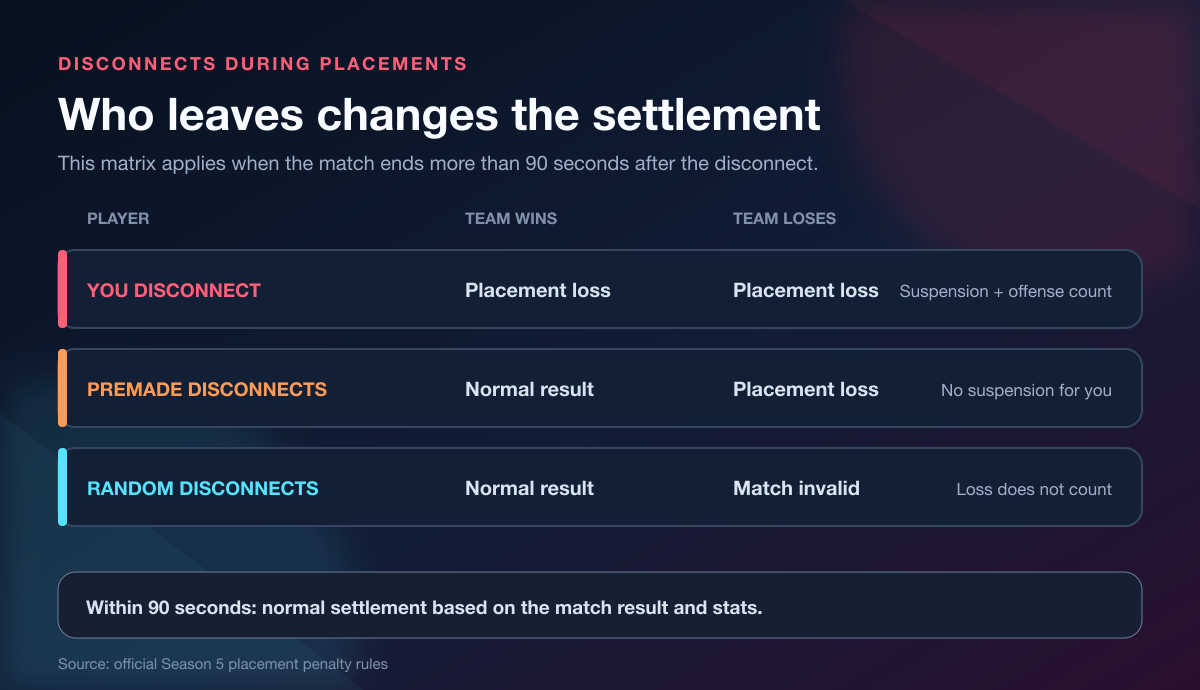
If the match ends within 90 seconds of the disconnect, the official rules use normal settlement based on the result and stats. Reconnect as fast as possible—waiting for the timer to solve the problem is gambling with the entire set.
NetEase also lists inactivity and deliberate AFK behavior in its penalty framework. A rough first fight is not a reason to mentally leave the match. Regroup, swap if the composition needs it, and keep the game valid.
Do Placement Matches Reset at Midseason?
No. Placements are tied to the full season, not both halves separately.
If you complete placements during the first half, you keep that rank when the .5 update arrives. If you started but did not finish, you can complete the remaining games in the second half. That matters in Season 9.5: a player who completed the Season 9 set does not run another 10 just because the midseason update added content.
Rewards have a separate match requirement:
- A half-season Gold costume requires 10 ranked matches during that half and a Gold-or-higher finish at the half’s end.
- Season-end rank rewards require a completed placement set plus the required final rank.
- Nine finished placement games are not enough, even if the predicted badge already shows Platinum.
Finish the set before the season timer becomes the hardest opponent in the lobby.
A Practical Plan for All 10 Placement Matches
Placements matter, but treating every death like a career-ending event makes you play scared. Split the run into three blocks.
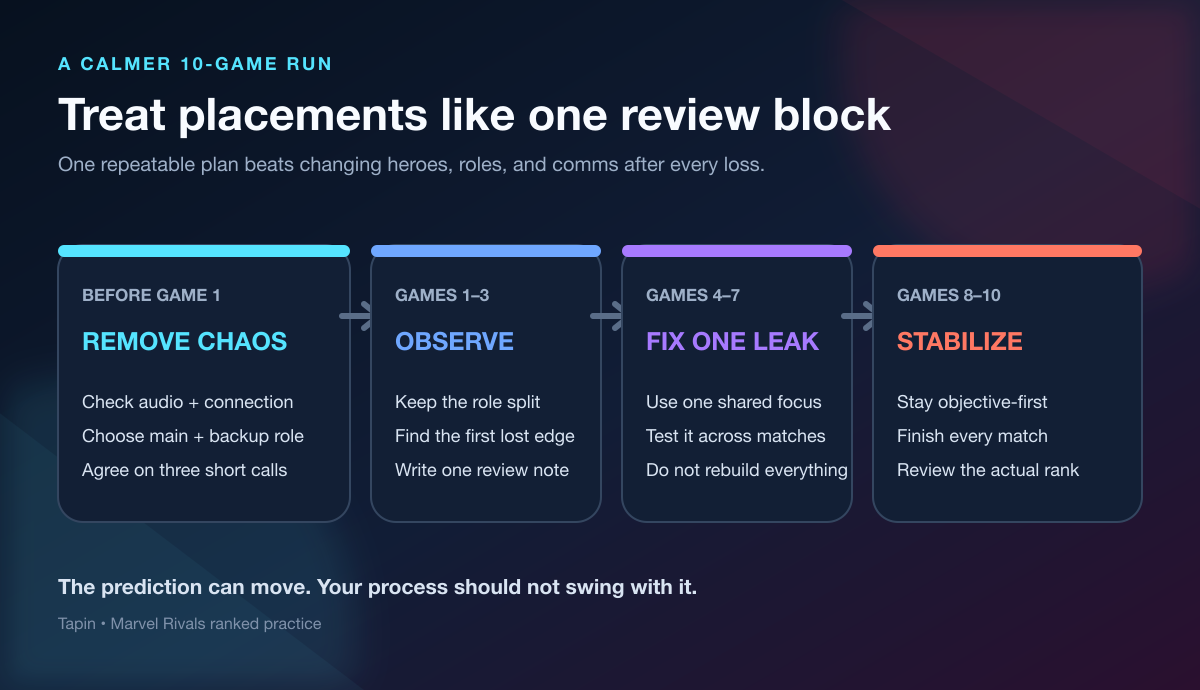
Before game one: remove avoidable chaos
Pick one main role, one backup role, and two heroes you can actually pilot under pressure. Check your connection, audio, and input settings before Competitive—not while five strangers wait in hero select.
If you are stacking, confirm the rank gap and party size first. Agree on three calls: target, disengage, and ultimate plan. More words do not automatically create better comms.
Games one through three: collect the pattern
Do not rebuild your hero pool after one loss. Track the first fight your team loses with an advantage: a 6v5 thrown by overchasing tells you more than the final damage card.
Keep the same role split when possible. Consistency gives you cleaner evidence and a fair chance to fix something before the set ends.
Games four through seven: change one thing
Choose one repeated leak—late regroup, wasted defensive ultimate, no peel call—and make it the shared focus. I believe this middle block is where a steady duo earns its keep: one person can catch the same mistake while you are busy surviving it.
Need a better recruiting filter before you commit the rest of the set? The Marvel Rivals LFG guide includes a role, rank, region, schedule, and comms template.
Games eight through 10: protect the process
Do not chase a flashy hero swap because the predicted badge dipped. Stay objective-first, keep your calls short, and finish every match.
After game 10, save the actual rank and one review note. Your next session should solve that note—not spend an hour arguing with the prediction you saw after game six.
Marvel Rivals Placement Matches FAQ
How many placement matches are in Marvel Rivals?
You must complete 10 placement matches to receive your actual rank. The predicted rank shown during those games can move and is not the final result.
What rank do new players start at in Marvel Rivals?
Players who have never completed 10 ranked games in a season begin with a Silver III predicted rank. Their actual rank arrives after all 10 placement matches.
Can I play Marvel Rivals placements with friends?
Yes. If anyone is still in placements, the party is capped at three players and the highest-to-lowest rank gap must be less than three divisions. The highest-ranked member anchors matchmaking.
Do individual stats affect Marvel Rivals placements?
Yes. Since Season 7, the game tracks individual performance during placements and can apply a -100 to +100 Competitive-point adjustment after game 10 based on personal results and tier. Wins and losses still move the predicted rank throughout the set.
Do I need to be level 15 for Competitive mode?
New players need account level 15 to enter Competitive. That unlock requirement is separate from the 10 placement matches used to determine the starting rank.
Do placements reset again at the .5 update?
No. A completed placement set carries from the first half into the second half of the same season. Half-season reward eligibility can still require 10 ranked matches during that specific half.
Finish the Set, Then Judge the Rank
Marvel Rivals placement matches are a 10-game process: a history-based prediction, live movement from results, and a bounded personal-performance adjustment at the end. Silver III is the new-player prediction—not a promised finish and not a permanent sentence.
Play the objective, keep the same communication plan, and finish every match. The actual badge after game 10 is the one worth reviewing.