

Last Updated: October 2026
A good Marvel Rivals team comp is not six strong heroes standing near each other. It is six players trying to win the same kind of fight.
Season 10.5 still uses open hero selection, so your lineup can change after every wipe. That freedom is the whole point: start with enough frontline, pressure, sustain, and peel, then adjust to the map and the enemy instead of defending a bad draft for 10 minutes.
⚡ Quick answer: Use two Vanguards, two Duelists, and two Strategists as a safe diagnostic—not a law. Then make sure the lineup can start a fight, hold space, pressure targets, finish kills, sustain allies, and protect its backline.
Table of Contents
- Start with six jobs, not six hero names
- Use 2-2-2 as a check, not a cage
- Choose dive, brawl, or poke
- Build around the map and matchup
- Treat Team-Ups as bonuses
- Know when to swap
- Assign communication ownership
- Build a ranked team with one reliable duo
- FAQ
Start With Six Jobs, Not Six Hero Names
Marvel Rivals officially sorts heroes into Vanguard, Duelist, and Strategist. NetEase's own hero-design write-up explains that those classes are part of how each hero's identity and kit are built, but a role label does not tell you everything a lineup can actually do.
Before the doors open, check whether somebody owns each of these jobs:
- Start: begin the fight on terms your team can follow.
- Hold: occupy the objective, choke, or high ground long enough to matter.
- Pressure: force movement, defensive cooldowns, or healing resources.
- Finish: convert a weak target into a confirmed elimination.
- Sustain: keep the team functional through damage and extended fights.
- Peel: stop divers from deleting the backline for free.
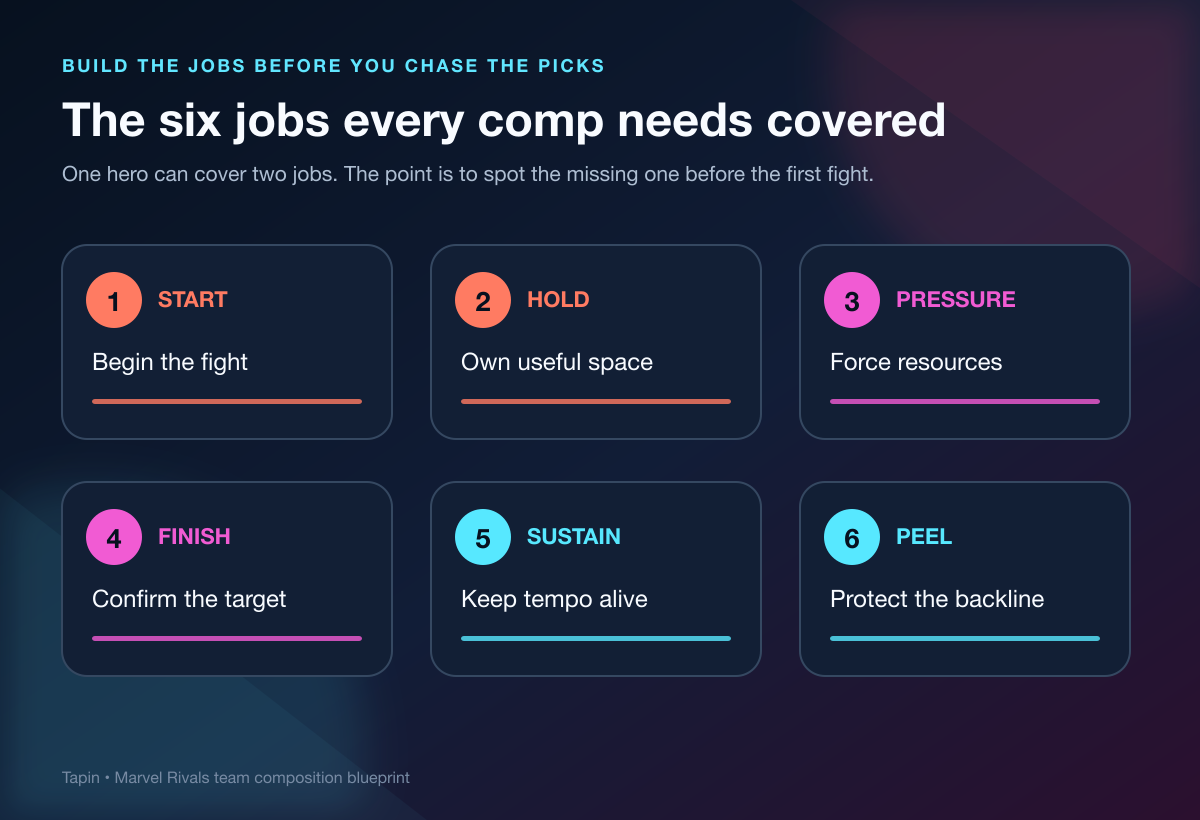
One hero may cover two jobs. A mobile Vanguard can start and disrupt. A Strategist can sustain and peel. A Duelist can pressure at range and finish low targets.
The failure comes when nobody owns a job. Six players may have damage, but if nobody can safely start the fight, the team waits until the enemy decides everything.
⚠️ Watch Out: “We need more damage” is usually too vague. Ask what failed: could nobody reach the target, did the frontline disappear, or did the backline get jumped? The answer tells you what the comp is missing.
Use 2-2-2 as a Check, Not a Cage
Two Vanguards, two Duelists, and two Strategists is a useful starting shape because it spreads responsibility. You are less likely to enter the first fight with zero frontline or one overwhelmed source of sustain.
It is not a rule built into matchmaking. Marvel Rivals remains open queue, and our role queue explainer covers why 2-2-2 is a player framework rather than a confirmed role lock.
Use the structure to ask better questions:
- Can one Vanguard hold while the other starts the fight?
- Can the Duelists pressure the same range, or are they splitting the team in opposite directions?
- Can the Strategists survive the enemy's likely engage?
- If one player swaps, which job disappears?
A 1-3-2 or 3-1-2 lineup can work when the actual kits cover the missing job and the team understands the plan. A pretty 2-2-2 can still fail when both Vanguards wait, both Duelists take disconnected angles, and both Strategists spend the fight running from the same diver.
I believe comfort matters until it blocks the win condition. A player on a practiced hero usually gives you more than a “perfect” meta pick they cannot execute—but comfort is not permission to ignore a broken team shape.
Choose Dive, Brawl, or Poke
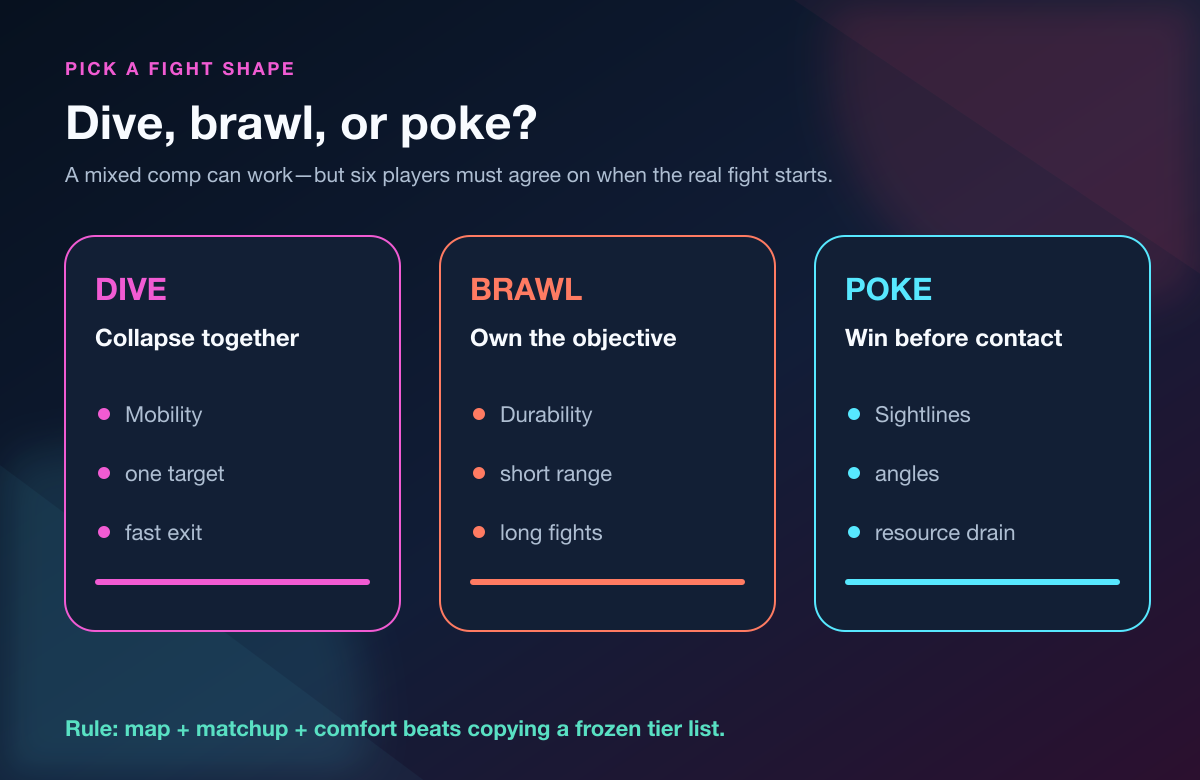
Every Marvel Rivals team composition leans toward a fight shape. Name that shape before you argue about individual heroes.
Dive: Collapse Together
Dive uses mobility to bypass the frontline and overwhelm one target. It wins when the engage lands together and the target cannot survive the first burst.
The key word is together. One player entering early is not a dive comp; it is a donation. Pick a target or location, count the engage, and leave when the kill window closes.
Dive struggles when the enemy can peel, stack defensive resources, or force your backline to fight alone. If your mobile players keep reaching the target but nobody can finish, the issue may be timing—not the hero list.
Brawl: Own the Objective
Brawl wants close-to-mid-range fights around useful space. It wins through durability, layered pressure, and the ability to keep fighting after the first cooldown cycle.
Take the corner, move the frontline together, and make the enemy spend resources just to enter the objective. Brawl loses value when it crosses open sightlines one player at a time or chases mobile targets away from the space it already won.
Poke: Win Before Contact
Poke creates damage and threat before the full engage. It wants clean sightlines, multiple angles, and enough patience to drain health or cooldowns before committing.
Poke does not mean six players hiding at maximum range. Somebody still has to contest space, and the team needs an answer when dive closes the gap.
Mixed lineups are normal. The danger is mixed timing: half the team wants to wait for poke while the other half dives immediately. Decide what starts the real fight.
Build Around the Map and Matchup
Do not copy one Marvel Rivals ranked team into every map. Ask where the next fight happens and how your six heroes reach that space.
On open approaches, pressure and safe movement matter. Around tight objectives, durability, area control, and peel become more valuable. Vertical maps reward heroes who can contest height or punish enemies using it; they punish lineups that can only move through one doorway.
Run this 20-second check in spawn:
- Where do we want the fight? Objective, choke, high ground, or backline.
- Who gets us there? Name the player who starts or enables the move.
- What stops us? Enemy range, dive, sustain, or area control.
- What is our first backup? One pre-agreed swap beats six tilted suggestions.
The matchup matters as much as the map. If the enemy spreads for poke, a coordinated collapse can punish an isolated angle. If they dive, shrink your spacing enough to trade and peel. If they brawl, stop feeding them the close fight they want for free.
This is also why a “counter pick” without a plan rarely fixes anything. A swap only works when the player knows the new job and the team changes its timing around them.
Treat Team-Ups as Bonuses
Team-Ups are a real part of Marvel Rivals composition building, and the current balance can change their value quickly. The official October 9 balance update adjusted multiple pairings, including Hulk with Wolverine, Magneto with Emma Frost, The Thing with Invisible Woman, Cyclops with Gambit, and Iron Man with Thor.
That is exactly why a Team-Up should strengthen a functioning comp—not excuse a broken one.
Use this order:
- Cover the essential jobs.
- Choose the fight shape.
- Check the map and enemy threat.
- Add a Team-Up when it supports steps one through three.
The latest October 15 patch notes did not introduce another balance pass; they focused on events and bug fixes. Season 10.5 is still fresh enough that you should check official notes before hard-locking a composition around old Team-Up values.
⚡ Pro Tip: If breaking the Team-Up gives your team the missing peel, reach, or sustain it needs, break it. A bonus ability cannot rescue a lineup that never gets to use it.
Know When to Swap
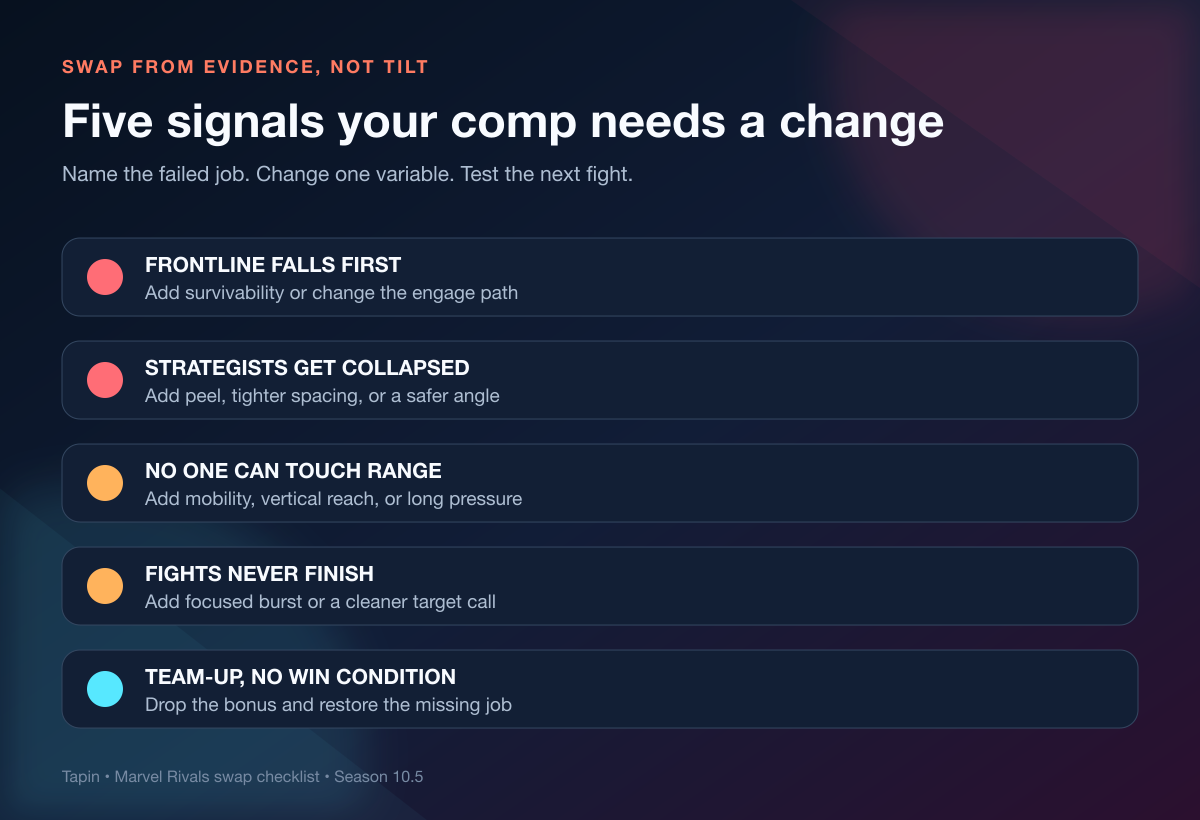
Do not swap because somebody typed “team diff.” Swap because you can name the failed job.
Your frontline dies before pressure starts
The team may need more survivability, safer staging, or a different engage route. Adding healing will not fix a frontline that walks through every enemy angle alone.
Your Strategists die first
Add peel, tighten the formation, or deny the route the diver is using. A Strategist swap can help, but the other five players still own protection.
Nobody can touch the threat
If a ranged or elevated enemy controls the fight untouched, add reach, mobility, or pressure on their angle. More short-range damage only makes the same problem louder.
Fights last forever without a pick
Your team may have sustain but no clean finish. Focus one target, align damage windows, or add burst that works at the range you are actually fighting.
The Team-Up works, but the team does not
Drop the bonus and restore the missing job. Composition is about the whole six, not protecting a two-hero interaction from reality.
Change one variable, then test the next fight. Six simultaneous swaps destroy the evidence you just earned.
Assign Communication Ownership
Composition theory dies when six people use six clocks. Give one player ownership of the fight sequence.
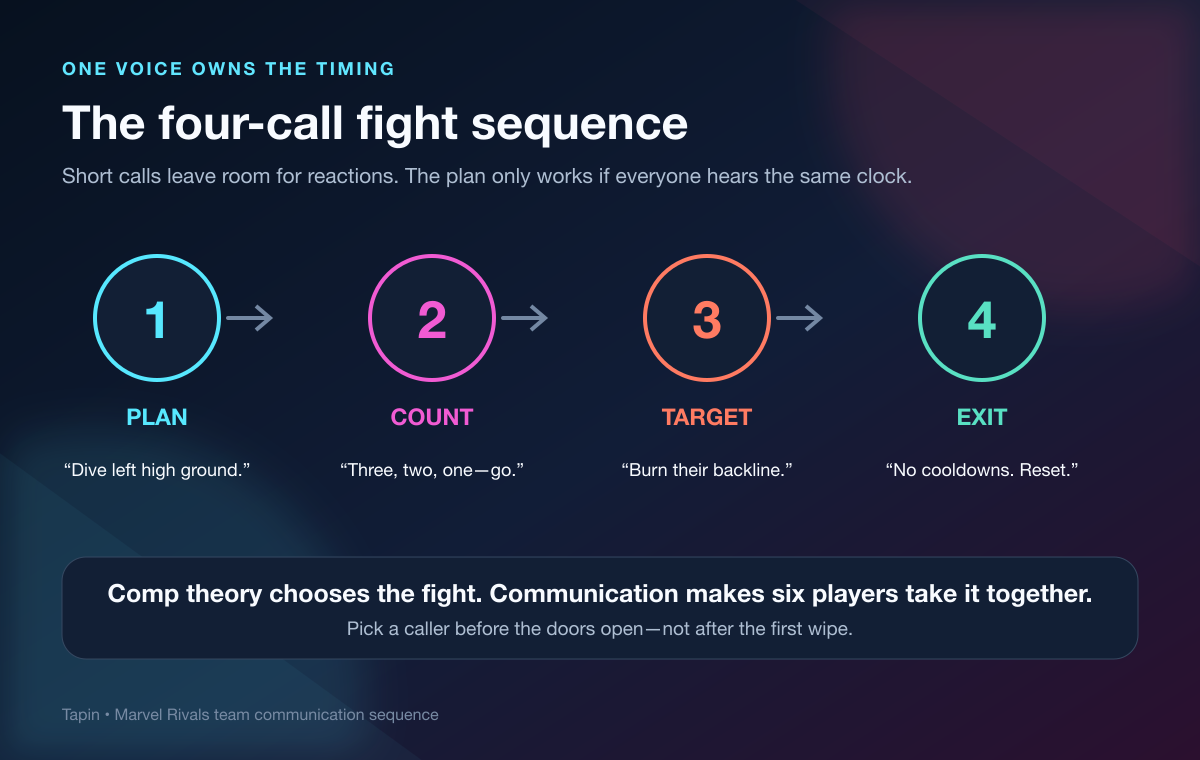
Use four short calls:
- Plan: “Dive left high ground.”
- Count: “Three, two, one—go.”
- Target: “Burn their backline.”
- Exit: “No cooldowns. Reset.”
The engage player usually owns the count. A backline player often has the clearest view for danger and retreat calls. One player should track the enemy tool that can stop your plan.
Keep comms descriptive. “Two on our backline” gives the team a location and a number. “Where is everyone?” gives them a complaint.
If you are assembling a regular group, our Marvel Rivals LFG guide has a copy-ready post that filters for rank, role coverage, platform, schedule, and comms style.
Build a Ranked Team With One Reliable Duo
You do not need a six-stack to make this framework useful. One consistent duo can guarantee two roles, one backup plan, and one shared engage clock before matchmaking fills the other four slots.
Pick complementary responsibilities. One player can hold or start while the other sustains, peels, or finishes the same target. Agree on one comp style and one swap trigger before queueing.
Platform also matters for Competitive parties. PC and console use separate ranked pools, so check our Marvel Rivals ranked crossplay guide before recruiting someone your account cannot queue with.
If your friends list is offline, find a Marvel Rivals teammate on Tapin who can cover the missing role and run the same plan for more than one fight. The value is not another random body—it is somebody who hears the count and moves with you.
Marvel Rivals Team Comp FAQ
What is the best Marvel Rivals team comp in 2026?
There is no single lineup that wins every map and matchup. Start with two Vanguards, two Duelists, and two Strategists, then verify that the six jobs—start, hold, pressure, finish, sustain, and peel—are covered.
Does Marvel Rivals require a 2-2-2 composition?
No. Marvel Rivals uses open hero selection, so 2-2-2 is a practical starting framework rather than a required format. Other role splits work when their kits still cover the team's essential jobs.
Is dive, brawl, or poke strongest in Season 10.5?
The strongest style is the one your team can execute on the current map into the enemy lineup. Dive needs synchronized timing, brawl needs controlled space, and poke needs sightlines plus an answer when enemies close the gap.
Should a team always activate a Team-Up ability?
No. Activate a Team-Up when it strengthens a complete game plan. If the pairing costs your team vital sustain, peel, reach, or frontline control, fix the missing job first.
When should I swap heroes in Marvel Rivals?
Swap when you can identify a repeatable failure: frontline dying before pressure starts, Strategists getting collapsed on, an untouched ranged threat, fights that never convert, or a Team-Up that leaves a critical job uncovered.
Build the Plan Before the Doors Open
A Marvel Rivals team comp works when six kits create one clear fight. Cover the jobs, choose the fight shape, name the caller, and make one evidence-based swap when the plan breaks.
Do that with one reliable teammate and open queue stops feeling like six strangers negotiating from scratch.