


Last Updated: April 2026
Most League of Legends champions get their power from some cosmic birthright, ancient bloodline, or magical accident. Pantheon's lore flips that on its head. Atreus — the man behind the spear — earned nothing. He was given nothing. And when the gods literally abandoned his body, he stood back up anyway.
That's what makes Pantheon's story one of the most compelling in Runeterra. Not divine power. Mortal will.
Atreus: The Man Who Kept Getting Back Up
Before he was Pantheon, Atreus was just a soldier. Born on the slopes of Mount Targon to the Rakkor tribes, he joined the Ra'Horak — the elite military unit of his people. But "elite" didn't describe Atreus himself.
He wasn't talented. He didn't have natural strength or some hidden gift. He failed constantly — every training bout, every regiment. But he had one thing nobody could take from him: he always stood back up.
That stubbornness earned him the respect of Pylas, a far more skilled warrior who became Atreus's closest friend. They'd beat the hell out of each other in the training circles, and through that, they forged a bond deeper than rivalry. Brotherhood.
This matters. Atreus's entire story is built on the same foundation — not talent, not destiny, just an unbreakable refusal to quit.
The Climb That Cost Everything
A barbarian ambush wiped out Atreus's patrol. Only he and Pylas survived. Desperate, they went to the Aspect of the Sun for help — and were refused.
So they decided to do it themselves. They'd climb Mount Targon's peak and take the power they needed.
The climb nearly killed them both. It did kill Pylas. He died in Atreus's arms at the summit — the friend who'd been there through every failure, gone at the moment of their greatest effort.
And then the skies opened.
The Aspect of War — the celestial being known as Pantheon — needed a host. It chose Atreus. Not because he was worthy. The Aspect actually considered him unworthy. But it needed a body, and Atreus was the only one standing.
The Aspect took over completely. Atreus was erased — a passenger in his own body, watching as a god used his flesh to wage wars he didn't choose.
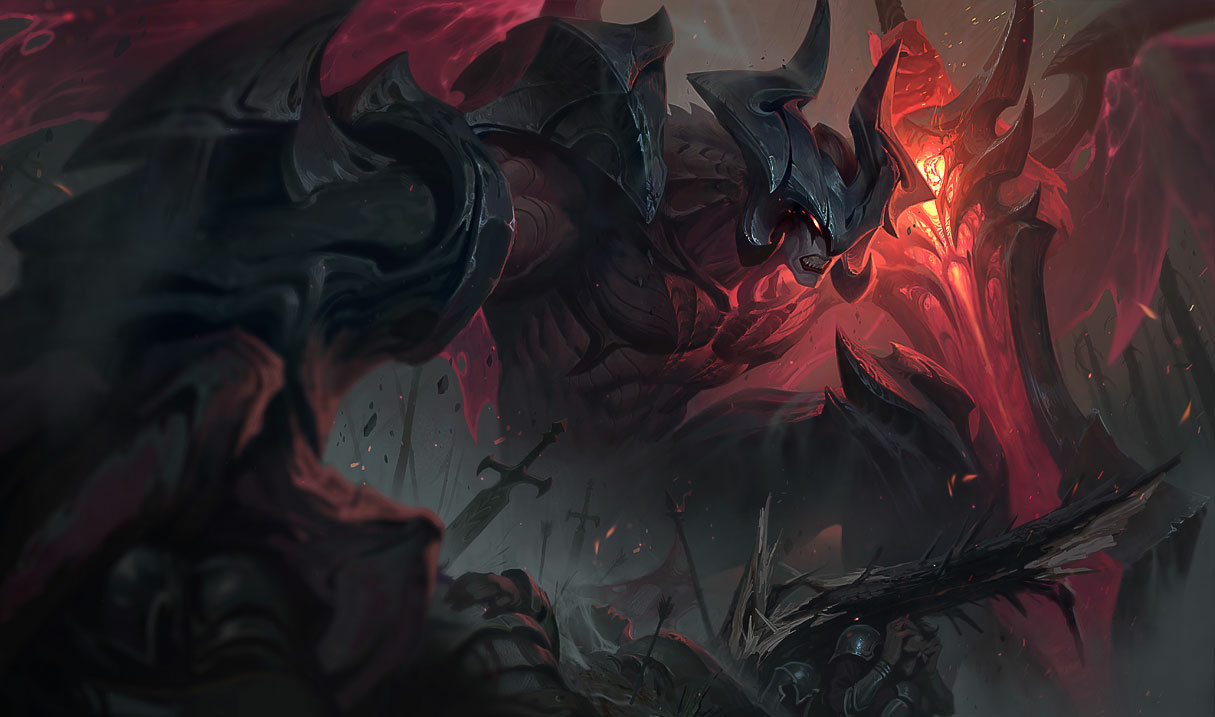
Aatrox: The Blow That Changed Everything
Here's where Pantheon's lore goes from tragic to transcendent.
The Aspect of War hunted Darkin across Runeterra — ancient, corrupted god-warriors imprisoned in their own weapons. Eventually, it found Aatrox, the Darkin Blade. The most dangerous of them all.
They fought. And Aatrox won.
Not a close fight. Not a narrow defeat. Aatrox drove his blade through the Aspect of War and killed a god. The constellation of Pantheon — the literal stars that represented the Aspect — were torn from the sky. The celestial entity that had puppeted Atreus for years was gone.
But Atreus wasn't.
Impaled on a Darkin blade, bleeding out, stripped of every ounce of divine power — Atreus looked up at the god-killing monster standing over him and spat in his face.
Aatrox laughed. Left him to die. Why wouldn't he? Atreus was just a mortal. A nobody. The leftover shell of a dead god.
Except Atreus doesn't die. That's the whole point.
A Mortal Reborn
Atreus dragged himself off that battlefield and stumbled into Rakkor territory, where he found Iula — the widow of his fallen friend Pylas. She nursed him back to health. And as he recovered, something shifted.
For the first time, Atreus wasn't fighting because a god commanded him. He wasn't climbing a mountain for power he didn't understand. He was fighting because he chose to. Because the people around him — Iula, the Rakkor, the mortals who'd never have a constellation in the sky — deserved someone who'd stand between them and the darkness.
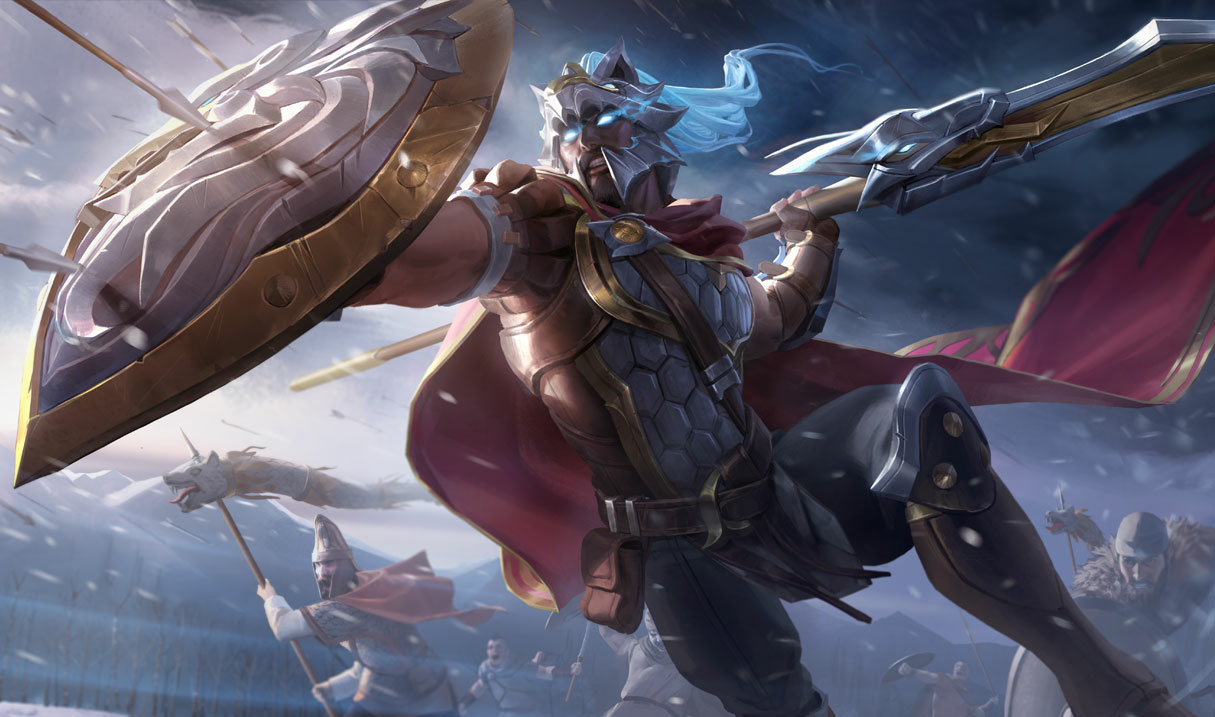
He picked up the Aspect's weapons. The spear. The shield. Not because they gave him power — the celestial magic was dead. He picked them up because they were tools, and he had work to do.
When Aatrox returned, leading a barbarian incursion toward the settlements that included Iula's farm, Atreus was waiting.
Aatrox saw him and noticed immediately: no divine power flowing through the spear, just the scar of his previous wound. A mortal man with a broken shield.
They fought again. And this time, fueled by nothing but rage, grief, and the screams of the people behind him, Atreus struck Aatrox's sword arm hard enough to sever the Darkin from its host body.
A mortal man wounded a god-killer. Through sheer, stubborn will.
And in that moment, something sparked. The celestial weapons reignited — not with the Aspect's power, but with something new. Atreus's own fire. Mortal will made manifest.
"I am not your weapon. I am not your host. I am the spear that will pierce the heavens."
The Targon Connection: Leona, Diana, and the Mountain's Children
Pantheon's lore doesn't exist in a vacuum. He's woven into the broader Targon storyline — one of the richest narrative threads in League of Legends.
Leona, the Aspect of the Sun, comes from the same Rakkor people. She's the devout Solari warrior who embraced her Aspect willingly. Where Atreus was used and discarded by his Aspect, Leona accepted hers with faith. They represent two sides of the same coin: what happens when mortals intersect with gods.
Diana, the Aspect of the Moon, adds another layer. Her story is about questioning the dogma that Leona defends — the Solari's suppression of moon worship, the hidden history of Targon. Diana and Leona's bond-turned-conflict mirrors the broader tension in Targon between blind faith and painful truth.
Atreus stands apart from both. He doesn't worship the Aspects. He doesn't seek their approval. After what Pantheon did to his body, he actively opposes the divine. His mission isn't faith or heresy — it's liberation. Mortals shouldn't be tools for gods. If you're interested in other champions with deep narrative connections, check out our Jinx ADC guide or explore more League of Legends content on Tapin's blog.
That philosophical stance makes him unique among Targon's champions. Leona serves. Diana rebels. Atreus rejects the entire framework.
If Targon's lore interests you and you want to explore champions like Pantheon, Leona, or Diana with someone who knows the game inside out, Tapin connects you with League players who can share the experience — whether that's lore discussions, duo queue, or learning matchups together.

The Ruination: Even Gods Can't Break Him
During the Ruination event, Viego's Black Mist swept across Runeterra, corrupting champions and bending them to the Ruined King's will. Pantheon was among those affected — the Ruined Pantheon skin depicts this chapter canonically.
But here's what's important about Atreus's corruption: it wasn't easy. The Black Mist feeds on grief, loss, and unfulfilled desire. Atreus carries all of those — Pylas's death, the violation of his body by the Aspect, years of war he didn't choose.
The Ruination proved that Atreus is vulnerable. He's not invincible. His will can be broken, temporarily. But that vulnerability is what makes his eventual resistance meaningful. He's not a god shrugging off corruption. He's a man who falls and gets back up — again.
Why Pantheon's Lore Resonates
Pantheon consistently ranks as one of the most beloved champion stories in the community, and it's not hard to see why.
He's the underdog taken to its extreme. Not the farm boy who discovers he's secretly royalty. Not the chosen one. He's the guy who was explicitly told he wasn't good enough — by a literal god — and proved that god wrong by outliving it.
His power fantasy is different. Most champions embody "what if you had incredible power?" Pantheon embodies "what if you had nothing and refused to stop?" That hits different for anyone who's ever been the worst player in their friend group, the hardstuck ranked grinder, the person who keeps losing but keeps queuing.
His defiance is earned. Atreus doesn't hate the gods because it's edgy. He hates them because one stole his body, ignored his friend's sacrifice, and treated him like disposable packaging. His rage has history.
The "get back up" motif is universal. It's the anime protagonist energy distilled into its purest form — no power-ups, no transformations, no secret bloodline. Just: I will not stay down.
Riot's cinematic The Call captured this perfectly. The scene where Atreus, battered and bleeding, reignites his spear against Aatrox is one of the most celebrated moments in League of Legends media. It works because by that point, you understand what it costs him.
FAQ
Is Pantheon a god in League of Legends lore?
No. The original Aspect of War (the celestial being named Pantheon) is dead — killed by Aatrox. The champion we play as is Atreus, a mortal man who inherited the Aspect's weapons and reignited their power through sheer willpower. He carries the name Pantheon, but he's fully human.
How did Aatrox kill the Aspect of War?
Aatrox drove his Darkin blade into the Aspect during a direct confrontation on the slopes of Mount Targon. The blow was so powerful it erased the Aspect's constellation from the sky — a feat thought impossible, since Aspects are celestial beings, not mortal. Atreus, the Aspect's host, survived the blow.
What is Pantheon's connection to Leona and Diana?
All three are tied to Mount Targon and the Rakkor people. Leona is the Aspect of the Sun (Solari faith), Diana is the Aspect of the Moon, and Atreus was the former host of the Aspect of War. While Leona and Diana grapple with faith and heresy, Atreus rejects the Aspects entirely — he believes mortals shouldn't serve as vessels for gods.
Was Pantheon affected by the Ruination?
Yes. During the Ruination event, Atreus was corrupted by Viego's Black Mist, which exploited his grief and trauma. The Ruined Pantheon skin depicts this canonical moment. He eventually broke free, consistent with his character's core theme of overcoming impossible forces through willpower.
Why do players love Pantheon's lore so much?
Pantheon's story resonates because it's a pure underdog narrative. Atreus has no innate talent, no divine gift he was meant to receive. He was used, discarded, and left to die — and he got back up. That theme of mortal determination against cosmic power appeals to anyone who's ever felt outmatched but refused to quit. His story earned its emotional weight through genuine suffering, not convenient power-ups.
The Unbreakable Spear
Pantheon's lore isn't just good by League of Legends standards. It's a genuinely compelling character arc — mortal man loses everything, refuses to die, and forges his own identity from the wreckage of a god's failure.
If you want to experience Pantheon's champion fantasy firsthand — the spear drops, the shield blocks, the Grand Starfall from the heavens — find a League of Legends teammate on Tapin who can show you the ropes or queue up alongside you. Some stories are better experienced together.
"Here is my eternity… a day the gods will remember."