

Last Updated: October 2026
The highest-ranked augment is not automatically the right click. It can be amazing across millions of games and still be awful for the board sitting in front of you.
This TFT augment guide gives you a repeatable way to pick for your actual spot: current strength, health, gold, items, direction, and realistic cap. The examples are checked against Set 18: Enchanted Wilds on Patch 18.4b, but the framework survives balance changes because it starts with what your board needs—not a frozen tier list.
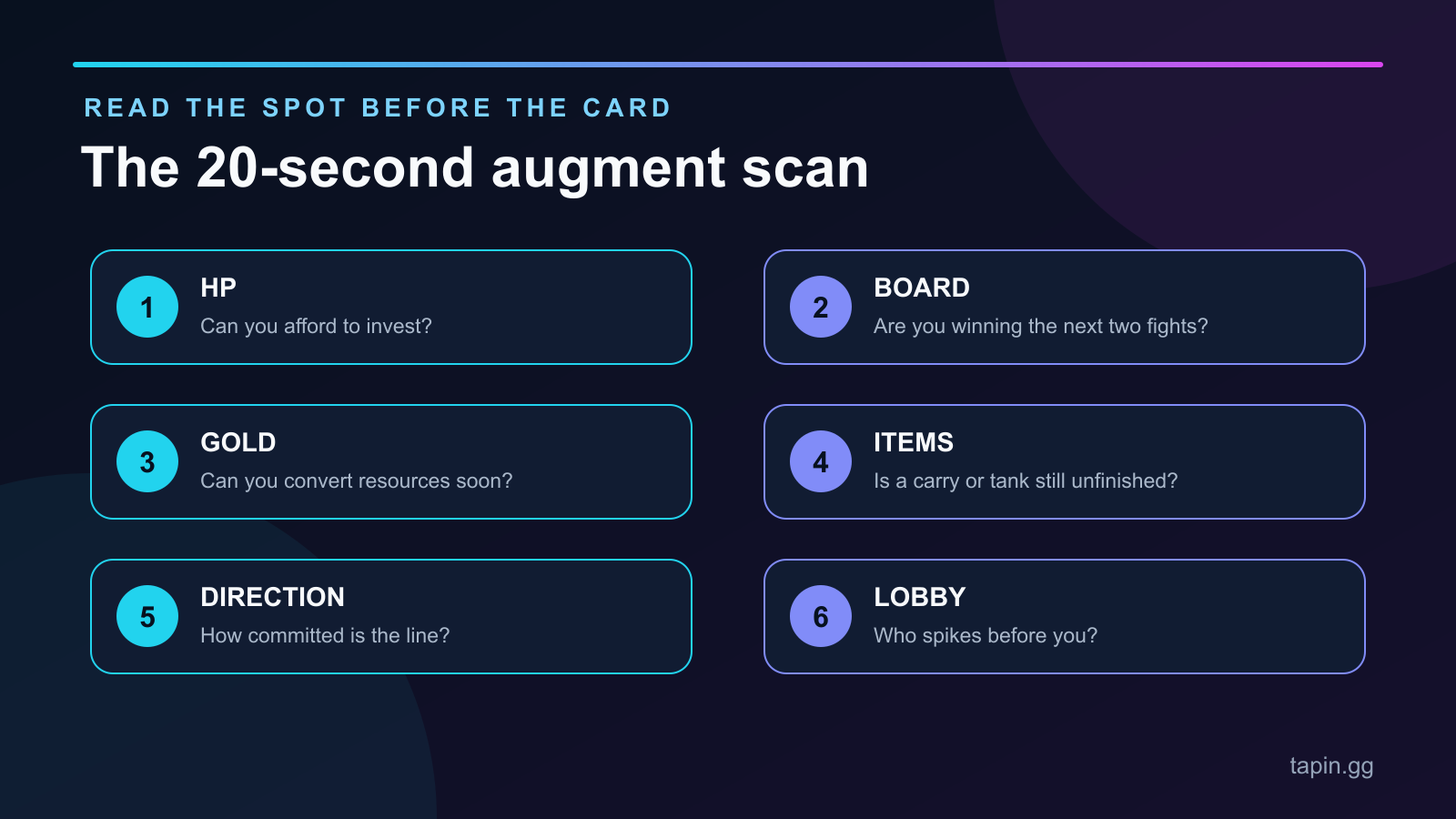
Quick answer: At 2-1, protect flexibility unless your opener gives you a real commitment. At 3-2, fix the part of your board that will lose Stage 3. At 4-2, convert resources into immediate combat power or a clearly reachable final-board upgrade.
Table of Contents
- Why augment tier lists need context
- The 20-second augment scan
- How to choose at 2-1, 3-2, and 4-2
- Combat, economy, item, and direction augments
- How to compare tempo with board cap
- How to use augment stats correctly
- A four-game review loop
- FAQ
A TFT Augment Tier List Is a Filter, Not an Answer
Current augment data is useful. The live Tactics.tools augment page was tracking 3.3 million compositions on Patch 18.4b when this guide was updated, and its stage filters matter because the same augment can have a different job at 3-2 than at 4-2.
The trap is reading average placement as a command. Aggregate data blends together strong openers, weak boards, different items, different compositions, and players who already know the augment's conditions.
Riot's Patch 18.4 notes also changed multiple augments in the October 7 B-patch. A screenshot, video, or tier list from before that update may rank a version you are no longer playing.
Use stats to create a shortlist. Then make the final choice with your board.
The 20-Second TFT Augment Scan
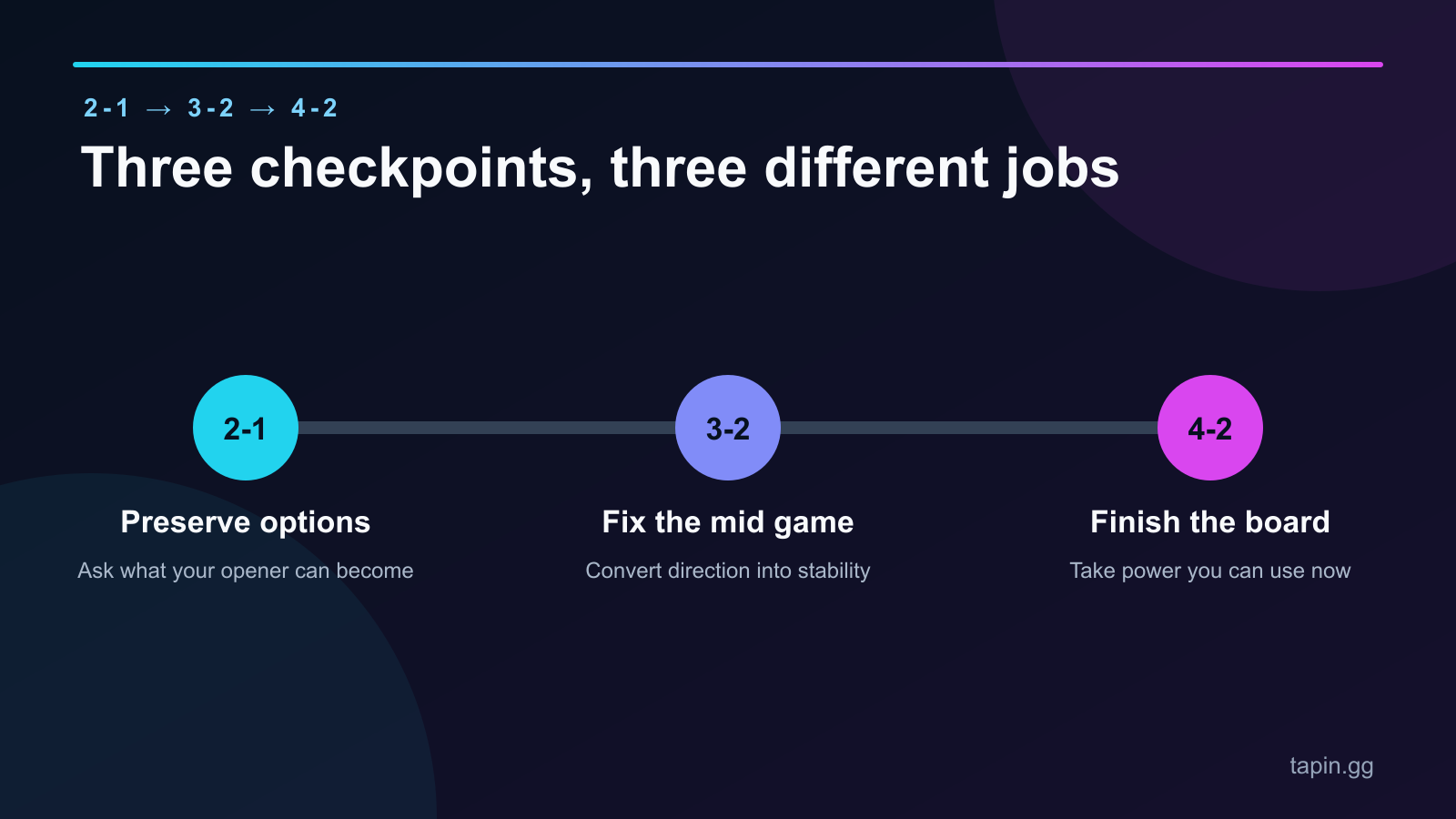
Before reading the three cards twice, read your spot once. Six questions are enough.
- HP: Can you afford an investment that does not win the next fight?
- Board: Are you stronger than the opponents you could face next?
- Gold: Can extra gold, XP, or rerolls become upgrades soon?
- Items: Does your main carry or tank still need a usable item?
- Direction: Are you holding a flexible shell, or already committed by units, items, and a trait?
- Lobby: Which players spike before your next planned level or roll-down?
The order matters. Low health changes the price of greed. A rich player with a weak board does not always need more money; they may need the combat power that lets their money survive long enough to matter.
I believe the cleanest augment habit is naming the board problem out loud before choosing. “My frontline dies before the second cast” is useful. “This augment is S-tier” is not a diagnosis.
Separate floor from ceiling
Your floor is how bad the board is when shops miss. Your ceiling is what the board becomes when the plan works.
An instant item, upgraded unit, or broad combat effect often raises the floor. An emblem, scaling economy effect, or narrow trait augment can raise the ceiling—but only if the required board is reachable.
When two choices look close, ask which miss you can survive. A lower-ceiling augment that prevents two heavy losses can outperform the dream pick that needs four more rounds and a perfect shop.
How to Choose TFT Augments at 2-1, 3-2, and 4-2
Most standard games present augment decisions at 2-1, 3-2, and 4-2. The cards change, but the stage tells you what kind of promise you can safely make.
At 2-1: preserve options with a purpose
Stage 2 is early, not blind. You already have some combination of upgraded units, components, pairs, and shop information.
Take a flexible augment when your opener has no clean direction. Broad combat, usable items, or resources with several conversion paths let later shops decide the line.
Commit when the evidence is real. A trait-specific choice needs more than one random unit: look for an upgraded core, compatible items, uncontested access, or a reward strong enough to justify rebuilding around it.
⚡ 2-1 rule: Do not ask, “What comp do I want?” Ask, “What choice keeps the most strong boards available after the next three shops?”
If basic economy, upgrades, and board shape still feel noisy, start with our TFT beginner guide. Augment decisions get easier when you can tell which part of a board is actually weak.
At 3-2: fix the next four fights
By 3-2, direction is becoming expensive to change. Your carry items, frontline pairs, streak, and lobby tempo now give the augment a concrete job.
Weak frontline? Take durability, an item, or resources you can convert immediately. Missing damage? Add a combat effect that your current units can trigger. Stable board with clean economy? You can invest, but write the conversion plan in one sentence: level on this round, roll this much gold, find these upgrades.
This is where players take a good economy augment in a bad economy spot. Extra resources do not erase a board that is already losing by five units.
At 4-2: stop collecting potential
The third choice has fewer rounds to pay you back. Immediate combat value rises because every Stage 4 loss costs more health and there are fewer future fights for slow scaling to recover the investment.
Late economy can still win when it converts now. Free rolls on the level you already reached, enough gold to complete the roll-down, or an extra unit that activates a real trait can be direct power.
What usually fails is vague value. If you cannot name the board you will field after spending the reward, you are buying possibility while the lobby buys strength.
Combat, Economy, Item, and Direction Augments
Put each choice into a job category before comparing names.
Combat augments
Combat augments improve damage, durability, healing, crowd control, or another fight outcome. They are strongest when your units already make sense and need help winning rounds.
Check whether the effect reaches the right units, starts soon enough, and covers a real weakness. More damage does not fix a carry that dies instantly. More healing does little when your frontline gets burst before it can use the sustain.
Economy augments
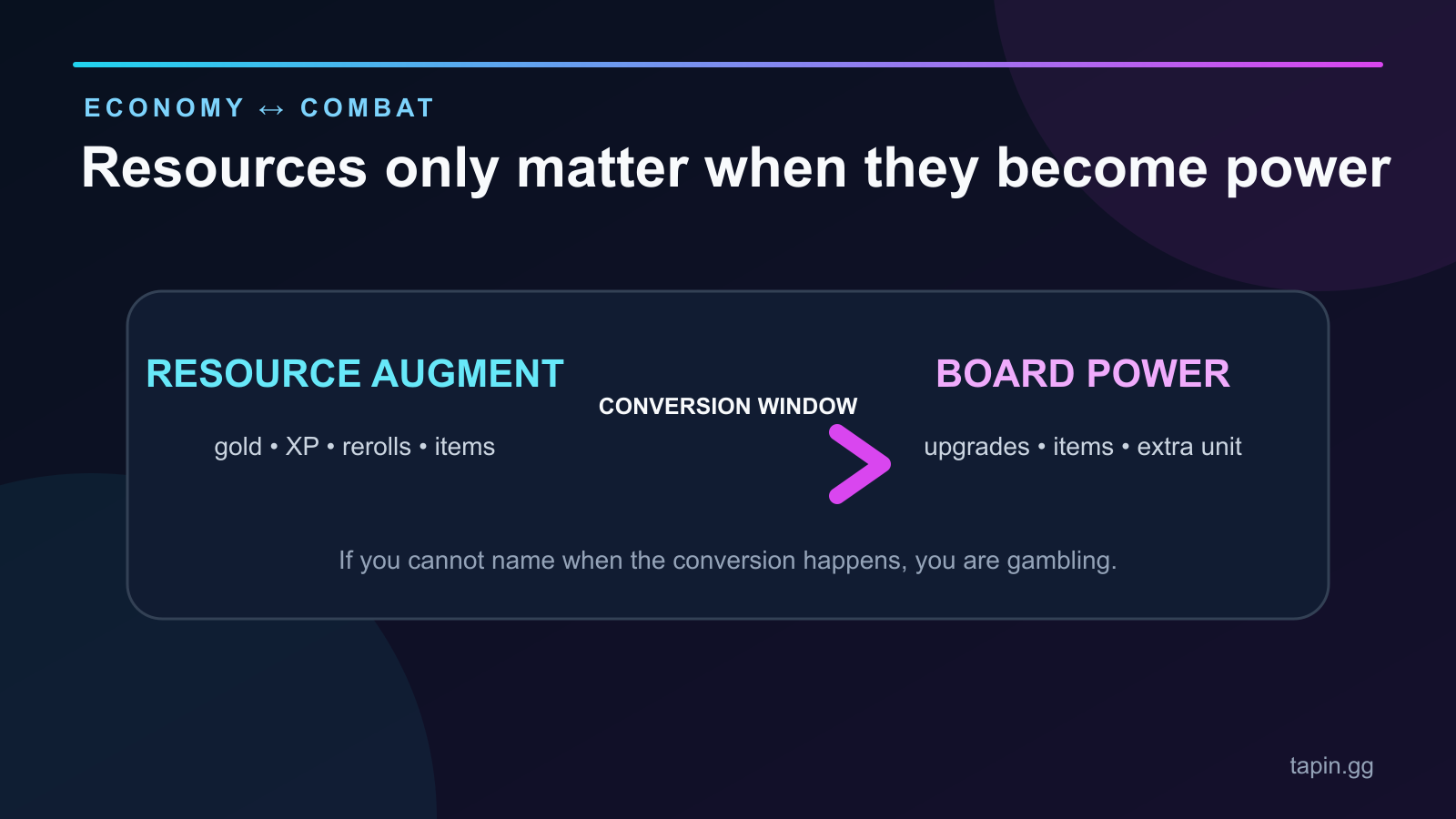
Economy augments give gold, XP, rolls, or delayed rewards. Their power is not the number printed on the card. Their power is the upgraded board that number can buy.
Before clicking, name the conversion window. If the gold funds a 3-2 stabilization, a 4-1 level, or a roll-down with several pairs, the plan is concrete. If it only makes the gold counter larger, it is not helping yet.
Item augments
Item value depends on who can use it now. A generic completed item can protect tempo; an artifact or specialized option may create a higher cap but demand the right holder.
Count completed jobs, not raw items. Does the pick finish your tank, give the carry a third item, or free a component from an awkward recipe? If not, it may just move clutter from the bench to the board.
Direction augments
Trait, hero, and composition-specific augments can define a game. They also carry the highest pivot cost.
Check four things before committing:
- You can field the effect without downgrading the current board.
- Your items fit at least one carry or tank in the line.
- The key units are not heavily contested.
- The payoff arrives before your health runs out.
One failed condition is manageable. Three failed conditions mean the card is selling you a highlight reel.
Tempo Versus Cap: The Choice That Actually Matters
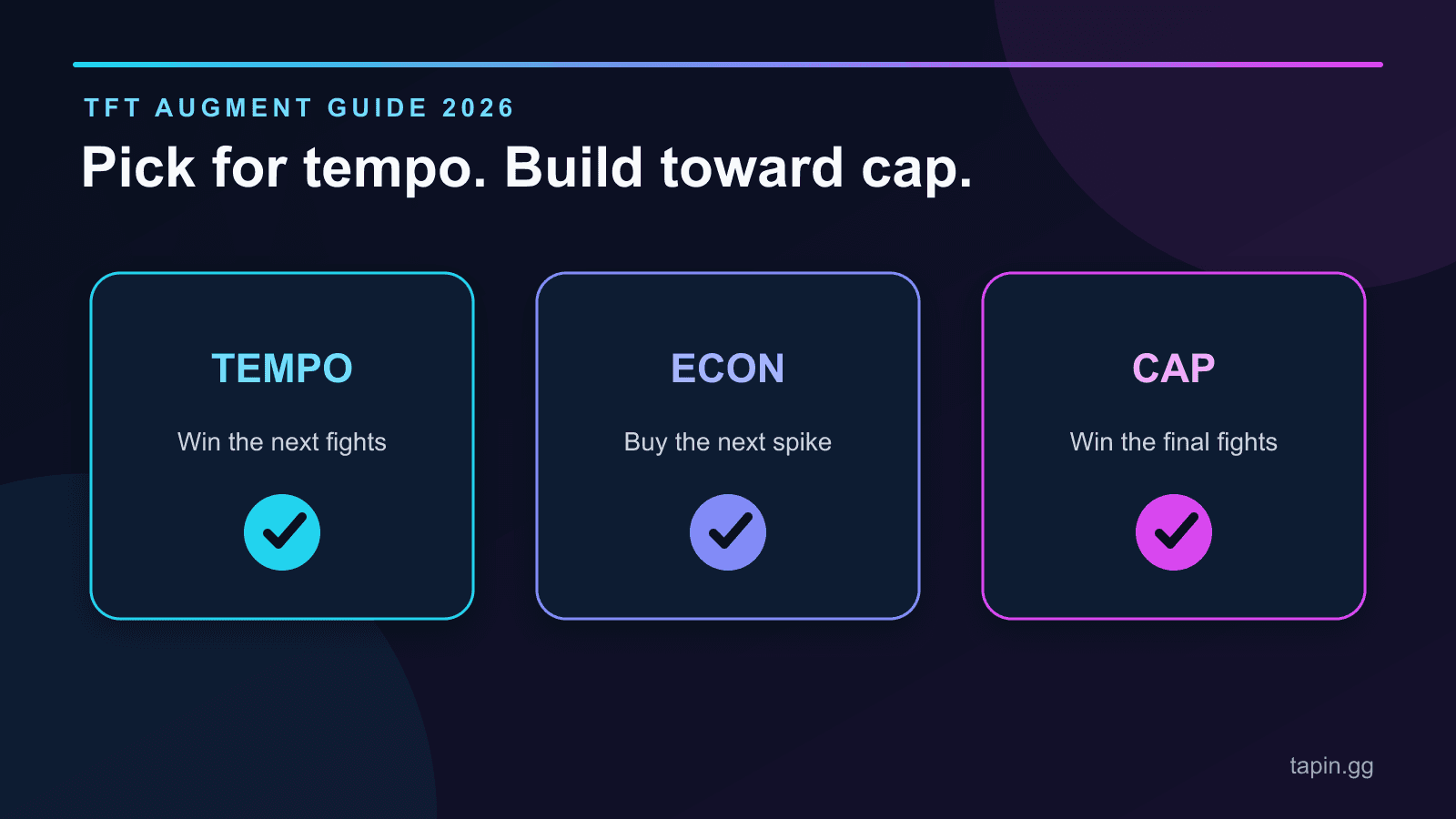
Tempo is strength you can use in the next few fights. Cap is the strongest realistic final board your spot can reach.
You need both, just not in equal amounts every round. High health, a winning board, and clean economy let you spend some tempo on cap. Low health, unupgraded frontline, and an aggressive lobby force you to buy the present.
Use this simple comparison:
| Your spot | Favor | Why |
| --- | --- | --- |
| Healthy and streaking | Cap or efficient scaling | You have time to collect the payoff |
| Healthy but losing narrowly | Targeted tempo | One upgrade may reverse several fights |
| Low HP and weak | Immediate combat | Future value is worthless after elimination |
| Rich with many pairs | Rolls, items, or combat | You already own resources; convert them |
| Stable but contested | Flexibility | A narrow line may collapse when shops miss |
Do not turn this into a rigid formula. Scout after the choice and before spending. The correct augment plus the wrong roll-down can still lose the game.
Our TFT leveling guide covers the second half of that decision: when the reward should become XP, rolls, or saved gold.
How to Use TFT Augment Stats Without Griefing Your Spot
Stats are best for three jobs: spotting obviously weak options, checking whether an augment changes by stage, and finding conditions you may have missed.
They are worse at telling you what to click in isolation. Average placement can hide selection bias. A trait augment may look incredible because players only take it from strong openings. A flexible augment may look merely average because almost everyone can click it, including players with terrible boards.
Use this order:
- Filter to the current patch and the correct augment stage.
- Compare the three options, not the entire pool.
- Identify the condition behind each result.
- Remove choices your board cannot use.
- Pick between the survivors using HP, tempo, and cap.
Patch recency matters. Riot adjusted both general and trait-specific augments in 18.4b, so old data can describe the wrong effect or power level. If a stat site and the client disagree, trust the live tooltip and current patch notes.
Review Four Games Instead of Memorizing 200 Augments
You do not need perfect recall. You need a feedback loop.
For four games, screenshot each augment screen and record four things: HP, gold, current board, and the choice you made. Before combat resumes, write one prediction: “This keeps my streak,” “This funds level 8,” or “This gives my final board enough frontline.”
After the game, do not grade the augment by placement alone. Check whether the promised value happened.
- Did the combat augment swing fights?
- Did the economy augment convert on the planned round?
- Did the direction augment improve the board, or trap it?
- Was the loss caused by the pick, the spending plan, or positioning?
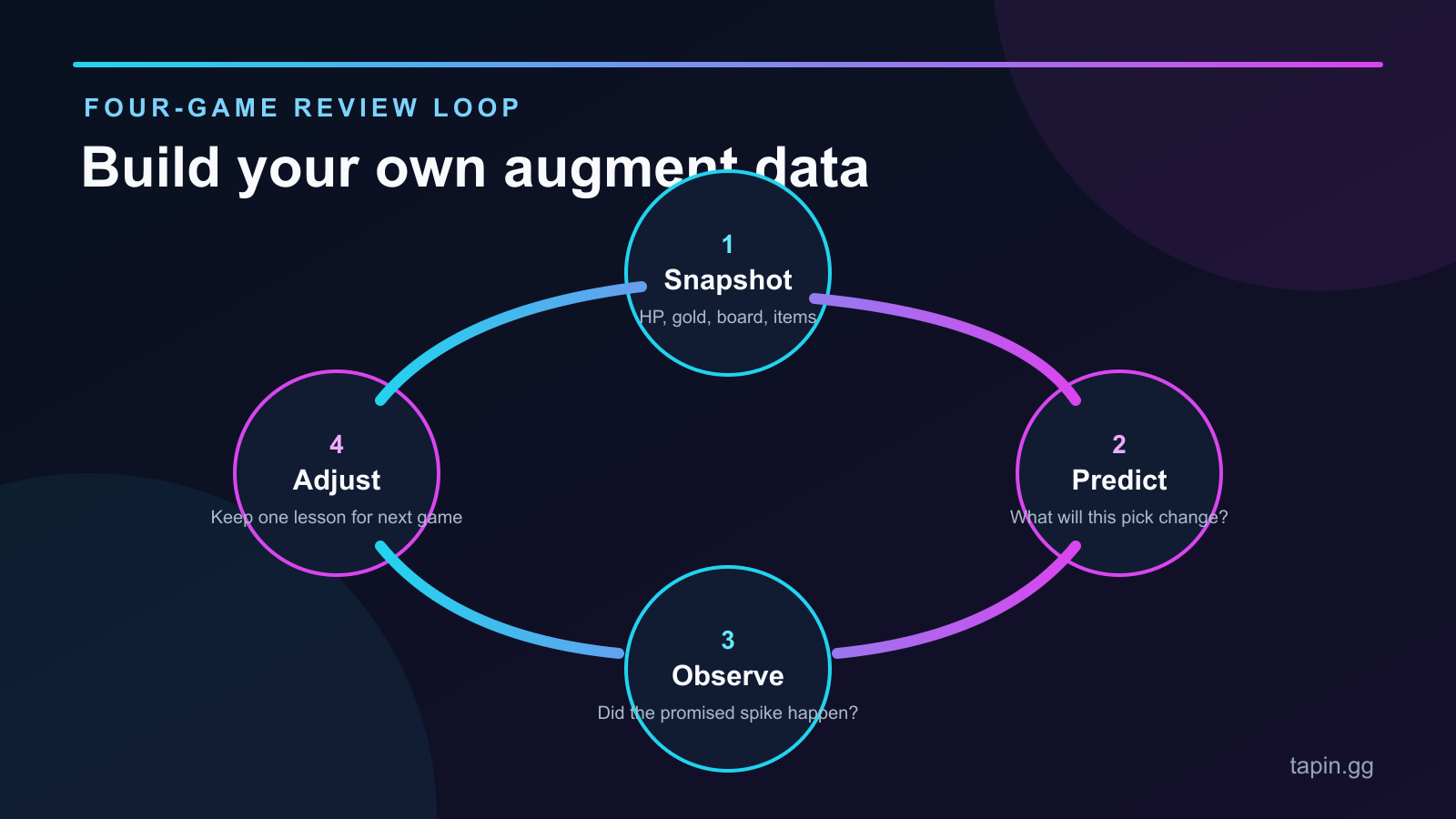
I believe one reviewed decision teaches more than ten games of copying a tier list. If you want another player to pause on those spots with you, find a TFT teammate or coach on Tapin and review the decision before the final placement rewrites the story.
TFT Augment Guide FAQ
What is the best TFT augment?
There is no universal best augment. The strongest pick is the one your current board can use, on the current patch, without asking for an unrealistic chain of shops, items, or extra time.
Should I always take a combat augment at 4-2?
No. Combat power becomes more valuable late, but an economy or item augment can be correct when it converts immediately into upgrades. Avoid rewards with no clear spending window.
How many economy augments should I take?
Do not use a fixed quota. Take economy when you can explain how and when it becomes board strength. Multiple resource augments can work from a stable spot; even one can be too greedy when you are low HP and losing badly.
Should I force a composition after taking a trait augment?
Only when your units, items, health, and lobby support the line. The augment is one input, not permission to ignore a contested carry or an unplayable item setup.
When should I check TFT augment stats?
Check after reading your board, not before. Filter for the current patch and the correct stage, then use the numbers to compare viable choices rather than to replace the decision.
Make Every Augment Promise Something Concrete
A good augment pick should finish one sentence: “This choice helps my board by…” If the ending is vague, keep reading the spot.
Pick for tempo when the lobby can punish you now. Invest when your health and board buy time. Build toward a cap you can actually reach—and your augment screens stop feeling random.