

Last Updated: October 2026
A tier-list screenshot tells you where eight units end up. It does not tell you what to do when the shop misses, two opponents contest your carry, or your components point toward a different damage type.
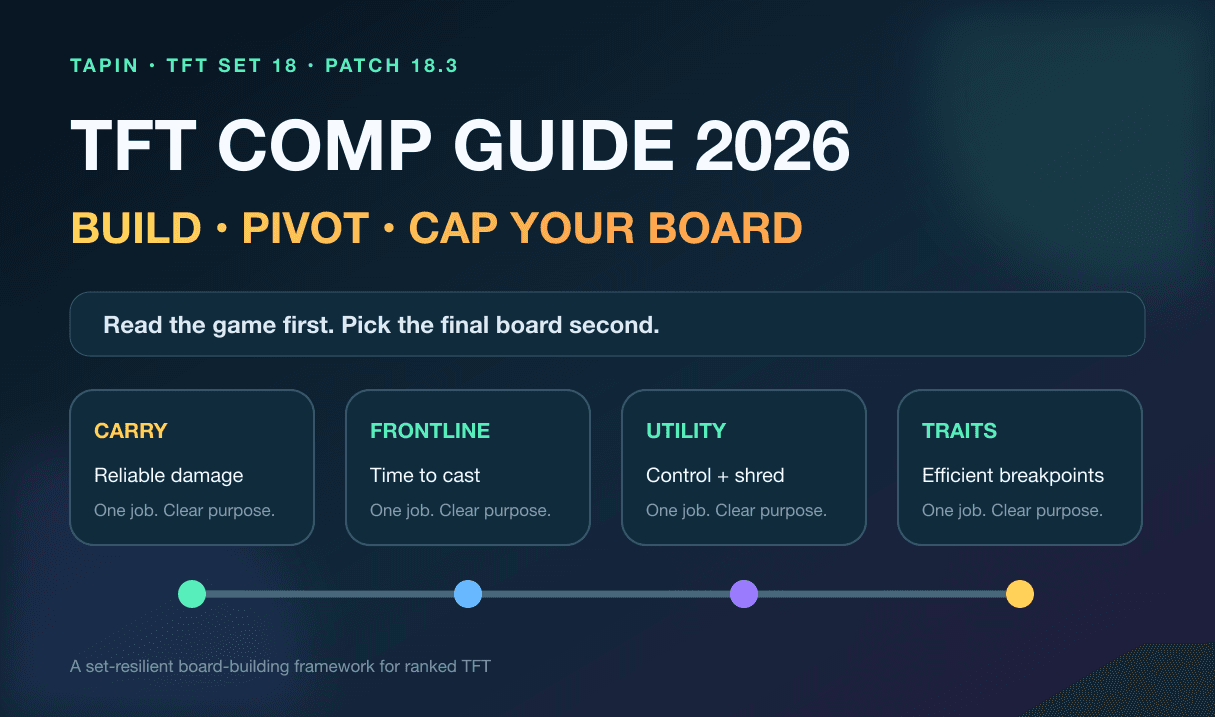
This TFT beginner comps guide fixes that gap. You will learn three line families—reroll, tempo flex, and Fast 8—plus the signals that make each line playable and two realistic exits when the original plan stops making sense.
Quick answer: Start with a reroll line when you naturally hit several copies of a low-cost carry. Play tempo flex when your upgraded units and completed items can preserve health without a final comp. Choose Fast 8 when your board is stable enough to buy levels and reach four-cost carries. Never commit from one unit alone.
Table of Contents
- What makes a comp beginner-friendly?
- Three flexible lines to learn
- Build a carry and frontline shell
- Read four commitment signals
- Plan two pivots
- Practice across five games
- FAQ
What Makes TFT Beginner Comps Easy to Play?
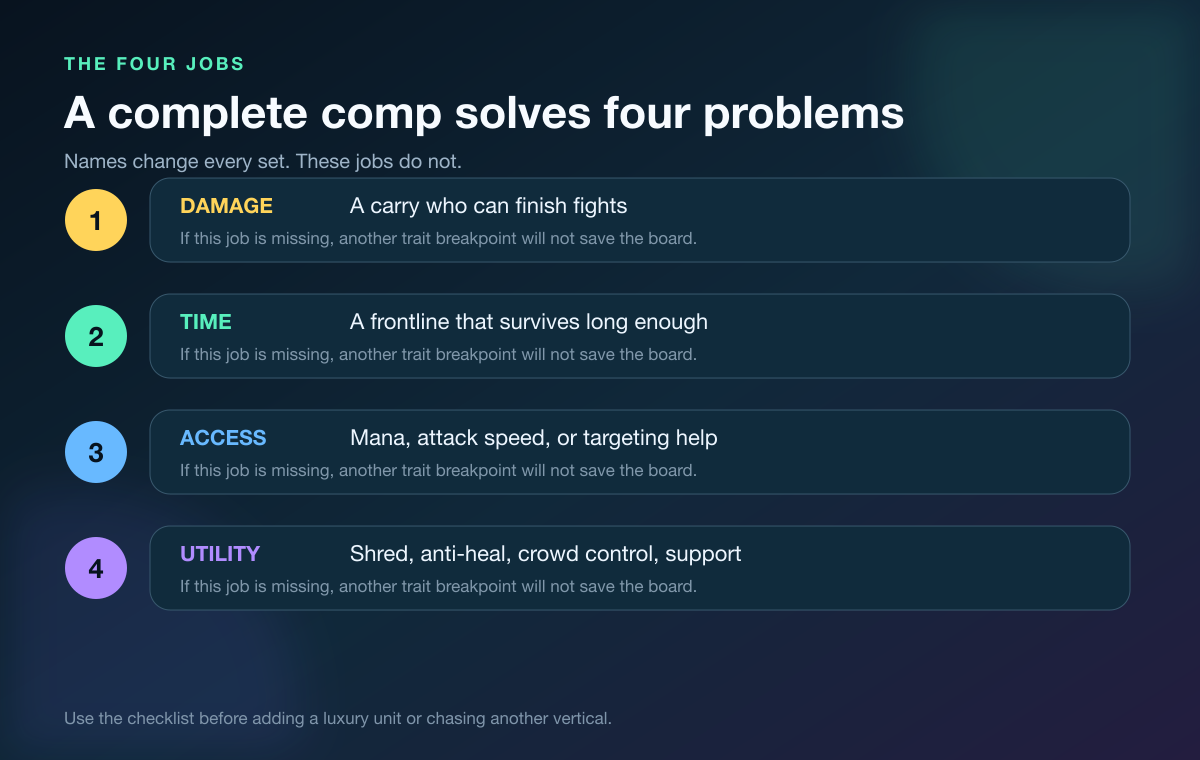
An easy comp is not the board with the fewest traits. It is a line with clear item holders, a visible roll timing, and more than one acceptable carry or frontline option.
Use this test before calling a line beginner-friendly:
- One carry job: You know which unit deals the reliable damage.
- One tank job: You know which upgraded unit buys time.
- A simple spend rule: The line tells you whether to reroll at a lower level, play for tempo, or save toward Level 8.
- Two exits: At least two other carries can use the same item family if the first one is contested or never appears.
- Few mandatory conditions: The line does not need a specific emblem, rare Augment, or exact opener to function.
That final point matters on the live patch. TFT is currently on Set 18: Enchanted Wilds, Patch 18.4b. Riot's official Patch 18.4 notes{:target="_blank"} describe a large balance pass that moved power between traits and units, with extra buffs for multiple one- and two-cost champions.
Patch 18.5 is scheduled for October 21{:target="_blank"}. The names at the top of a tier list may move tomorrow. The line families below still tell you how to use whatever the next shop gives you.
If you are still learning the screen, economy, and basic combat loop, start with our TFT beginner guide before adding pivot rules.
Three TFT Comps for Beginners to Practice
Do not try to learn every current board. Learn these three ways to reach one.
| Line family | Play it when | Your first commitment |
| --- | --- | --- |
| Reroll | Natural pairs, correct components, low contest | Hold copies and roll at the carry's best level |
| Tempo flex | Early two-stars and usable completed items | Play the strongest board; delay the final carry |
| Fast 8 | Healthy board, strong economy, flexible items | Save and level toward four-cost carry options |
1. Reroll: turn natural copies into a three-star carry
A reroll line stays at a level with strong odds for its key unit and spends gold finding copies. It is the cleanest line to understand because the goal is visible: upgrade the carry and main tank before leveling again.
On Patch 18.4b, the live PivotTFT comp list{:target="_blank"} labels Riftbeast Reroll as an easy Level 5 line. That makes it a useful current example, not an order to force it every game.
Play a reroll line when you already have several useful copies, the components fit the carry, and scouting shows the units are reasonably open. Leave when two opponents have more copies, your items fit another damage profile, or rolling would destroy your economy before the board can stabilize.
Beginner rule: Do not reroll because the guide says “reroll.” Reroll because several hits improve the board at the level you are buying shops.
2. Tempo flex: keep winning while the final comp stays open
Tempo flex is a bridge, not an eight-unit destination. You field upgraded units, make flexible items, and preserve health while the lobby reveals the better endgame line.
This is the best practice line when the opening shops give you mixed traits but strong two-stars. Pick one temporary AD holder or AP holder, one upgraded tank, and enough utility to help them. Replace one job at a time as stronger units arrive.
I believe beginners improve faster here than by hard-forcing a single screenshot. Every round teaches a real question: “What makes my board stronger now without deleting my options later?”
If you want someone to pause on those choices instead of feeding you every answer, find a no-stress gaming partner on Tapin. The useful part is hearing why a shop is strong, then making the next decision yourself.
3. Fast 8: save health first, then buy access to four-cost carries
Fast 8 uses a stable midgame to reach Level 8 with enough gold left to upgrade a more expensive carry and frontline. Beginners often copy the final board but skip the condition that makes it possible: you cannot greed levels while losing huge chunks of health.
PivotTFT currently marks Elderwood Aphelios as an easy Level 8 line. Use that as a model for the structure: an AD carry, a real frontline, and connecting units that can hold the board before the final upgrades appear.
Choose Fast 8 when your current board wins or loses narrowly, your items can move between multiple four-cost carries, and leveling will not leave you broke. If the board is collapsing, stabilize first. Level 8 with no health and no roll money is not a strategy.
Build Easy TFT Comps Around Two Jobs
Every beginner line starts with two workers: a damage carry and a main tank. Traits, support units, and utility matter after those jobs function.
For the carry, ask:
- Does this unit use every stat on the completed items?
- Can it deal damage before the frontline disappears?
- Is there another unit that can inherit the same items later?
For the tank, ask:
- Is it upgraded now, not just perfect on a future board?
- Does it take first contact and cast before dying?
- Can the frontline shell survive if the backline changes?
The TFT item guide explains when to slam, save, or transfer components. For this exercise, use item families: physical damage, spell damage, frontline, and utility. A flexible completed item that saves health now is worth more than a perfect recipe that stays on the bench for six rounds.
Do not spread power evenly. Three half-itemized damage dealers give you no reliable read on why a fight failed. Concentrate damage on one holder and defense on one tank, then watch those two jobs.
Use Four Signals Before You Commit
Commit when items, upgrades, Augments, and the lobby mostly agree. One signal is a clue. Three signals are a plan.
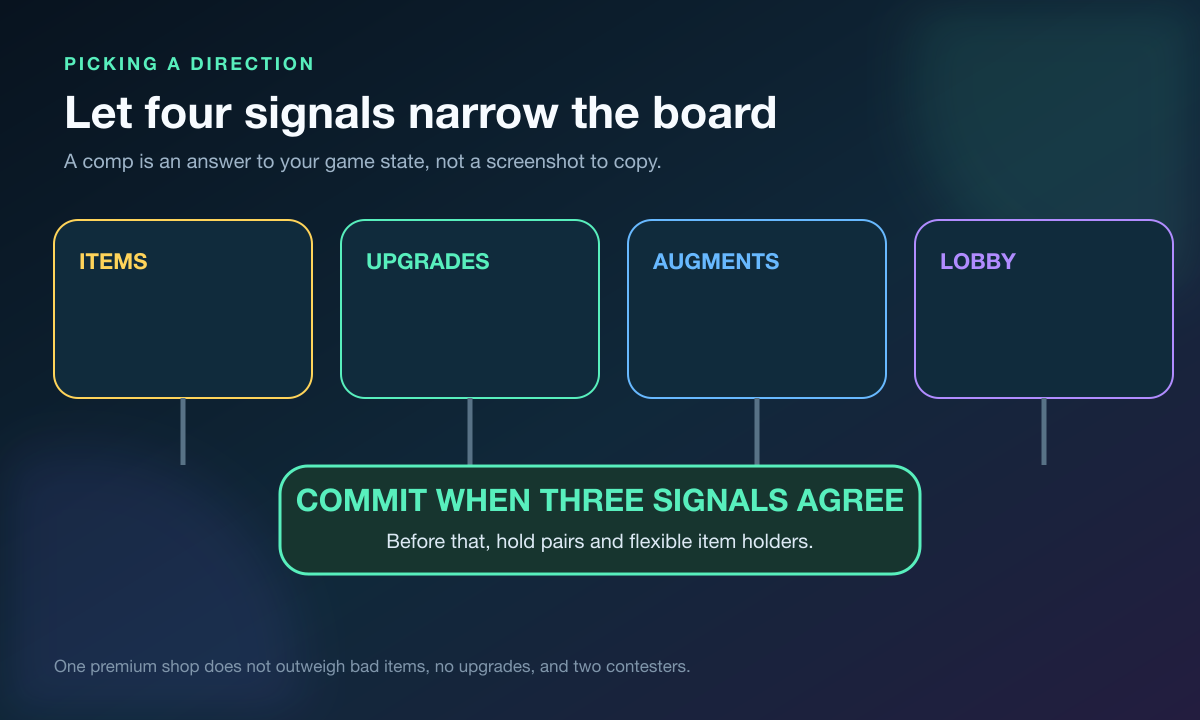
Items set the damage family
Several attack-damage and attack-speed components suggest an AD holder. Ability-power and mana components suggest a caster. Defensive items tell you which frontline can remain useful across multiple lines.
Upgrades set the current tempo
Pairs and two-stars show what the shop is offering now. An upgraded temporary holder can carry items for several stages even when it never appears on the final board.
Augments change the price of a line
A generic combat or economy Augment keeps options open. A trait-specific Augment narrows them, but it still needs compatible items and units. An emblem is not permission to ignore the rest of the board.
The lobby tells you whether the units are affordable
Scout for the carry, tank, and lower-cost support units—not only the finished trait. One opponent on your line is manageable. Two stronger players holding the same copies can turn a cheap reroll plan into an expensive miss.
The broader TFT comp guide covers how those signals connect to strongest board, stabilization, and capping. Here, keep the commitment rule simple: do not sell your current strength until the replacement is ready.
How to Pivot TFT Comps Without Selling Everything
A safe pivot preserves at least two of three layers: items, frontline, and traits.
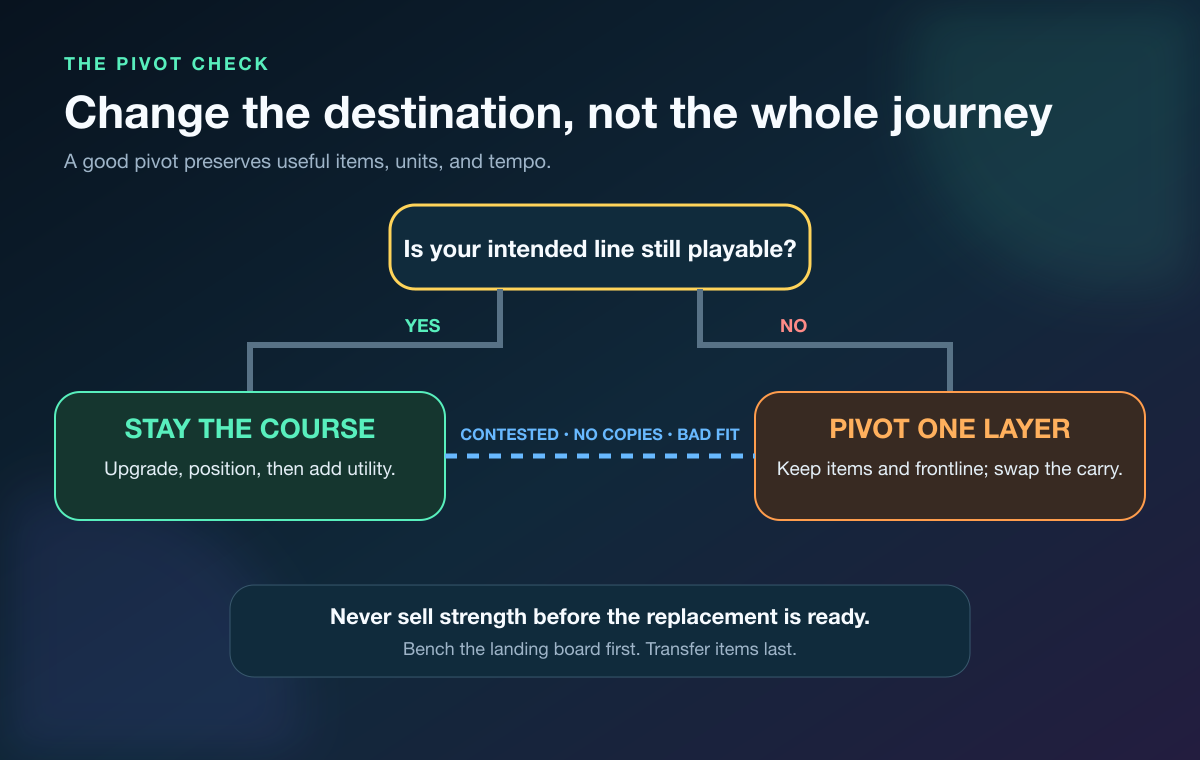
Plan two exits before the roll-down:
- Same items, new carry. Keep the frontline and move the damage package to another AD or AP unit.
- Same carry, new frontline. Preserve the backline while replacing contested or weak tanks with upgraded units that buy the same amount of time.
Buy the landing board before selling the takeoff board. That means holding the replacement carry, a connecting unit, and enough frontline to survive the next fight. Selling five upgraded units and hoping the next shop completes the new comp is not flexibility. It is a gamble with your remaining health.
Watch out: One premium unit does not justify a full pivot. Check whether its items, frontline, and supporting slots already exist—or can exist after one affordable roll-down.
A Five-Game Practice Plan for Flexible TFT Comps
Give each game one learning target. Placement is secondary.
- Game 1 — Reroll discipline: Play reroll only if you have natural copies and correct components. If the condition fails, practice leaving the line.
- Game 2 — Temporary holders: Choose one carry holder and one tank holder. Transfer their items only when the replacements are ready.
- Game 3 — Fast 8 condition: Decide before Stage 4 whether the board is stable enough to level. Write down the health, gold, and upgrades behind the decision.
- Game 4 — Two exits: Name two carries that can use your damage items before the main roll-down.
- Game 5 — One-layer pivot: Change either the carry or frontline while preserving the other two layers.
After each game, review the first round where three signals agreed. Did you commit before that moment, after it, or never? That single checkpoint teaches more than staring at the final placement.
TFT Beginner Comps FAQ
What is the easiest TFT comp for beginners?
The easiest comp is one supported by your current shops, items, and lobby—not a permanent name. On Patch 18.4b, Riftbeast Reroll and Elderwood Aphelios are current examples labeled easy by PivotTFT, but both still need the right opening conditions.
Should beginners force one TFT comp?
Force one line for a few normal games if you are learning its holders, roll level, and positioning. Then add two compatible pivots so the lesson becomes transferable instead of depending on exact shops.
When should I pivot in TFT?
Pivot when the carry is heavily contested, your components fit another line better, or the current board needs too many exact hits to stabilize. Preserve items or frontline so the change does not delete every upgrade you already paid for.
Is reroll or Fast 8 easier for beginners?
Reroll has a clearer spend rule, but it fails when the units are contested or never appear. Fast 8 offers more carry options, but it requires health and economy discipline. Practice both so the opener can choose for you.
How many TFT comps should a beginner learn?
Learn three line families before memorizing more final boards: one reroll route, one flexible tempo shell, and one Fast 8 route. For each, know a primary carry, a tank, and two item-compatible exits.
Beginner comps should reduce decisions without turning your game into autopilot. Build one carry and one tank, wait for three signals, and keep two exits ready before you spend.
Do that across five focused games. The shop stops feeling like a test you failed—and starts becoming information you can use.