

Last Updated: October 2026
You copy an eight-unit board from a tier list, hit every trait, and still lose to someone playing “random” upgraded units. That loss feels fake. It usually is not.
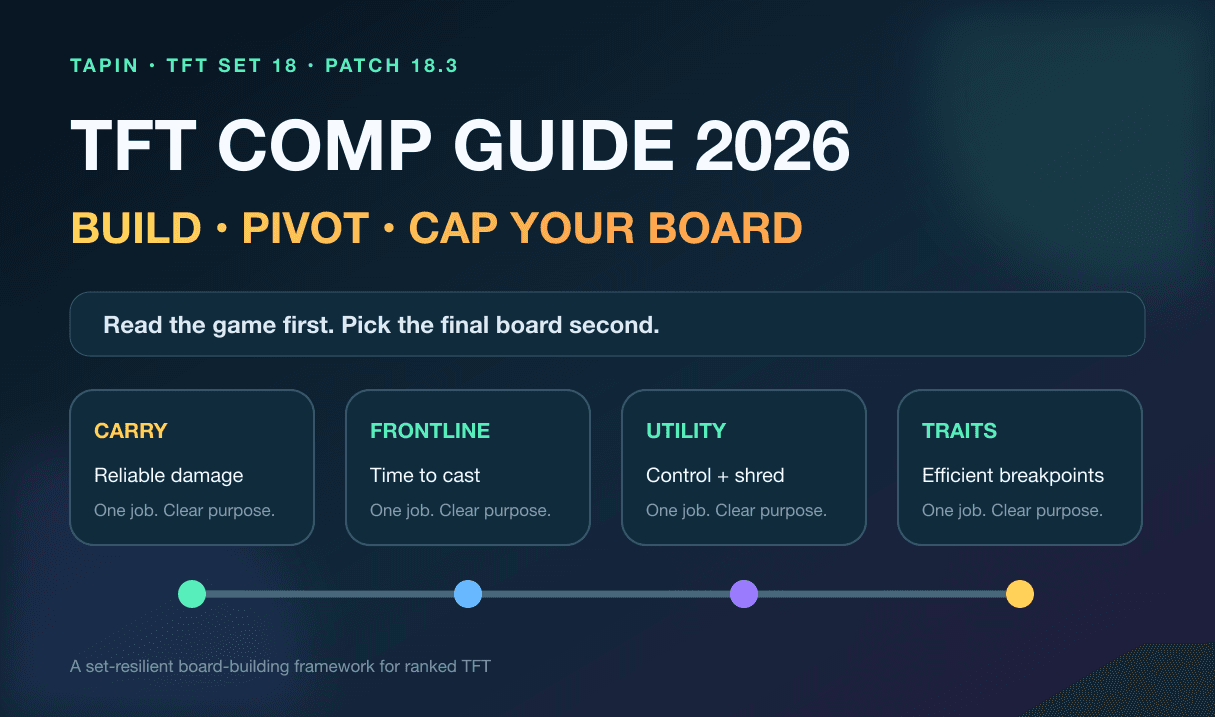
This TFT comp guide teaches the part a screenshot cannot: how to build a board from your items, shops, Augments, health, and lobby. The goal is not to memorize one Set 18 comp. It is to know why a board works, when to pivot, and how to cap it without throwing away the strength you already bought.
Quick answer: A functional TFT comp needs reliable damage, enough frontline to buy time, useful trait breakpoints, and utility that helps the first two jobs. Choose a direction when your items, upgrades, Augments, and lobby point the same way. Pivot one layer at a time, then cap the board by replacing weak links instead of chasing more traits.
Table of Contents
- Understand the four jobs
- Play your strongest board
- Choose a comp direction
- Build around items and holders
- Pivot without selling your board
- Stabilize and cap
- Review your decisions
- FAQ
TFT Comp Guide: Start With Four Jobs
A comp is not eight champions with matching trait text. It is a small system where every slot helps the board deal damage, stay alive, or make those two jobs easier.
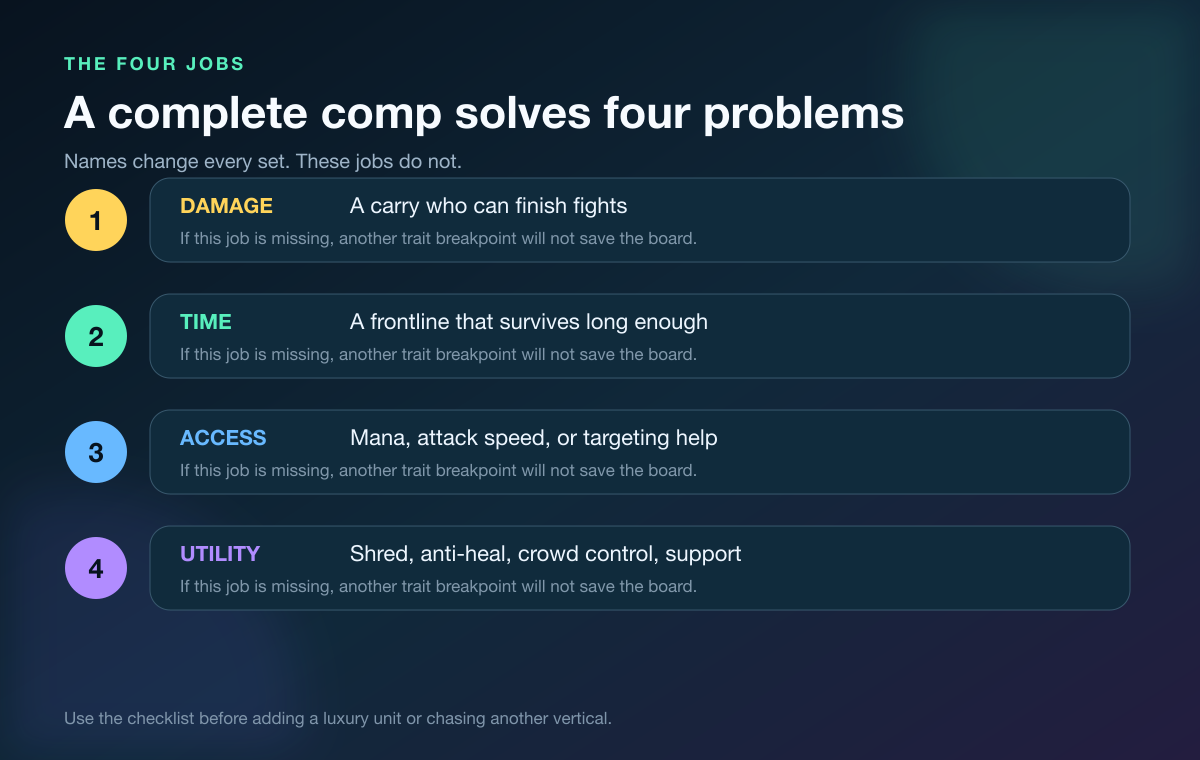
Use four jobs to test any board:
- Damage: One primary carry has the items and access to finish fights.
- Time: A real frontline keeps enemies away from that carry long enough to cast or attack.
- Access: Mana, attack speed, targeting, range, or movement lets damage reach the right place.
- Utility: Crowd control, healing reduction, resistance shred, support effects, and a secondary threat fix specific matchups.
Traits matter, but only when they improve one of those jobs. Adding a trait bot for a tiny breakpoint can make the board worse if the unit contributes no damage, tankiness, or utility.
I believe this is the cleanest way to escape tier-list dependency. When a patch moves numbers around, the champion names change. The jobs do not.
Set 18 proves the point. Riot's live Patch 18.3 notes{:target="_blank"} changed trait ceilings, reroll lines, combat Augments, and multiple units. A copied board can go stale overnight; a job-based board check survives the patch.
How to Build Your Strongest Board
Your strongest board is the formation most likely to win the next fight without wrecking the plan for later. It is not always the board with the most traits, the highest-cost shop, or the units shown in your final comp.
Start with upgrades. A two-star unit with a useful item usually earns its slot over a one-star “perfect” synergy piece. Then check whether the frontline and damage are balanced. Four fragile damage dealers do not matter if the first enemy cast reaches them.
Before every PvP round, run this 20-second check:
- Carry: Who holds the damage items right now?
- Tank: Which upgraded unit holds the defensive items?
- Front-to-back: Does the frontline survive long enough for the carry to work?
- Trait value: Which active breakpoint changes the fight, and which is just glowing text?
- Bench value: Are you holding pairs that can improve this board within one or two shops?
- Opponent: Can one positioning swap avoid the biggest threat?
The early board should use temporary item holders. Give an AD item to the upgraded unit already attacking well; give AP or mana to the caster who actually gets a second cast. You can move those items later when the destination carry appears.
Do not weaken the present for a future board that is not ready. Selling two upgraded units because one four-cost entered your shop is not a pivot. It is donating HP for a promise.
Choose Your TFT Comp From Four Signals
The game gives you direction through items, upgrades, Augments, and the lobby. Commit when at least three agree. Until then, stay flexible and preserve useful pairs.
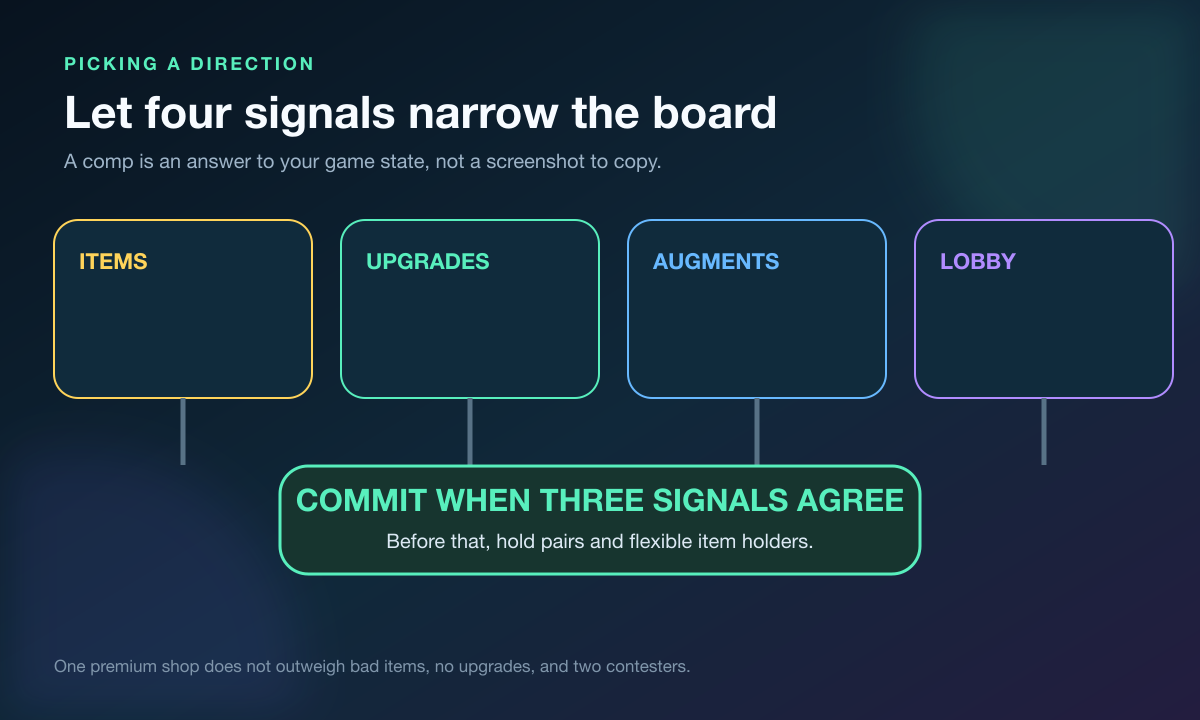
1. Items define the damage profile
Components are harder to replace than most units. Attack-damage and attack-speed pieces point toward physical carries. Ability-power and mana pieces point toward casters. Defensive components tell you which frontline can stay relevant.
One awkward component should not decide the whole game. Look at the package. If five components support one damage profile and a sixth does not, build around the five and turn the leftover into utility.
2. Upgrades define your tempo
Pairs and two-stars tell you what the shop is offering now. An upgraded opener can carry items even when it never appears on the final board.
This signal matters most when health is under pressure. A theoretical late-game comp cannot help if you refuse three available upgrades and lose by seven units.
3. Augments narrow or widen the line
A trait-specific Augment can make the direction obvious. A generic combat or economy Augment keeps more doors open.
Do not force a comp just because an Augment mentions it. Check whether the items and shops can support the same plan. An emblem with no carry, frontline, or upgrades is a clue—not a complete board.
4. The lobby sets the price
Scout for players holding the same carry, frontline, and key lower-cost units. Being contested does not make a line impossible, but it raises the gold and time needed to finish it.
If two players already have stronger versions of your intended board, ask what you can preserve. Often the answer is the item profile and frontline shell. Change the carry line, not all eight units.
Build Around Items, Not a Final Screenshot
A useful comp sheet should answer three questions: Who carries now? Who carries later? Which units connect those two boards? If it only shows the final formation, it skipped the hard part.
Think in item families instead of perfect builds:
| Item family | What the board needs | Flexible holder test |
|---|---|---|
| Physical damage | AD, attack speed, crit, or range | Can this unit attack safely and use every stat? |
| Spell damage | AP, mana, or cast frequency | Does this unit cast early enough to save HP? |
| Frontline | Health, armor, resistance, or sustain | Is this unit upgraded and taking first contact? |
| Utility | Shred, anti-heal, support, or control | Does the effect reach the targets that matter? |
The TFT item guide goes deeper on when to slam, save, or transfer components. The comp-building rule is simpler: completed flexible items should protect health now while keeping at least two late-game carries available.
Set mechanics can change the budget. Riot's Enchanted Wilds overview{:target="_blank"} says Wisps appear in every other shop and can offer combat power, gold, XP, items, or shop effects. That means a Set 18 roll-down is not only about units. Leave room to buy a Wisp that solves the current fight or improves the next shop.
If these decisions keep collapsing during a fast roll-down, review a game with a TFT coach on Tapin. A second set of eyes can stop on the exact shop where your items, board, and lobby stopped agreeing.
TFT Pivot Guide: Change One Layer at a Time
A pivot is not selling the board and buying a new one in 25 seconds. A clean pivot changes the destination while preserving as much paid strength as possible.
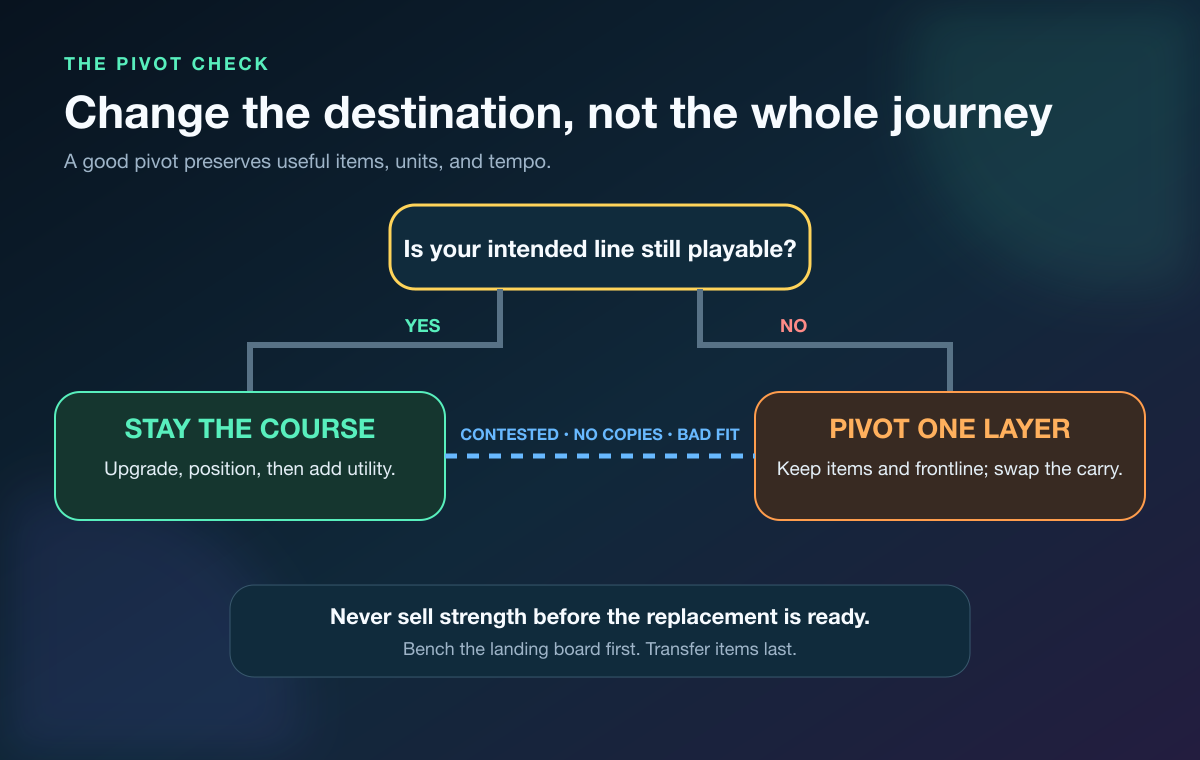
Pivot when the evidence becomes stronger than the sunk cost:
- Your intended carry is heavily contested and you have few copies.
- The components no longer fit the line after later drops.
- A different carry appears upgraded and uses the same items.
- Your current board cannot stabilize without several exact hits.
- A new Augment or set mechanic creates a better route with pieces you already own.
Use the one-layer rule. Keep two of these three layers whenever possible:
- Items — move the same damage package to a compatible carry.
- Frontline — retain upgraded tanks while the backline changes.
- Traits — keep the useful shell and swap one carry branch.
Bench the landing board before selling the takeoff board. Buy the replacement carry, supporting pair, and connecting unit first. Transfer items only when the new formation can survive the next fight.
Watch out: A pivot made only because you saw one premium unit is usually a bait. One copy is not a board. Check items, upgrades, and the remaining unit pool before you move.
The TFT leveling guide helps choose the shop odds and timing for the units you are targeting. Leveling and pivoting are linked: the right destination at the wrong level can still empty your bank.
Stabilize First, Then Cap Your Board
Stabilizing means the board can survive the current lobby without losing huge chunks of HP. It does not mean every unit is final or every item is perfect.
Set a concrete stop condition before rolling: two-star the main tank, find one usable carry, activate the core breakpoint, or reduce losses to one or two units. Stop when the board does its job. Rebuilding the bank gives you another decision later.
Once stable, cap the board by removing waste:
- Upgrade the workers. Two-star the carry, main tank, and utility units that decide fights.
- Replace trait bots. Trade a low-impact unit for stronger crowd control, support, or a better frontline body.
- Add a second threat. Split damage when one carry can be disabled, blocked, or targeted.
- Fix positioning. The TFT positioning guide covers scouting, late swaps, and protecting the real carry.
- Spend for the fight. At low health, a combat purchase that wins now matters more than a prettier economy screen.
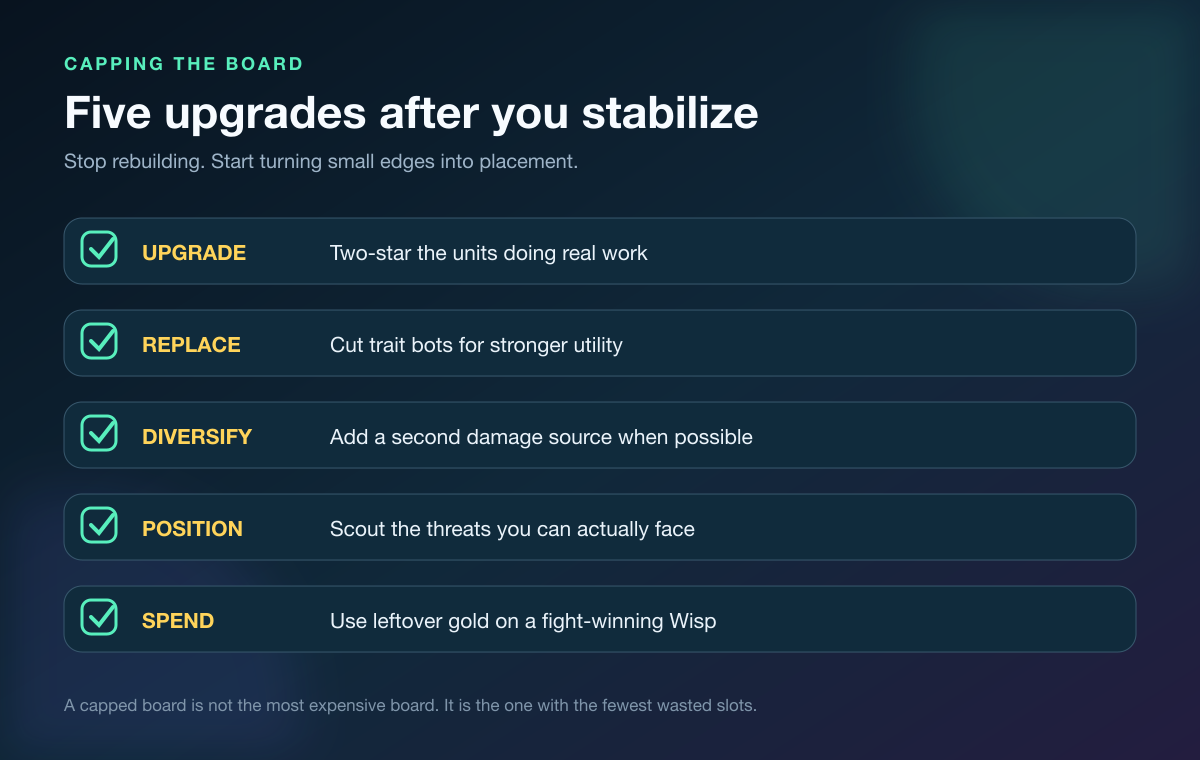
A capped board is not automatically the most expensive board. It is the one with the fewest dead slots. Every unit has a job, every item reaches a useful holder, and every trait breakpoint earns the space it costs.
Review the Decision Tree, Not the Placement
Finishing sixth does not prove the comp was wrong. Finishing second does not prove every decision was right.
Review three checkpoints after the game:
- Direction: When did items, upgrades, Augments, and the lobby first agree?
- Commitment: Did you lock the comp before or after that point?
- Conversion: Once stable, which unit or item slot added the least value?
Take one screenshot before the first major roll-down and one after it. Compare the four jobs. Did you add damage but lose all frontline? Did the trait count rise while board quality fell? Did you keep rolling after the stop condition was already met?
That review builds a reusable skill. Memorizing a comp wins while the numbers stay friendly. Understanding the decision tree keeps working when the patch changes them.
TFT Comp Guide FAQ
How do you build a good TFT comp?
Start with one reliable damage carry and one upgraded frontline, then add traits and utility that help them work. Use items, current upgrades, Augments, and lobby contesting to choose the final direction.
When should you commit to a TFT comp?
Commit when at least three signals agree: your items fit the carry, your shops provide upgrades, your Augments support the line, and the important units are reasonably open. Before that point, keep flexible holders and useful pairs.
When should you pivot in TFT?
Pivot when the intended line is too contested, your items fit another carry better, or the board needs too many exact hits to stabilize. Preserve the item package or frontline shell so the pivot changes one layer instead of deleting all your tempo.
What does it mean to cap a TFT board?
Capping means turning a stable board into its strongest realistic version. Upgrade the key units, replace low-impact trait bots, add utility or a second threat, improve positioning, and spend remaining resources before HP runs out.
Is it better to force one comp or play flexibly?
Forcing one line can teach its roll timing, holders, and positioning. Flexible play has a higher ceiling because it responds to the actual game, but it requires a small pool of compatible carry lines rather than trying to know every comp at once.
A strong TFT comp is built, not copied. Solve damage and frontline first, let the game narrow your direction, and pivot without selling strength before the replacement is ready.
Once the board stabilizes, stop chasing a perfect screenshot. Upgrade the units doing real work, cut wasted slots, and make the next fight easier than the last.