


Last Updated: July 2026
TFT Double Up is what happens when an already stressful roll-down becomes a two-person group project. You and your partner run separate boards, but your health, placement, gifts, and late-game survival are tied together. One greedy loss can sink both of you. One clean reinforcement can save the entire game.
This TFT Double Up guide covers the current mode in Set 17: Space Gods on Patch 17.7: shared-health decisions, the Teamwork Cannon, Gift Armories, reinforcement timing, economy, and the comms that actually matter. The goal isn't to force two “perfect” comps. It's to make two flexible boards behave like one team.
Quick reference
- Lobby: four teams of two
- Boards: one per player
- Health: shared by both partners
- Win condition: finish as the last team standing
- Teamwork Cannon: sends units and trades equal-value basic or completed core items
- Gift Armory: free choices sent to your partner
- Reinforcement: win your fight, then surviving units can join your partner's battle
- Current live set: Set 17, Space Gods
- Current patch: 17.7
Table of contents
- How TFT Double Up works
- Build two boards with one plan
- Use the Teamwork Cannon well
- Manage shared health and economy
- Win with reinforcement timing
- Use comms that save HP
- Common Double Up mistakes
- TFT Double Up FAQ
How TFT Double Up works
Double Up uses four teams of two. Each player shops, levels, positions, and fights on their own board, but the team shares health and placement. Riot's current Double Up overview also confirms that the old last-chance 1 HP shield is gone—when the shared pool hits zero, you're out.
The mode has three systems standard TFT doesn't:
- The Teamwork Cannon lets you send champions after its cooldown and trade equal-value components or completed core items without a cooldown.
- Gift Armories give you free rewards chosen for your partner.
- Reinforcements send your surviving units to your partner's board after you win and a short delay passes.
That changes how you judge every decision. A board that wins slowly can be worse for the team than a slightly weaker board that clears fast. A component collecting dust on your bench might finish your partner's carry item. A three-star unit isn't worth chasing if both boards bleed out before you hit it.

⚡ Quick rule: Ask “does this save more team HP on my board or theirs?” before you send any unit, item, or gold-equivalent reward.
Build two boards with one plan
The strongest Double Up pair isn't necessarily two copies of the strongest ladder comp. Shared champion pools make that awkward fast. If both players need the same four-cost carry, frontline, and components, you're contesting each other before the other six players even matter.
Split your needs early:
- Different primary carries: one AD item holder and one AP item holder usually reduce component conflicts.
- Different reroll levels: avoid having both partners roll heavily at the same level unless the shops naturally support it.
- Complementary fight speeds: one board can be the fast clearer while the other builds a durable frontline that survives long enough for help.
- Flexible support units: hold useful pairs only when they improve a real line; don't clog both benches with “maybe” units.
Set 17 adds another layer through its God offerings and Boons. Riot's Space Gods overview makes it clear that those choices reward different plans—health management, economy, quests, positioning, or unit access. Tell your partner what your offering pushes you toward before either of you commits.
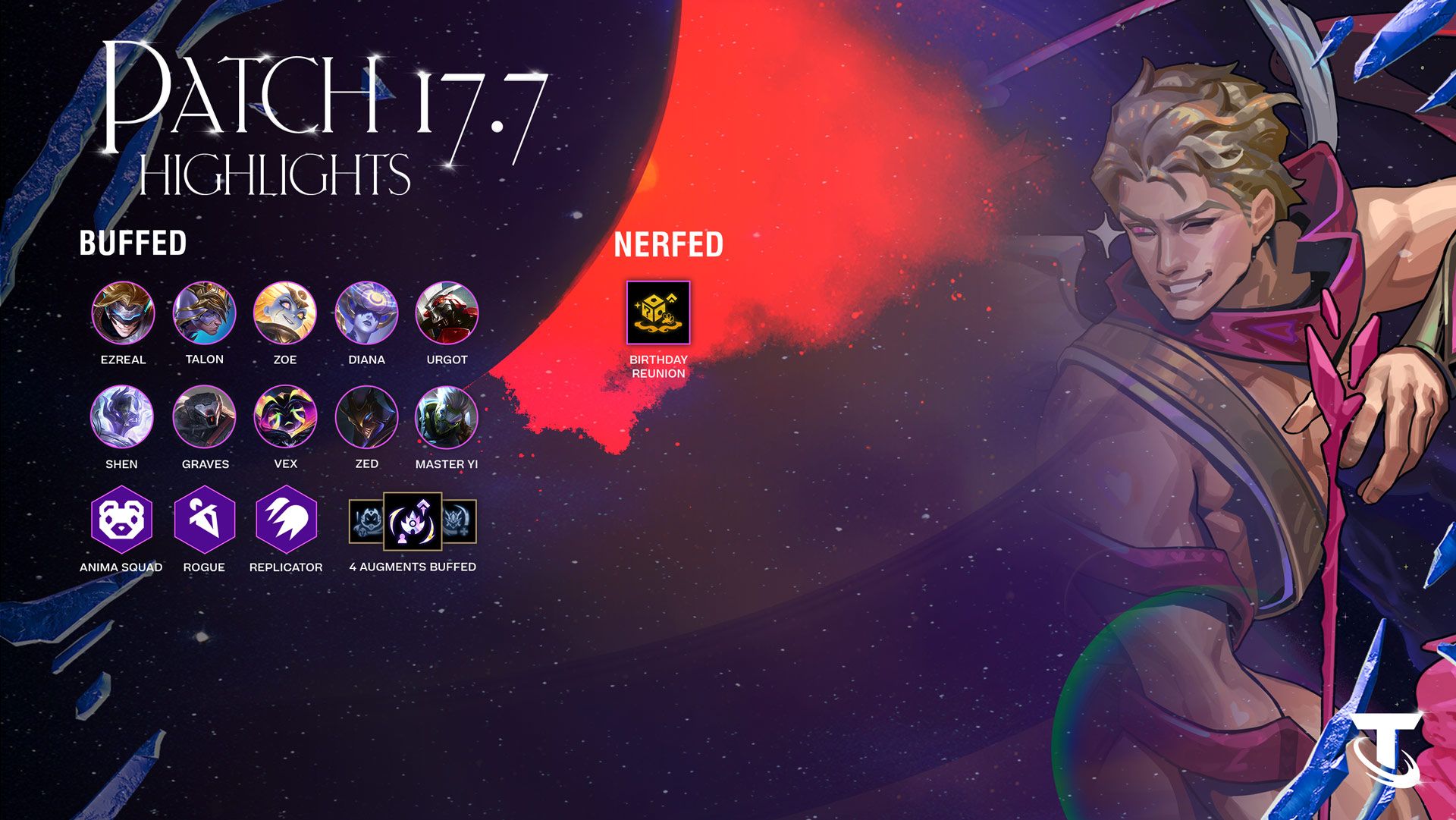
Patch 17.7 also adjusted traits and several units. Read the official 17.7 notes before copying a board from an older screenshot. The exact best line will move; scouting and splitting contested units won't.
If you want a current Set 17 starting point, our Freljord Invokers guide shows how to think through a full board. In Double Up, use that structure as one possible line—not a command for both partners to force it.
Use the Teamwork Cannon well
The Teamwork Cannon is your biggest shared resource. Riot replaced the old Rune of Allegiance with a permanent cannon that occupies a bench slot. It can send a champion of any cost when charged, while item trades are one-for-one and limited to equal-value basic items or completed core items.
That means the right send is often boring:
- Send the partner's final copy for a two-star carry before sending your speculative three-star piece.
- Trade a dead component for the exact equal-value component that completes a real item.
- Move a utility unit when it activates a breakpoint immediately.
- Keep a sent unit off your board plan; every temporary hold costs bench space and shop flexibility.
The cleanest habit is a cannon check after every PvP round: charge, target, reason. Say whether it's ready, what you're looking for, and why the send matters. “Cannon ready; hold one Zoe; it makes my two-star” is useful. “Send me stuff” is how eight gold of bench space disappears.
⚠️ Watch out: Don't send a unit just because the cannon is charged. A flexible late-game send can be more valuable than a low-impact early copy.
Manage shared health and economy
Shared health doesn't mean shared gold. You still control separate economies, which creates the mode's nastiest trap: both players protecting interest while both boards lose.
Use a simple stabilization rule:
- One board weak: the weak player spends enough to stop taking heavy losses; the strong player protects economy.
- Both boards weak: both spend. Saving 20 extra gold is useless if the shared pool disappears first.
- One board one upgrade away: funnel the relevant unit or item there, then let that board clear quickly and reinforce.
- Low shared health: value immediate board strength over distant cap.
You don't need identical level timings. One partner can reroll while the other pushes levels, as long as both understand who needs units, who needs time, and who is supposed to arrive as reinforcement.

This is where a consistent partner matters more than a perfect spreadsheet. If random teammates keep forcing incompatible lines or going silent during roll-downs, find a TFT teammate who can plan with you. A familiar voice who knows when you greed—and when you panic-roll—makes Double Up feel like a real duo mode instead of two solo games sharing a health bar.
If your weak spot is choosing when to stabilize rather than finding the right duo, our TFT coaching breakdown explains what live feedback can fix that a static comp sheet can't.
Win with reinforcement timing
Reinforcement rewards fast, clean wins. After you beat your opponent, surviving units can travel to your partner's fight after a short delay. They arrive with whatever health they had left, so a one-unit scrape isn't the same as a dominant clear.
Build around three questions:
- Who is expected to win first? Position that board for damage and target access.
- Can the other board survive long enough? Add frontline, crowd control, or safer carry positioning when the answer is no.
- What arrives alive? A durable frontline crossing over can matter more than a glass-cannon unit that dies before the portal opens.
Scout both opposing boards. Your own matchup might be easy while your partner is about to face a burst-heavy board. Swapping one unit or moving a carry can buy the seconds needed for reinforcement.
I believe this is the biggest difference between decent Double Up pairs and great ones: great pairs don't ask only, “Can I win?” They ask, “Can I win fast enough to matter?”
Use comms that save HP
Good Double Up comms are short and actionable. You don't need to narrate every shop.
Call these:
- Board strength: “I'm weak this round” or “I should clear fast.”
- Key pairs: “Hold one copy of X.”
- Component needs: “I can finish tank item with Belt.”
- Roll timing: “Rolling at 3-2; ping my units.”
- Opponent threat: “Their carry is right side; protect yours.”
- Reinforcement plan: “Stall—I should portal.”
Ping the unit or item after the call. During a 30-second planning phase, “Need this” plus a ping beats a speech.
Silence also has a cost. If your partner doesn't know you're rolling, they sell the copy you needed. If they don't know your board will lose fast, they position for damage instead of survival. Two five-second updates can save 15 shared HP.
Common Double Up mistakes
Both players force the same comp
You're sharing a champion pool. Agree on separate carries and backup lines before Stage 3 unless the shops give you an absurd reason not to.
Gifts are chosen without asking
The Gift Armory is free, but a useless reward still wastes team power. Ask what completes an item or fixes the board.
One player hoards all the help
Sending every premium unit to one capped board leaves the other unable to survive until reinforcements. Fix the losing board enough to buy time.
Both players greed at low health
There is no old 1 HP safety shield. When the shared pool is in lethal range, roll and level for now.
Nobody scouts the partner's matchup
Your board is only half the round. Check what your partner faces, then decide whether you need to clear faster or help them stall.
TFT Double Up FAQ
Can you queue TFT Double Up solo?
Yes. You can enter without a premade partner, but the mode gets much easier when both players communicate about items, units, economy, and reinforcement timing.
Does TFT Double Up use shared health?
Yes. Both partners draw from one team health pool. Riot removed the old last-chance 1 HP shield when Double Up graduated from the Workshop, so lethal damage now ends the team's game directly.
How does the Teamwork Cannon work?
The cannon sends champions after a cooldown and trades eligible basic or completed core items at equal value without that unit-send cooldown. It takes a dedicated bench slot, so plan your holds.
What should two partners play in Double Up?
Play lines with different primary carries and limited unit overlap. One fast-clearing board plus one durable board is often easier to coordinate than two greedy boards competing for the same four-costs.
Is TFT Double Up ranked?
Yes, Double Up supports ranked play and has its own social-first rules. Riot allows broad rank mixing, while full eight-player custom parties do not change LP or MMR.
Make the two boards work together
TFT Double Up isn't standard TFT with a passenger. Split your unit needs, talk before gifts, spend when shared health demands it, and build one board to survive while the other clears.
Then run it back with the same person. The more your partner understands your tempo, greed, and roll habits, the fewer words you need—and the more often those reinforcements arrive exactly on time.