

Last Updated: September 2026
You can hit 50 gold on schedule and still finish eighth. The bank balance looks clean, but the board is one-star, the streak is gone, and 28 HP has turned every future decision into a panic button.
This TFT economy guide fixes that problem. It covers the exact interest and streak rules, then gives you a stage-by-stage way to choose between saving, leveling, and rolling in Set 18: Enchanted Wilds on Patch 18.1.
Quick answer: Save when your board is stable and the next breakpoint builds toward a real spike. Spend when leveling adds immediate strength, rolling can complete several upgrades, or another heavy loss costs more than the interest you protect. Gold is a tool. HP gives it a deadline.
Table of Contents
- Learn the income math
- Use interest breakpoints correctly
- Protect win and loss streaks
- Follow a stage-by-stage plan
- Know when to roll
- Budget for Set 18 Wisps
- Review economy mistakes
- FAQ
TFT Economy Guide: Learn the Income Math
Standard TFT income has four reliable pieces: base income, interest, the one-gold win payout, and streak gold. Loot, Augments, encounters, and Set 18 Wisps can add more, but you should understand the guaranteed engine first.
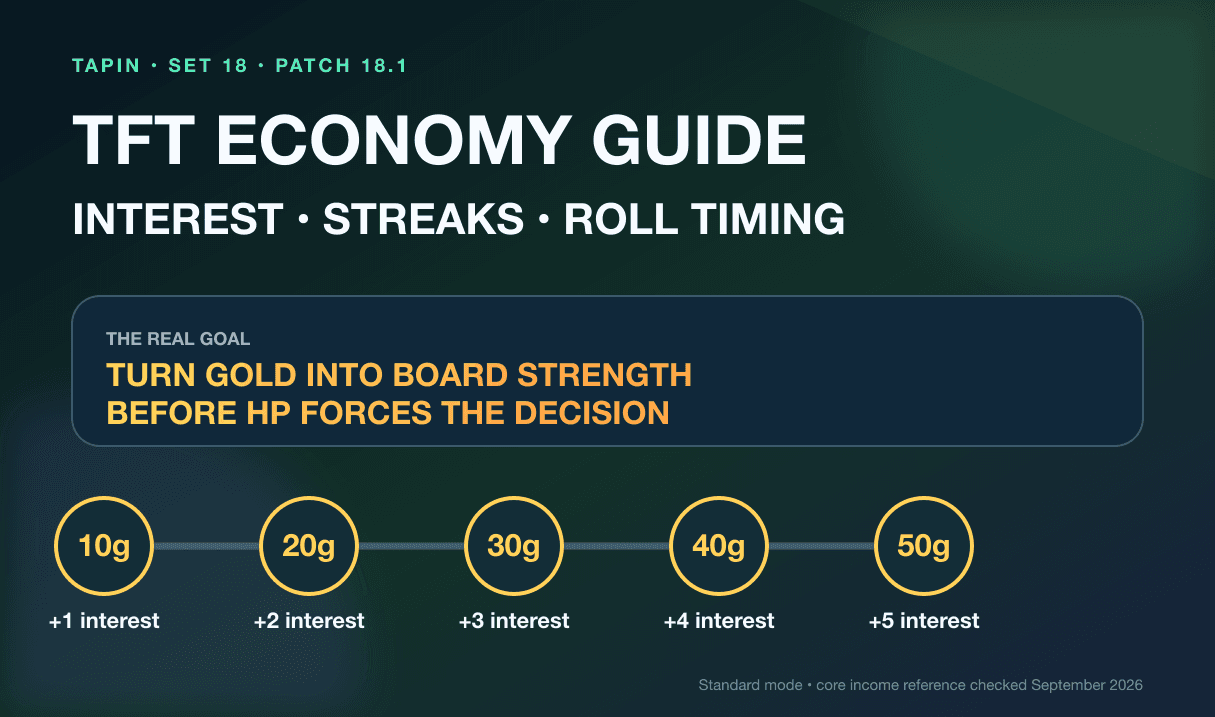
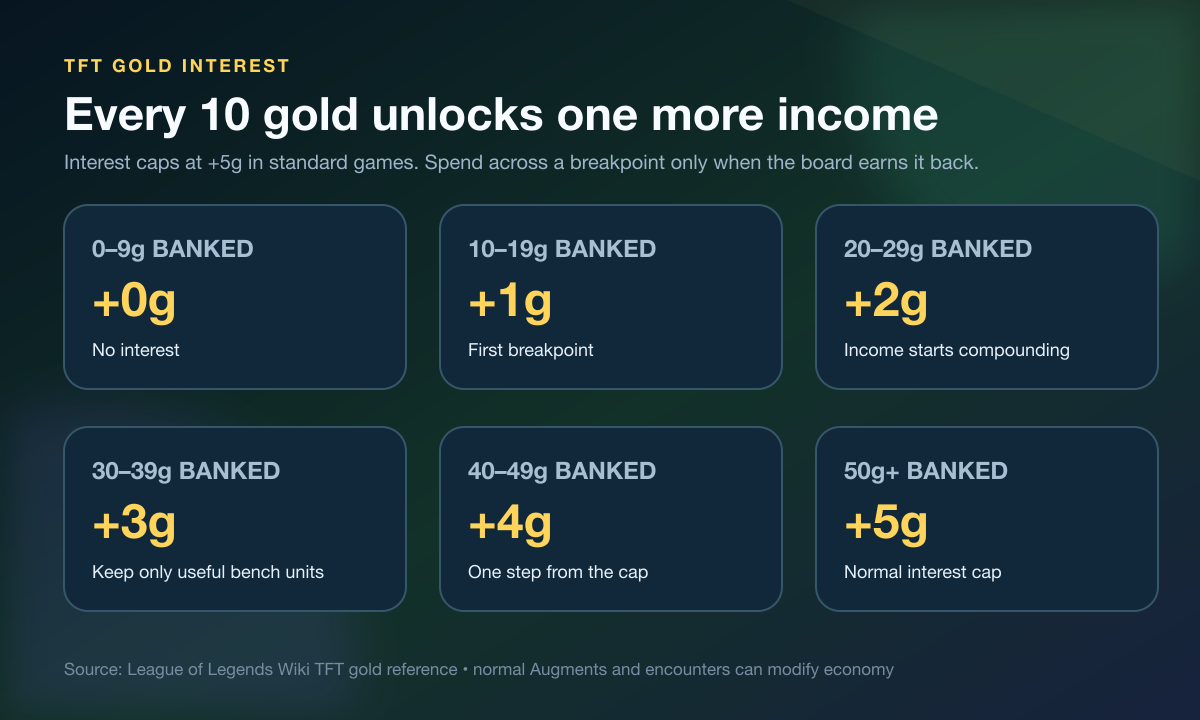
The current TFT gold reference{:target="_blank"} lists an early income ramp of 2, 2, 3, and 4 gold on rounds 1-2, 1-3, 1-4, and 2-1, followed by five base gold per planning phase. Interest adds one gold per 10 saved, up to five at 50.
| Income source | Gold | What controls it |
|---|---:|---|
| Base income | 5 per round | Automatic after the early 2-1 ramp |
| Interest | 0 to 5 | Gold banked at each 10-gold breakpoint |
| PvP win | +1 | Win the round |
| Win or loss streak | 0 to 3 | Keep the same result across rounds |
| Loot, Wisps, Augments | Variable | Game-specific offers and choices |
At 30 gold, your normal interest is +3. At 49, it is still +4. That last point matters because TFT punishes fuzzy math: holding a useless one-cost on the bench at 19 or 29 can quietly cost the same gold you were trying to save.
Do not turn the math into a religion. The normal ceiling is 50 gold, not a command to protect 50 while losing by eight units. Every saved coin only matters if you live long enough to spend it.
TFT Gold Interest: Use Breakpoints, Not a 50-Gold Commandment
The useful breakpoints are 10, 20, 30, 40, and 50 gold. Treat each one as a small income tier, then decide whether the next purchase creates more value than the interest you give up.
Use this three-part check before crossing a breakpoint:
- Name the purchase. Which unit, XP threshold, or set of rolls are you buying?
- Name the board change. Does it complete a two-star, activate a trait, add frontline, or improve the shop odds for your carry?
- Name the stop. How much gold remains, and what result tells you to stop rolling?
If you cannot answer those questions, keep the gold. “Maybe the shop gives me something” is how 42 turns into 12 with no stronger board.
Bench management belongs in the same decision. A one-cost pair at 19 gold may be worth missing one interest if either copy completes a frontline upgrade next round. A fourth speculative pair that does not fit your items or board probably is not.
I believe the cleanest economy habit is saying the trade out loud: “I am giving up one interest to protect this streak,” or “I am selling this unit because the pair is not part of my next board.” That sentence forces the spend to have a job.
TFT Win and Loss Streak Economy
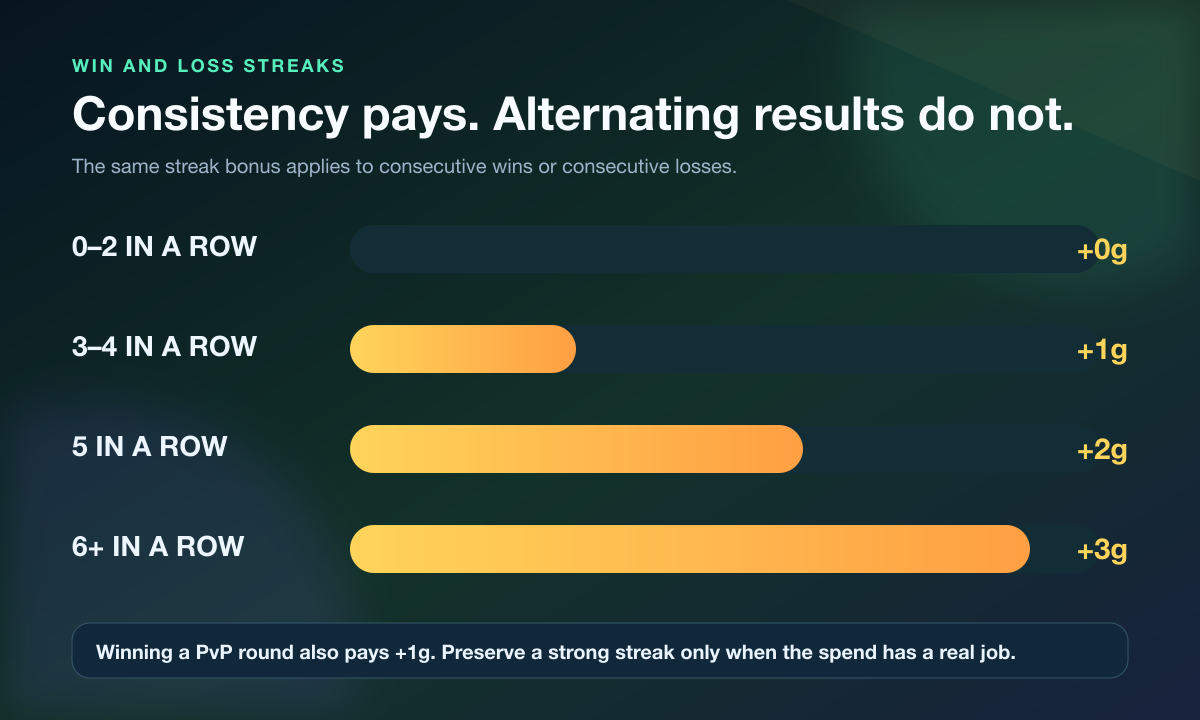
The same streak table applies to consecutive wins and consecutive losses: +1 gold at three to four, +2 at five, and +3 at six or more. A PvP win also pays its separate +1 gold.
That is why win-loss-win-loss feels awful. You preserve neither a payout streak nor a clear plan, and you often spend just enough to stay mediocre.
When to spend for a win streak
Spend when the purchase materially changes the next fight. Leveling to add a real frontline unit, completing two upgrades, or slamming a flexible item can protect both the bonus gold and your HP.
Do not spend eight gold to add a unit with no trait, no item, and no useful target. You are not buying tempo; you are buying a higher number beside your level.
How to loss streak without throwing the game
A controlled loss streak needs a cash-out round. Decide the level, stage, and upgrades you expect to buy before the losses become expensive.
Keep the board coherent enough to kill units and preserve HP. Scout for players who are also weak, because one accidental win can break the streak without fixing your board. The goal is not to lose forever. It is to trade early health for a stronger, funded spike.
If the lobby refuses to give you a clean streak, stop forcing one. Play your strongest board, build interest when it is free, and reassess at the next natural level or item decision.
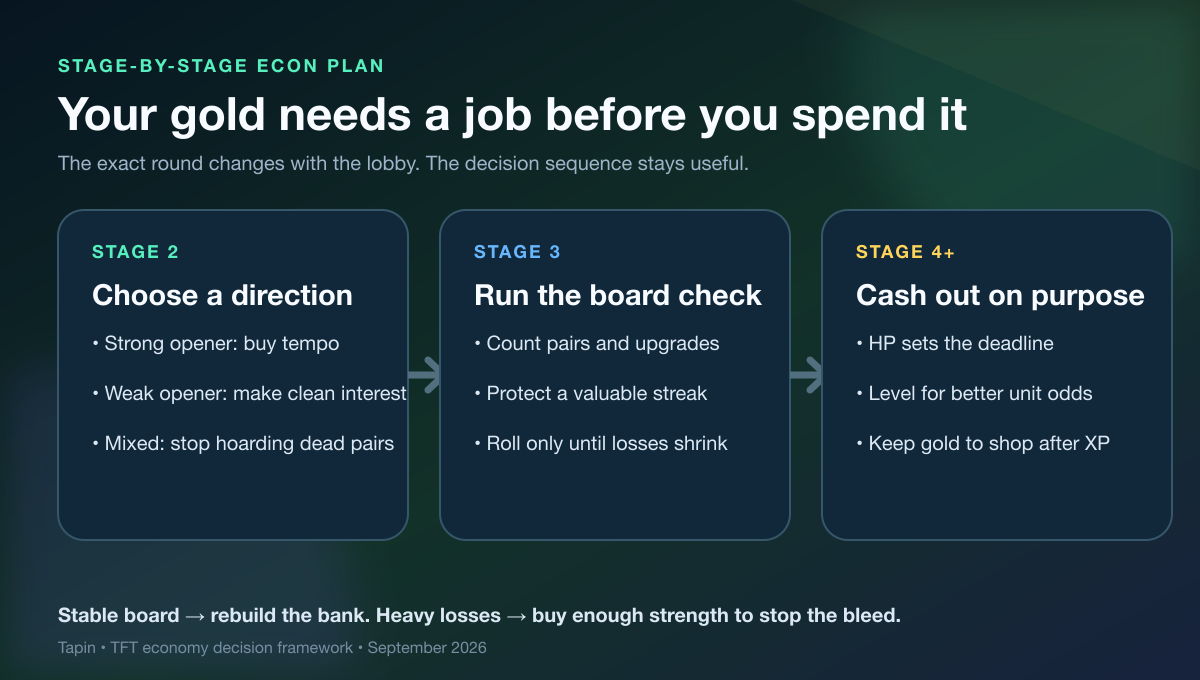
A Stage-by-Stage TFT Economy Plan
Memorized round timings are landmarks. Your board, health, streak, and contested units decide whether you arrive early or late.
| Stage | Main question | Default action |
|---|---|---|
| Stage 2 | Am I actually strong or weak? | Commit to tempo or clean interest |
| Stage 3 | Can this board survive the lobby? | Stabilize enough to shrink losses |
| Stage 4+ | What is my funded end board? | Convert gold before HP forces a panic roll |
Stage 2: choose a direction
Play upgraded units and identify whether you can realistically win streak. If yes, a level or useful unit can protect income and health. If no, reach interest breakpoints without hoarding every pair in the shop.
Mixed openers need honesty. If you win only against the bottom two boards, you are not a win-streak board. Either strengthen with a specific move or stop leaking gold to units that never make the next formation.
Stage 3: run the first real board check
Count your pairs, frontline quality, item holder, and likely opponents. A short roll can be correct when two or three upgrades are available. Rolling for one exact copy on an otherwise weak board is usually a trap.
Set a survival target: “two-star the tank and one damage unit,” or “roll until this board loses by three units instead of seven.” Stable does not mean perfect.
Stage 4 and beyond: cash out on purpose
Your health bar sets the deadline now. A healthy, upgraded board can rebuild its bank or push another level. A low-health board needs to spend before one bad matchup ends the game with 30 gold untouched.
The TFT leveling guide goes deeper on standard XP timings. The economy rule underneath them is simple: do not buy the level unless you can add strength or retain enough gold to use the better shop.
When to Roll in TFT
Roll where the shop can actually find your upgrades. The live Set 18 shop-odds table{:target="_blank"} gives Level 6 40% 2-cost odds, Level 7 40% 3-cost odds, and Level 8 30% 4-cost odds.
Your carry cost points to the efficient level. Your health and competition decide how long you can wait there.
Before pressing reroll, ask:
- How much am I losing by? A two-unit loss and an eight-unit loss create different deadlines.
- How many upgrades can I hit? Three live pairs make each roll more valuable than one missing copy.
- Am I contested? Every copy held elsewhere reduces what remains in the shared pool.
- What is the stop condition? Pick a board-strength target or gold floor before the first shop appears.
- What happens next round? Leave enough gold to buy the units you hit and execute the next level plan.
Roll-down rule: Stop when the board can do its job. Chasing the final perfect unit after stabilizing is how a recovery roll becomes a bankruptcy roll.
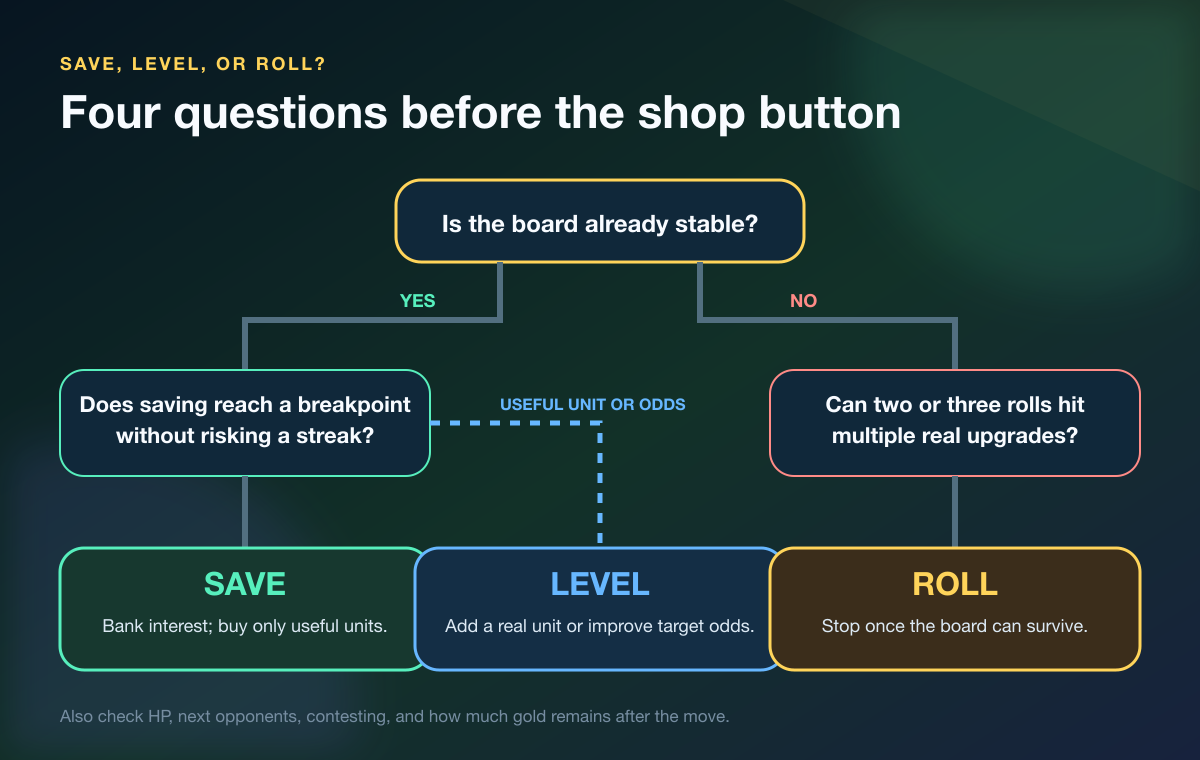
Level instead when one more unit creates immediate power or meaningfully improves the odds for your core pieces. Save when the current board already beats enough of the lobby and the next spike needs a larger bankroll.
How Set 18 Wisps Change Your Spending Plan
Set 18 adds another claim on your gold. Riot's Enchanted Wilds overview{:target="_blank"} says Wisps appear in every other shop, occupy the rightmost slot, and can normally be purchased once per round. Some offer gold or XP; others provide combat, shop, item, or risky effects.
That does not make every Wisp an automatic buy.
Before a roll-down, decide whether you are reserving gold for a Wisp. During the roll, compare its immediate value with the unit hidden behind it and the breakpoint you would cross. After Stage 5, Riot says every other Wisp is guaranteed to be a Combat Wisp, so late-game gold can buy more than shop access alone.
Patch 18.1{:target="_blank"} also brought the Carousel back. That increases the value of planning one round ahead: item access, Wisp offers, and shop odds can all change what your next gold should accomplish.
Review the Decision Before the Roll-Down
The final placement is bad feedback. By then, five different choices may have changed the game.
Review one economy checkpoint instead—usually the first major spend in Stage 3 or Stage 4. Write down:
- Gold, HP, and current streak before spending
- Board pairs and missing jobs
- Level and shop odds for the units you wanted
- Other players contesting those units
- Gold spent and the exact stop condition
- Damage taken over the next two fights
If you spent 24 gold and still lost heavily, inspect the decision before blaming the rolls. Were too few pairs live? Did you roll at the wrong level? Did the items point to a different carry? The TFT item guide and TFT positioning guide help separate an economy error from a board-construction or fight-setup error.
If you cannot see which decision started the collapse, review the game with a TFT coach on Tapin. Pause before the roll-down, state the plan, and compare it with what the lobby was actually telling you.

TFT Economy Guide FAQ
How much interest do you get in TFT?
You normally gain one interest gold per 10 gold banked, capped at +5 when you hold 50 or more. Augments, encounters, and set mechanics can modify your economy, so check the current game effects before assuming the standard cap is the whole story.
How much gold does a TFT streak give?
Both win and loss streaks pay +1 gold at three to four consecutive results, +2 at five, and +3 at six or more. Winning a PvP round also grants a separate +1 gold.
Is it always correct to save 50 gold in TFT?
No. Save 50 when your board is stable and the bankroll supports a future spike. Spend below it when a level, upgrade, or short roll prevents heavy damage or protects a valuable win streak.
When should I roll down in TFT?
Roll when several attainable upgrades can stabilize the board, especially if your HP is low or losses are getting larger. Choose the level with efficient odds for your carry cost and set a stop condition before rolling.
Is a win streak better than a loss streak?
A win streak preserves HP, pays the one-gold win bonus, and can earn streak gold, so it has more immediate upside. A planned loss streak can still fund a strong recovery, but it spends health and needs a clear cash-out point.
Good TFT economy is not “never spend” or “always play tempo.” It is knowing what the next gold buys, how much waiting costs, and when HP removes your freedom to be greedy.
Protect clean breakpoints when the board is stable. Spend with a stop condition when it is not. Then review the turn before the collapse—that is where the climb usually starts.