

Last Updated: October 2026
Your first three bullets look clean on the wall. Then a real player swings, you fire while drifting, hold the mouse for too long, and call the result “bad recoil.” That label hides the part you can actually fix.
This Valorant recoil control guide separates four jobs: stop before bullet one, control the opening group, wait for accuracy to recover, and choose when a full spray is worth the commitment. You will leave with a 15-minute routine and a scorecard—not a promise that one mouse path wins every duel.
The live game is on Patch 13.08 in V26 Act 6. Riot’s current notes do not replace the basic rifle model: movement accuracy, firing error, recoil, and recovery still decide whether your next bullet starts clean.
⚡ Quick answer: Stop fully, fire a short group, and release before the spray escapes your control. Tap when the target is small, burst through most medium-range rifle fights, and commit to a spray when the fight is close or a trade has already forced the issue. Test your own reset timing in the Range instead of memorizing one magic pause.
Give a teammate one observation job during practice: call early shot, broken group, late reset, or panic transfer. That turns “I whiffed” into a cue you can use on the next repetition.
Table of Contents
- What recoil control actually includes
- When to tap, burst, or spray
- How the Vandal and Phantom change the decision
- The 15-minute practice routine
- How to test recoil reset timing
- How to transfer the drill into matches
- Common recoil-control mistakes
- FAQ
What Valorant Recoil Control Actually Includes
Three different failures can draw a messy bullet group.
Movement error ruins the start. Riot increased rifle movement error in Patch 2.02 specifically to make moving rifle kills rarer, especially at longer range. If bullet one leaves before your movement settles, later recoil correction is not the first problem.
Recoil moves the weapon as the group continues. Your hand counters the early climb instead of dragging only after bullets already leave the target.
Firing error and recovery decide how clean the next shot begins. Riot’s rifle recovery explanation in Patch 0.50 says inaccuracy accrues when you refire before the weapon’s full recovery time. A short release is useful only if it lets the gun settle enough for the next group.
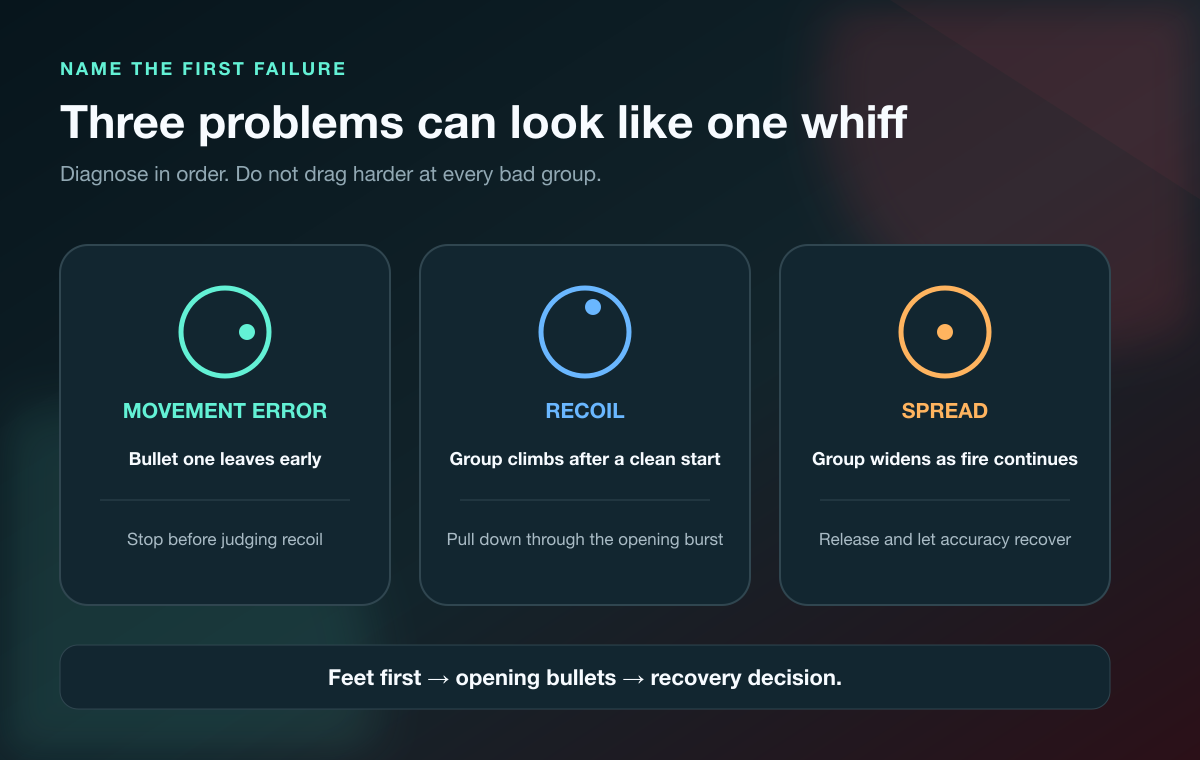
Diagnose in that order:
- Did movement stop before bullet one?
- Did the opening group climb off the target?
- Did you release before the group became unreliable?
- Did the next burst begin after a real reset?
I believe most recoil practice fails because players answer question three while question one is still broken. Pulling down harder will not repair a bullet fired too early.
Use the firing-error graph as feedback
Turn on the firing-error graph while you test. Riot updated it in Patch 6.03 to represent worst-case error in degrees from the aim direction.
Use the graph between reps, not as a HUD minigame during the spray. Fire, release, read the feedback, then repeat the same setup.
When to Tap, Burst, or Spray in Valorant
Distance matters, but it is not the only input. Target size, available cover, your weapon, the chance of an immediate trade, and whether the enemy can escape all change the right firing mode.
| Mode | Best starting use | Exit rule |
|---|---|---|
| Tap | Long angle, small exposed target, deliberate head-level shot | Wait until the next shot begins clean |
| Burst | Most medium-range rifle duels | Release before the group escapes |
| Spray | Close fight, smoke spam, trade, or committed multi-target fight | Stop when control breaks or the target leaves |
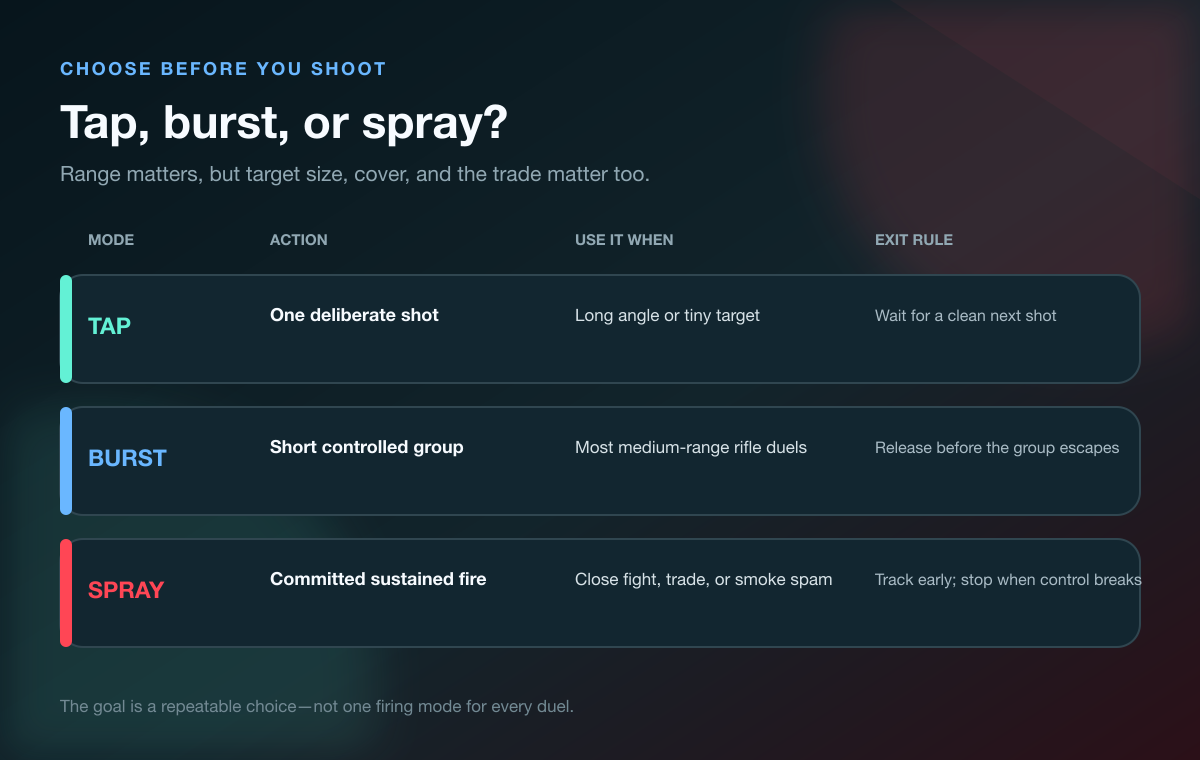
Tapping is not “always accurate” if you click faster than recovery allows. Bursting is not a fixed bullet count you must use at every distance. Spraying is not automatically wrong; it is simply the most expensive commitment when your first correction fails.
Build one visible exit rule: when the opening group leaves the target, release. You can extend the group later, but first you need a point where your hand stops donating the rest of the magazine.
Crosshair placement comes before recoil correction
Recoil control starts from the first bullet’s location. A perfect pull from knee height is still a bad duel.
Use our Valorant crosshair settings test if the crosshair disappears against map colors, covers distant heads, or gives you misleading movement feedback. If it stays visible and your starting point is simply low, fix placement rather than redesigning the crosshair again.
Vandal vs. Phantom Recoil Control
Train the weapon you actually buy. Switching between the Vandal and Phantom every few repetitions gives you less comparable evidence from both.
Riot’s official Phantom vs. Vandal Data Drop analyzed more than four million Unrated and Competitive matches. In that historical dataset, nearly half of Phantom kills happened within 15 meters, and the Phantom led close-range multi-kill scenarios used as a real-match proxy for spray control. The Vandal’s kill distribution stayed more consistent across distances.
That is not a command to buy one rifle forever. It gives your drill a better question:
- If your role keeps you in close site fights and smoke-heavy trades, test the Phantom’s opening spray and one transfer.
- If your role takes longer head-level duels, test Vandal taps and short bursts before extending the group.
- If your buy changes, do not import yesterday’s timing blindly. Run three wall groups and three reset tests first.
Use separate notebook rows for each rifle. “Rifle practice” is too vague to tell you which timing improved.
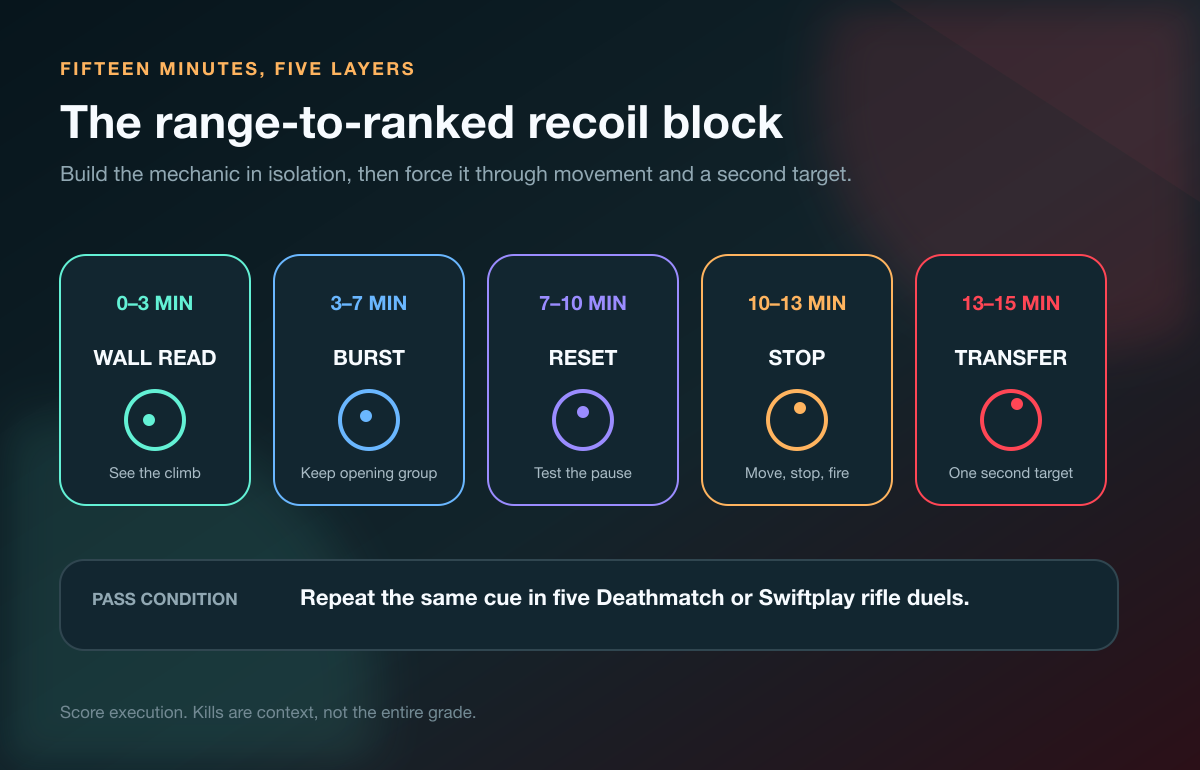
Valorant Recoil Control: The 15-Minute Routine
Keep the first seven sessions comparable: same weapon, same target, same distance markers, and the same score.
| Time | Drill | Pass condition |
|---|---|---|
| 0–3 min | Wall read | Name where the group first climbs or drifts |
| 3–7 min | Short bursts | Opening group stays inside your chosen target |
| 7–10 min | Reset test | Next group begins from a settled state |
| 10–13 min | Strafe-stop-burst | Movement ends before bullet one |
| 13–15 min | One transfer | One deliberate switch reaches target two |
Minutes 0–3: read the weapon
Stand still and fire three uninterrupted groups at the wall. Do not compensate on the first group. You are looking for the opening climb, when the group widens, and when side-to-side correction starts demanding more attention.
On the next groups, counter the opening climb smoothly. Do not try to trace one perfect full-magazine drawing; your first goal is a useful opening group and a clear release point.
Minutes 3–7: make the burst repeatable
Pick a target area and fire short groups. Record the first bullet where the group consistently escapes.
If that happens early, slow down the start and shorten the group. Progress means the break point moves later across repeatable reps—not that one lucky group looks clean.
Minutes 7–10: learn your reset
Fire, release, then fire again. Change only the pause until you can tell a clean second group from one that began too soon.
Do not chase the shortest possible pause. Find the shortest pause you can repeat while keeping the next group useful.
Minutes 10–13: put your feet back in
Strafe a short distance, stop, and fire the same group. Any rep where bullet one leaves before the stop counts as a movement failure, even if later bullets land.
Minutes 13–15: transfer once
Place two targets close enough for one controlled switch. Fire the planned opening group, move to target two once, and judge the first bullet after the transfer.
No bouncing back and forth. One target, one switch, one finish.
Test Valorant Recoil Reset Timing
Do not borrow a creator’s reset number without testing it on your weapon and firing rhythm. Riot’s recovery system punishes refiring before accuracy has recovered, and your visual or audio cue must survive actual play—not only a stopwatch.
Run a simple ladder:
- Fire one short burst.
- Release long enough that the next group is obviously clean.
- Repeat with a slightly shorter pause.
- Stop shortening when the second group repeatedly opens wider or climbs sooner.
- Return to the last reliable pause and score 10 reps.
Keep sensitivity, stance, weapon, and target unchanged. If you change four inputs, you cannot tell which one fixed the group.
⚠️ Watch Out: A crosshair that visually returns does not prove your next bullet is fully settled in every situation. Score the bullet group and firing-error feedback, not the animation alone.
Move Valorant Spray Control Into Real Matches
Wall drills teach a clean input. Ranked adds movement, cover, utility, pressure, and a target that shoots back.
Carry one cue at a time into five Deathmatch or Swiftplay rifle duels:
- “Stop before bullet one.”
- “Release when the group breaks.”
- “One transfer, not panic tracking.”
- “Burst, move, then burst again.”
VALORANT’s Replay system lets you inspect recent matches from every player’s first-person view and slow the action down, according to Riot’s Replay system guide. Review the first repeated failure rather than only the final death frame.
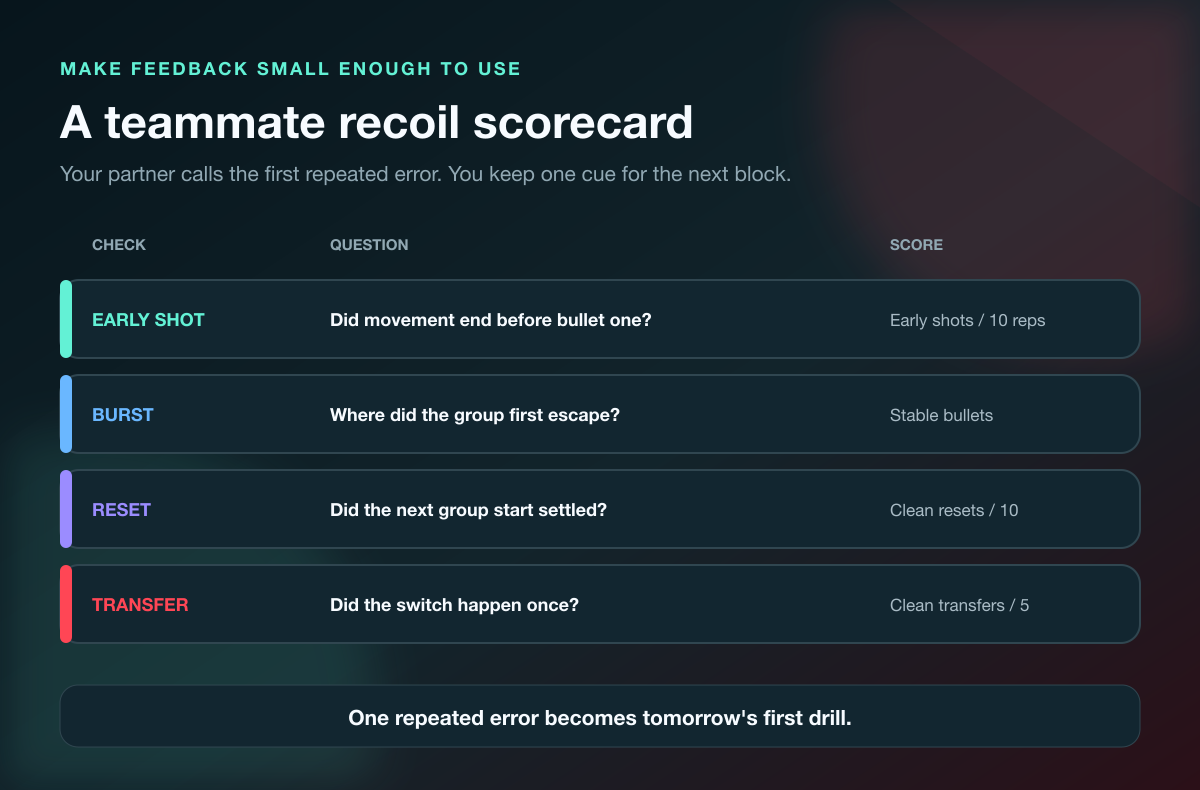
Have a teammate watch five clips and use the four-label scorecard. Their job is not to coach your entire match. They call the first repeated error; you choose tomorrow’s first drill.
If you need somebody who will actually run the block with you, find a Valorant teammate on Tapin. You can also use the Valorant duo partner guide to screen for schedule, rank goals, and communication style before you queue.
I believe this is where a duo beats another solo practice video. The same person can tell you whether the clean wall burst survived a real swing, trade, and reset across several sessions.
Six Valorant Recoil Control Mistakes
1. Practicing full magazines first
The later spray adds more decisions before the opening group is stable. Own a smaller block, then extend it.
2. Firing before the stop
If movement error ruins bullet one, do not grade the rep as a recoil failure. Reset your feet first.
3. Pulling down after the group escapes
Late correction turns into a violent drag. Start the counter-movement with the opening climb and keep it smooth.
4. Forcing one firing mode at every range
Tap, burst, and spray are tools. Pick before the duel instead of proving your favorite tool works everywhere.
5. Changing weapons every minute
Different rifles produce different timing and feedback. Give each weapon its own session row.
6. Scoring kills instead of execution
A sloppy moving spray can still get a kill. Track early shots, break point, clean resets, and deliberate transfers so the result teaches you something.
Valorant Recoil Control FAQ
Does Valorant have recoil patterns?
Weapons have recognizable recoil behavior, especially through the opening part of sustained fire, but a long spray should not be treated like one perfectly repeatable wall drawing. Learn the opening correction, watch the group, and release when control becomes unreliable.
Is it better to tap, burst, or spray in Valorant?
Tap when the target is small and you can wait for a clean follow-up. Burst through most medium-range rifle duels. Spray when the fight is close, the trade is immediate, or the situation demands sustained fire.
How long does recoil take to reset in Valorant?
Recovery differs by weapon and by how you fired before releasing. Test it with repeated groups: begin from an obviously clean pause, shorten gradually, and keep the shortest interval that produces a reliable next group.
How should I practice Valorant recoil control?
Use one rifle for 15 minutes: read the wall pattern, score short bursts, test reset timing, add a strafe-stop, then make one transfer. Carry one cue into five live rifle duels and review the first repeated error.
Is the Phantom or Vandal easier to spray?
Riot’s large historical dataset favored the Phantom in close-range multi-kill situations, while the Vandal produced kills more consistently across distance buckets. Test the rifle that fits your usual fights instead of turning the choice into a universal rule.
Make the Release Part of the Skill
Good Valorant recoil control is not endless mouse-down time. It is a clean stop, a useful opening group, a reset you can recognize, and a firing-mode decision that survives pressure.
Run the 15-minute block for seven sessions. Then take one cue into queue with a consistent Valorant teammate on Tapin and see whether your first repeated failure starts happening later.