

Last Updated: October 2026
Five comfort picks can win a ranked game. Five picks with no smoke timing, no safe first step, and three people waiting to trade usually make every round feel harder than it should.
This Valorant team composition guide gives you a better draft rule: cover the jobs the map demands, then assign who acts first, second, and third. You will get a default five-slot formula, a 60-second agent-select check, utility sequences, and swap triggers that work even when the meta changes.
The live game is on Patch 13.08 in V26 Act 6. That update moved Bind and Corrode into Competitive while Ascent and Split rotated out. Copying one frozen comp is fragile; your process needs to survive map and patch changes.
⚡ Quick answer: Start with one space-taker, one information or clearing specialist, one smoke owner, one anchor or flank watcher, and one flex pick that solves the map's biggest remaining problem. Comfort matters, but every player must own a job and every execute needs an order.
Table of Contents
- The five jobs every Valorant comp needs
- A default ranked team formula
- The 60-second agent-select test
- How the map changes your flex slot
- How to sequence utility
- When to change the comp
- Practice and review
- FAQ
The Five Jobs Every Valorant Team Composition Needs
Riot organizes its current agent roster into Duelists, Initiators, Controllers, and Sentinels. Those classes are useful labels, but a class badge does not tell you whether your five picks can execute one round together.
Draft around these five jobs instead:
| Job | What it must produce | Failure signal |
|---|---|---|
| Entry | A safe first lane and trade window | Team stalls behind the choke |
| Information | Location, displacement, or cleared angles | Entry checks five threats alone |
| Smokes | Sightlines removed at the right second | Defenders see the whole hit |
| Anchor | Site stability, flank control, or delay | One lurker or rush breaks the setup |
| Flex | The missing tool for this map and plan | Comp has roles but no win condition |
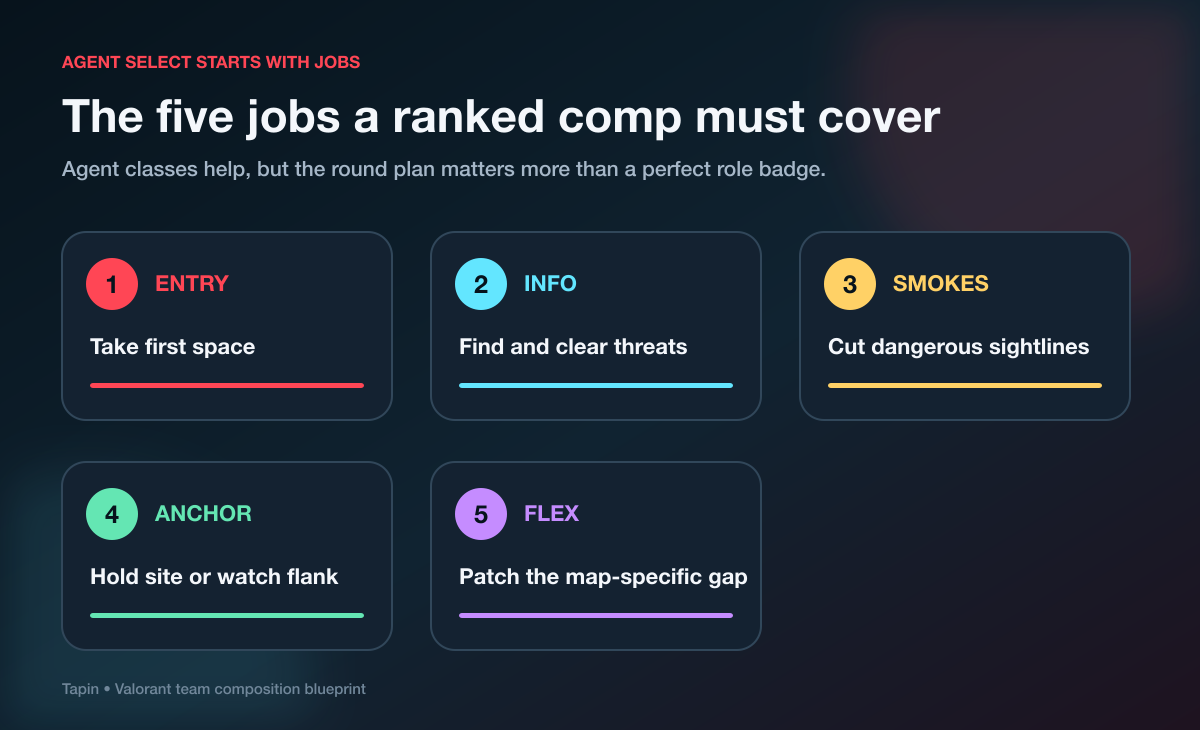
One agent can cover parts of two jobs. A player can also own the mid-round call without selecting a specific class. What matters is whether everyone can answer, “What do I do before first contact?”
I believe this is the cleanest way to stop agent-select arguments. “We need a Sentinel” starts a debate about labels. “We keep losing the flank and cannot hold the weak site” defines a problem the fifth pick can solve.
Give each player one sentence
Before the barrier drops, each player should finish one line:
- “I start the hit by ___.”
- “I make the first contact safer by ___.”
- “I remove this sightline when ___.”
- “I protect the round from ___.”
- “If the first plan fails, I still have ___.”
If two players claim the same first job and nobody owns the next one, fix it before pistol round.
A Default Valorant Ranked Team Formula
For most ranked lobbies, use this as the starting shell:
- One Controller for reliable sightline denial.
- One Initiator for information, clearing, or setup.
- One Duelist or committed entry player to take first space.
- One Sentinel or defensive anchor for stability and flank control.
- One flex chosen for the map, player comfort, and round plan.
That is a baseline, not a law. Double-Controller, double-Initiator, and other shapes can work when both picks do distinct jobs. Two Controllers who smoke the same choke at the same time are not “more control.” They are one job with twice the confusion.
Ranked comfort has real value. An experienced player on a slightly imperfect pick will usually execute more useful utility than a first-time fill copying a tournament lineup. Keep the comfort pick, then reshape the plan around what the player can repeat.
⚠️ Watch Out: Do not force one of every class and assume the draft is finished. You still need an entry route, a clearing order, smoke timing, flank ownership, and a plan after the plant.
The 60-Second Agent-Select Test
Run four questions from top to bottom. Do not start by asking which five agents a tier list ranked highest.
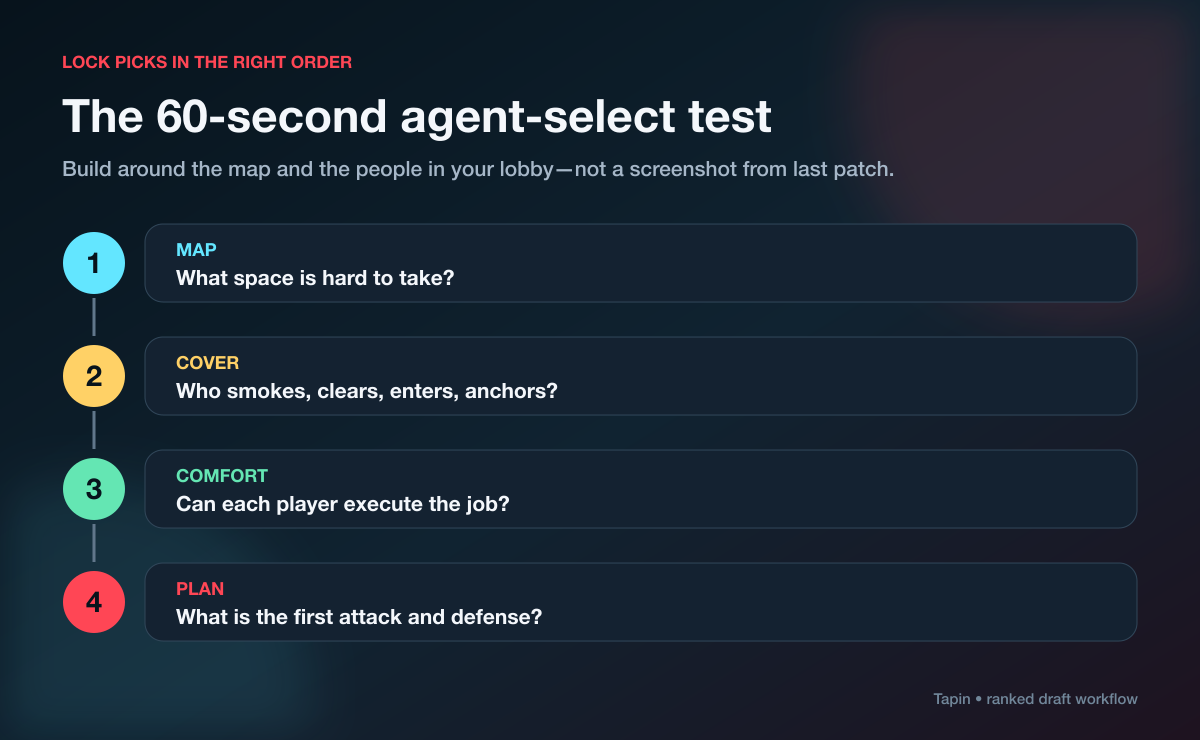
1. What does the map make difficult?
Name the hard space: a narrow choke, a long lane, a contested middle, a fast defender rotation, or multiple sites that stretch the defense. The fifth pick should answer that problem.
Patch 13.08 is a useful reminder. Riot changed the Competitive rotation and also adjusted Corrode. Your old Ascent plan cannot simply be renamed for Bind.
2. Are the four core jobs covered?
Point to the player who enters, the player who gathers or clears information, the smoke owner, and the anchor. If any answer is “everyone,” nobody owns it yet.
3. Can these players execute the picks?
Ask for two pieces of proof: one attack setup and one defense setup. A player does not need a library of lineups. They need something specific enough to run in pistol round.
4. What is the first plan?
Finish agent select with one attack and one defense sentence:
- Attack: “Info clears close, smoke lands, entry takes left lane, second player trades.”
- Defense: “Anchor delays, weak side gives space, rotator holds utility until contact is confirmed.”
That is enough structure to start. Add depth after the team proves the first layer works.
Build Your Valorant Comp by Map Problem
Map-specific drafting is not memorizing five names for every loading screen. Sort the map into the problems it creates, then spend the flex slot deliberately.
Tight chokes and committed hits
Prioritize layered clearing, a dependable first step, and utility that prevents defenders from taking several clean fights through one doorway. The execute should compress danger before the entry moves.
Wide lanes and long sightlines
Prioritize vision denial, information before dry peeks, and a second way to cross exposed ground. If the Controller spends every smoke just getting into the first area, the flex may need to add another screen, pressure tool, or route.
Multiple sites and long rotations
Prioritize information, a stable weak-side anchor, and utility that can delay without demanding an immediate duel. Three people rotating on the first sound cue is not a composition issue; it is an ownership issue.
Maps with valuable central control
Decide whether the team will contest, pressure, or concede middle. “We will figure it out in the round” usually means one player fights alone while the other four hold unrelated angles.
Use the Valorant team finder guide if you are building a recurring five. It covers the next layer—schedule, agent pools, trials, and the difference between a ranked stack and a Premier roster.
Sequence Utility So the Team Comp Actually Works
A good draft can still produce five solo plays. Utility has to land in an order that creates a gunfight your team can trade.
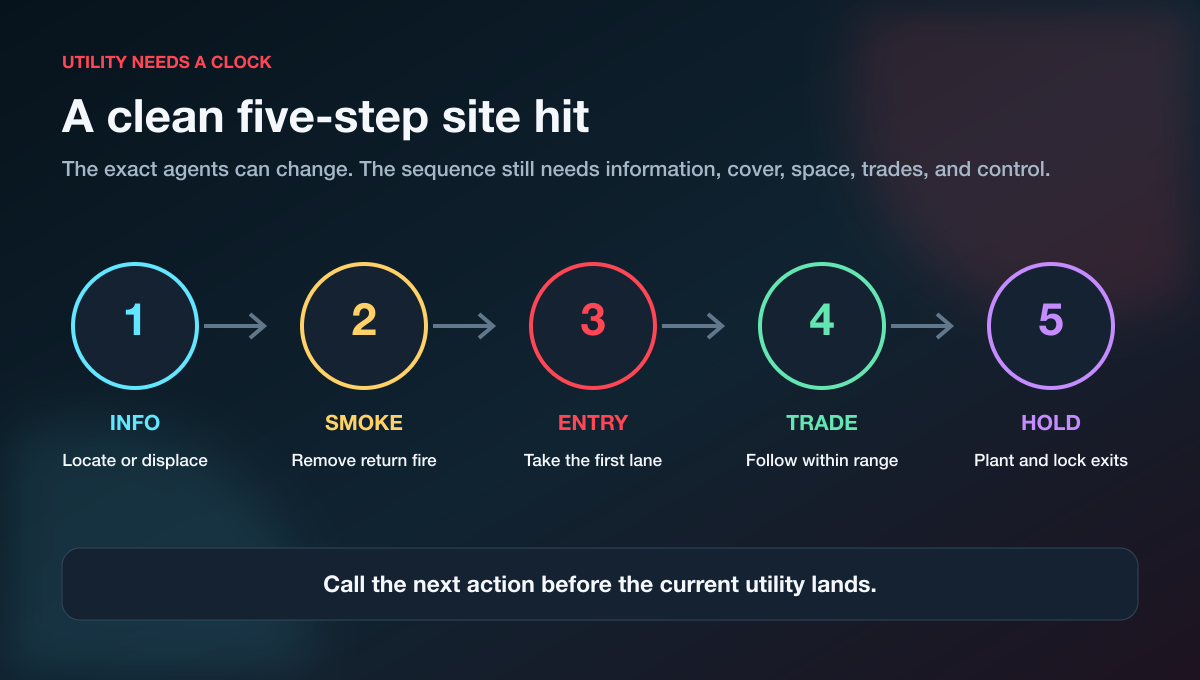
Use this default attack sequence:
- Information: locate, clear, or force the first defender away.
- Smokes: remove the dangerous return sightlines.
- Entry: take one defined lane—not the entire site.
- Trade: follow close enough to punish first contact.
- Hold: plant, protect exits, and save one tool for the retake.
The calls should be just as ordered: “drone,” “smoking,” “flash in three,” “go,” “planting.” Short calls create a shared clock.
Defense needs an order too:
- Early information identifies pressure.
- The anchor calls whether the hit is real.
- Delay utility buys rotation time.
- Rotators choose fight or retake before arriving.
- The team saves enough utility to clear the plant and common hold positions.
Do not dump every tool because one enemy appeared. A team composition needs utility for the second decision, not only the first ten seconds.
Separate mechanics from structure
If the player misses the opening duel, review the input. Our Valorant recoil control routine helps diagnose movement, burst control, and reset timing. If three players arrive at three different moments, fix the sequence before blaming aim.
Five Signs Your Valorant Team Comp Needs Help
Do not swap after one lost round. Look for the same failure twice, name the missing job, then change one variable.
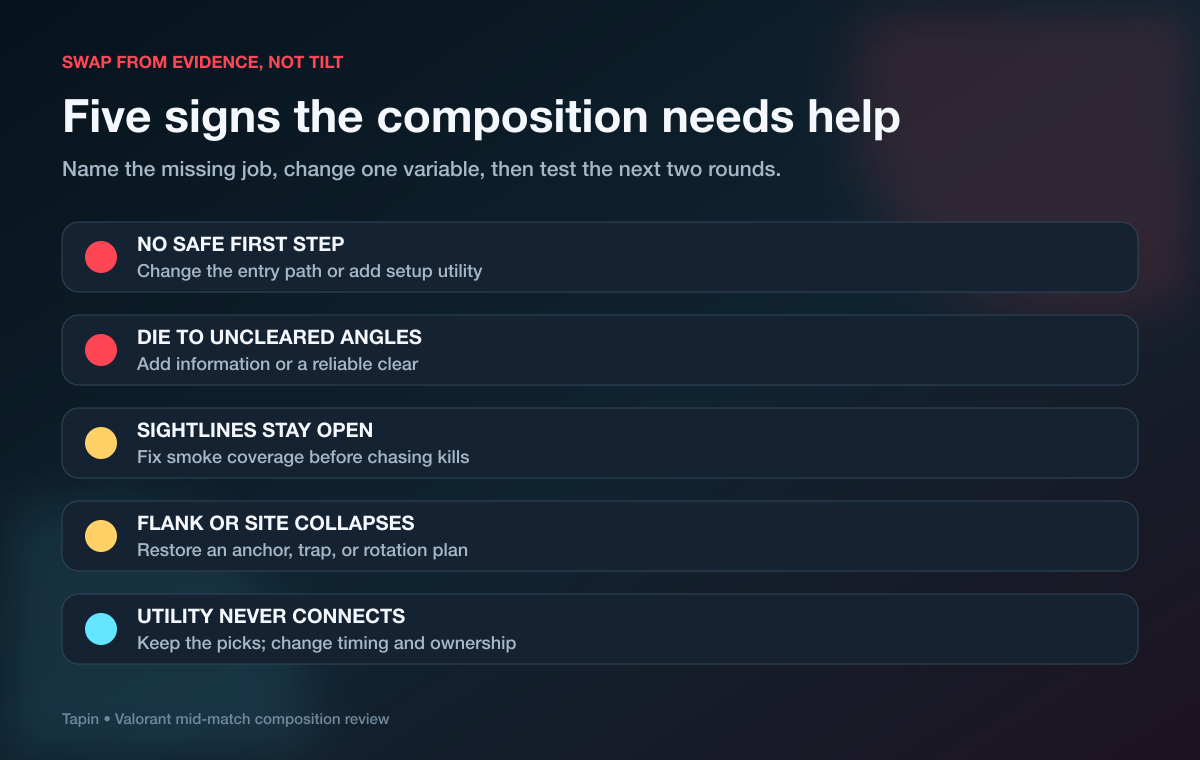
1. There is no safe first step
The entry reaches the choke, gets hit by three pieces of utility, and nobody can trade. Change the route, add setup, or move the entry timing after the first defender tool.
2. Uncleared angles keep winning
Add information or a repeatable clearing tool. If the utility already exists, assign the exact angle it clears instead of swapping agents.
3. Dangerous sightlines stay open
Fix the smoke placement and timing first. A late smoke can make a correct Controller pick look useless.
4. The flank or weak site keeps collapsing
Restore an anchor, trap, or explicit rotation rule. Do not solve every defensive problem by stacking more people on the last site that lost.
5. Utility exists but never connects
Keep the picks and change ownership. One caller counts the execute; everyone else confirms their tool in sequence.
I believe this review rule saves teams from endless comp churn: change the pick only when the missing job cannot be restored through timing, position, or responsibility.
Practice the Comp Without Building a Playbook
You need four rehearsed blocks per map:
- One default that gathers information safely
- One fast hit with exact utility order
- One anti-eco plan that protects rifles
- One defensive response for each site
Run each block twice in a custom lobby. The first rep finds confusion. The second proves whether the fix was clear.
After a match, review five rounds: pistol, first full buy, first failed execute, first lost anti-eco, and one late retake. Label the first break as draft, timing, spacing, mechanics, or comms.
If you need a consistent player to practice that structure with, find a Valorant teammate on Tapin. Start with one duo who can repeat the same setup and give honest feedback; a reliable two-player sequence is the seed of a real five-stack.
Valorant Team Composition FAQ
What is the best Valorant team composition for ranked?
A reliable starting formula is one Controller, one Initiator, one Duelist or committed entry, one Sentinel or anchor, and one flexible pick. The best version is the one that covers every job while keeping players on agents they can execute.
Do you need one agent from every role?
No. One of each class is a useful baseline, not a requirement. Judge the final five by whether it can take space, gather information, deny sightlines, control flanks or sites, and handle the map's remaining problem.
Is double Duelist bad in ranked?
Not automatically. It works when the two Duelists create different pressure and the other three picks still cover information, smokes, and defensive stability. It fails when both wait for the other to enter.
Should someone fill Controller if they do not play the role?
Only if they can run a simple, repeatable smoke plan. A forced fill with late or misplaced smokes can be worse than adapting the round plan around a comfort pick.
When should a team change its comp?
Change after a repeated failure exposes a job the current five cannot perform. If the required utility already exists, fix timing, positioning, or ownership before replacing an agent.
A Valorant team composition is a round plan disguised as five portraits. Cover the jobs, assign the order, and make the flex pick solve the map—not somebody's fear of breaking a template.
Start with one attack sentence and one defense sentence. Queue, review the first repeated failure, and build the next layer from evidence.