

Last Updated: August 2026 — WoW Midnight Patch 12.1, Season 2
The hardest part of Delves is not entering one. It is knowing when to push, when to protect a Bountiful run, and when the group is repeating the same mistake without fixing it.
This WoW Delves guide gives you a clean Midnight Season 2 plan: choose the right tier, use Bountiful Delves intentionally, protect the shared revive pool, and turn three runs into actual improvement.
Table of Contents
- What changed in Season 2
- How Delves work
- Choose solo, duo, or group
- Plan Bountiful rewards
- Protect revives
- Practice with a teammate
- FAQ
What Changed in WoW Delves for Midnight Season 2
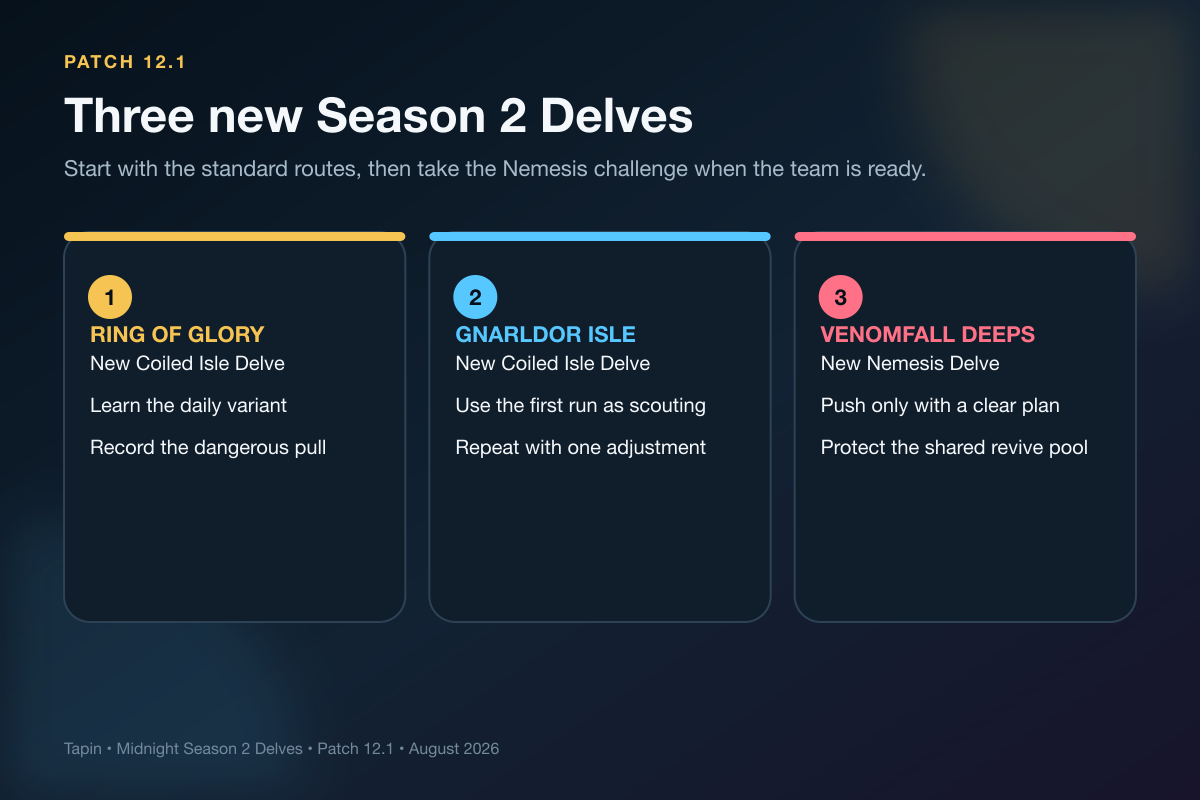
Patch 12.1 added three Coiled Isle Delves: The Ring of Glory, Gnarldor Isle, and the Venomfall Deeps Nemesis Delve. Blizzard’s Curse of Ula’tek update notes also confirm new snake and venom variants inside existing Midnight Delves.
The season did not replace the base expansion system. Midnight still includes ten standard Delves plus one seasonal Nemesis Delve, spread across Silvermoon City, Eversong Woods, Harandar, the Isle of Quel’Danas, Zul’Aman, and Voidstorm. Blizzard’s Midnight Delves overview lists the full expansion set and confirms that Valeera Sanguinar can fill the three familiar companion support roles.
Season 2 opened Bountiful Delves and keys on August 18. All tiers were already available during the pre-season week, but the reward loop only became complete when Bountiful runs, keys, and Season 2 Great Vault gear came online.
That timing matters because a normal scouting run and a key-backed Bountiful run should not be played with the same risk tolerance.
How WoW Delves Work
Delves are short instanced adventures that can be completed solo or with up to five players. The current Midnight Delves reference describes them as roughly 10–15 minute scenarios with changing objectives, a final encounter or equivalent objective, and progression toward the Great Vault.
The useful mental model is simple:
- Normal run: learn the variant, test the tier, and practice mechanics.
- Bountiful run: protect the clear because a key and better end chest are involved.
- Nemesis run: take the challenge only when the route, damage profile, and recovery plan are stable.
Each Delve can rotate story variants. Check the in-game Delver’s Guide before entering so the route you practiced yesterday does not become a surprise today.
Set Valeera for the problem you have
Valeera is not a substitute for your own defensives, interrupts, or positioning. She is a tool for covering the gap in the current setup.
If you are dying slowly to sustained pressure, choose support that improves survival. If the run is safe but stalls on priority targets, shift toward damage. Recheck the setup at the supplies point instead of carrying a bad choice through the entire instance.
⚡ Pro Tip: Change one thing at a time. If you switch tier, companion role, curios, and route together, you will not know which change fixed the run.
Choose Solo, Duo, or a Full Delve Group
Solo is clean for learning your own class. Every interrupt, defensive, and movement mistake belongs to you, which makes the review honest.
A duo is the sweet spot for many players. You gain another interrupt, another combat perspective, and somebody who can name the mechanic you missed without turning the run into five people talking at once.
A larger group gives you more tools but increases coordination cost. Before entering, confirm:
- who calls priority targets;
- who owns the first interrupt;
- who watches the shared revive count;
- whether the run is scouting, completion, or a tier push;
- whether the group leaves after a failed Bountiful attempt or resets immediately.
If you need to build that group from scratch, use our WoW LFG guide to write a listing with the tier, goal, pace, and communication expectation already visible.
Plan Bountiful Delves and Great Vault Progress
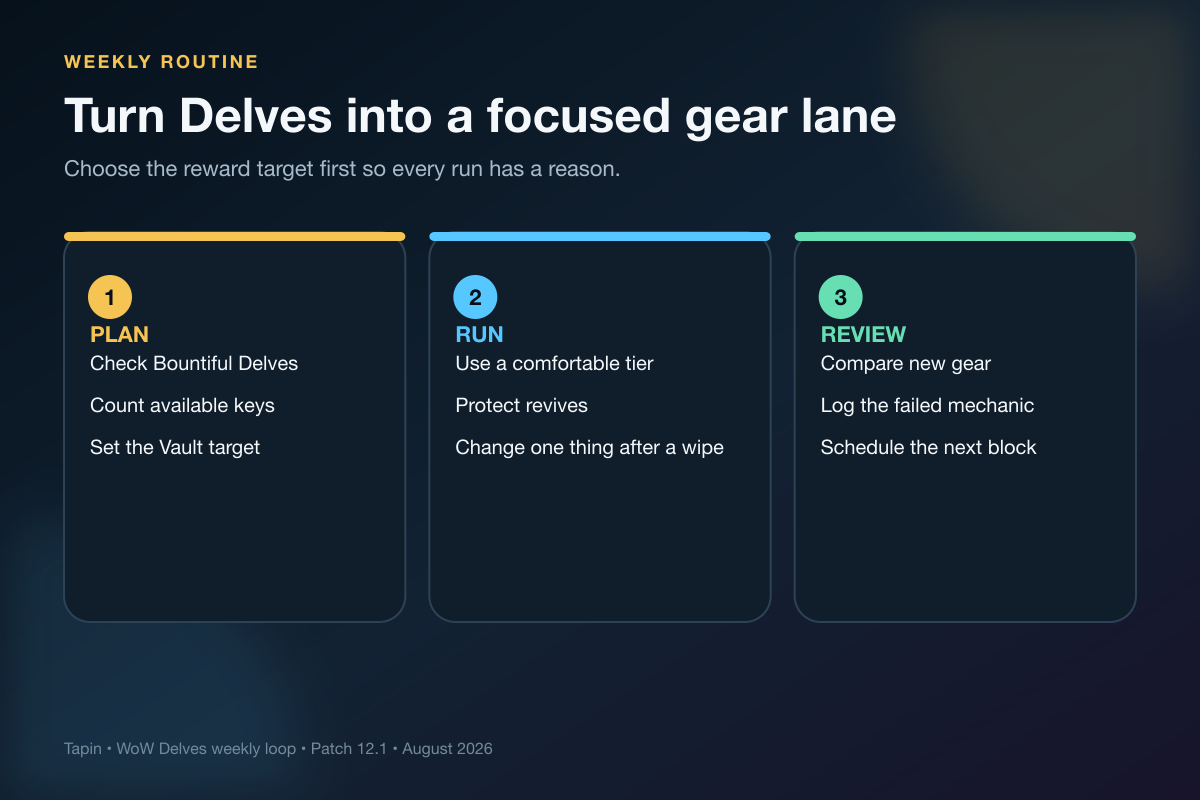
Do not spend a key just because a Bountiful icon is on the map. Decide what the run is supposed to accomplish first.
Start with a weekly target
At reset, compare your weak slots, available keys, and realistic playtime. The official Season 2 pre-season details say the first World-row Vault was capped at Champion 3/6, while later World-row rewards can reach Hero 1/6.
The current Delves system unlocks World-row Great Vault choices after two, four, and eight qualifying Delves. That does not mean every character needs eight runs. Two focused clears can be better than eight tilted ones on an alt you barely play.
Push the highest tier you can repeat
Loot scaling tops out before the hardest challenge tiers. The current Delves reference lists Tier 8 as the reward ceiling for end-of-run and Vault gear, while higher tiers exist for crests and challenge.
I believe the best weekly tier is the highest one you can clear repeatedly without relying on a lucky pull. A one-off victory proves possibility. A stable clear creates a gearing lane.
Use our broader Midnight Season 2 gearing guide to compare Delves with world content, Mythic+, and raid before committing the whole week to one source.
Save the key for the stable attempt
Scout a new variant without spending the valuable attempt if your character or group is not ready. Learn where the dangerous packs, objective transitions, and checkpoint sit. Then start the Bountiful run with a plan.
⚠️ Watch Out: A Bountiful icon is not a command to push. If the group is burning revives before the midpoint, step down or reset before spending the rest of the session repeating the same failure.
Protect Revives Before You Push the Tier
Revives belong to the group, not the player who died. Every release spends from the same pool, so one careless loop can erase the run’s reward before the final encounter.
The current revive rules give no death limit in Tiers 1–3, five revives in Tiers 4–8, four in Tier 9, and three in Tiers 10–11. Reaching a checkpoint adds a revive and moves the respawn point forward, but it does not make early deaths free.
Before a dangerous room, use three calls:
- Target: mark the enemy that must die or stop casting first.
- Cooldown: say who is using the major defensive or crowd control.
- Reset: decide whether a death means release, wait, or restart.
The reset call matters most. Five players releasing instantly can spend the pool before anybody realizes the fight was recoverable.
After a wipe, name one cause. “We died” is useless. “The second cast went through because both kicks hit the first one” gives the next pull a fix.
Run WoW Delves With a Teammate
A good Delve partner does not carry your character. They make the run easier to read.
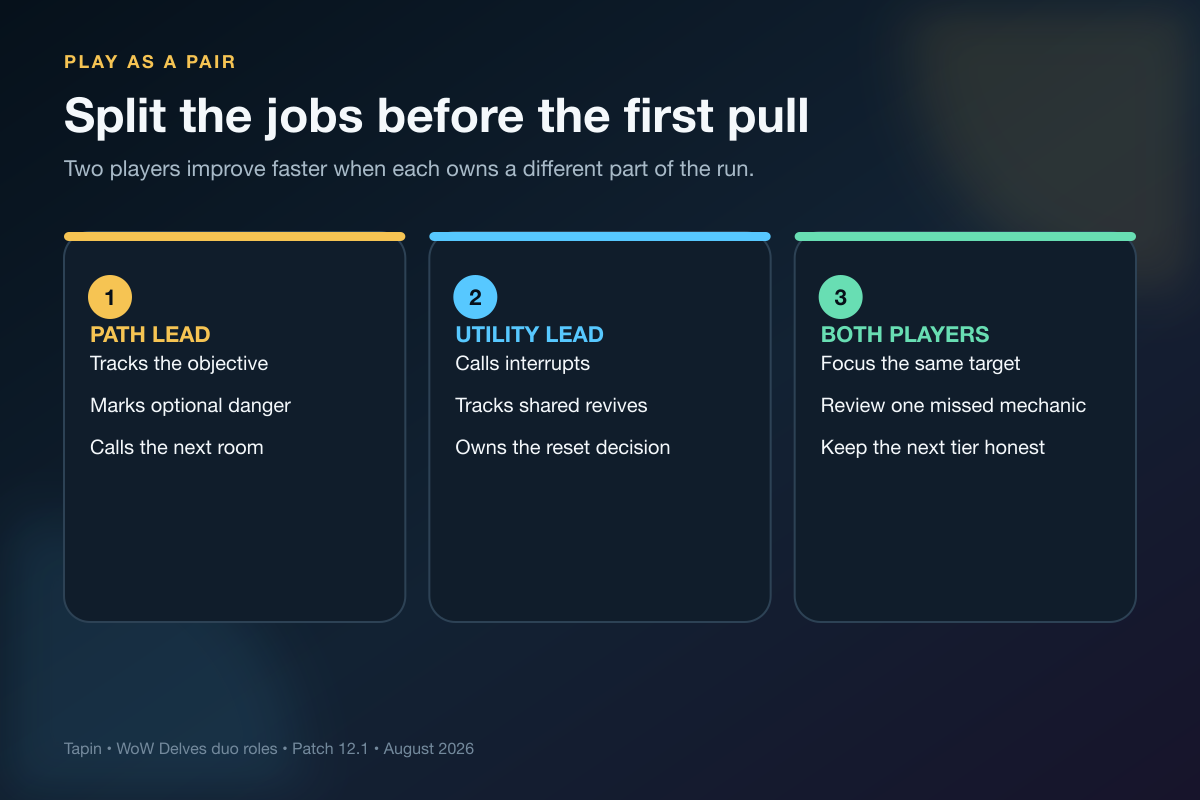
Split the work:
- Path lead: tracks the objective, marks optional danger, and calls the next room.
- Utility lead: assigns interrupts, watches revives, and owns the reset decision.
- Both players: focus the same target, review one missed mechanic, and keep the tier honest.
That split keeps the stronger player from doing every decision while the other follows silently. Rotate roles after a few runs so both people learn the system.
If your regular group is offline, find a World of Warcraft teammate on Tapin for a defined Delve block. Put the tier, session length, and goal in the request so you match with somebody who wants the same run.
Keep account access private. A teammate can guide, heal, interrupt, and review beside you without ever needing your login.
Use a Three-Run Delve Practice Block
Grinding ten different Delves with ten different groups produces activity. It does not always produce improvement.
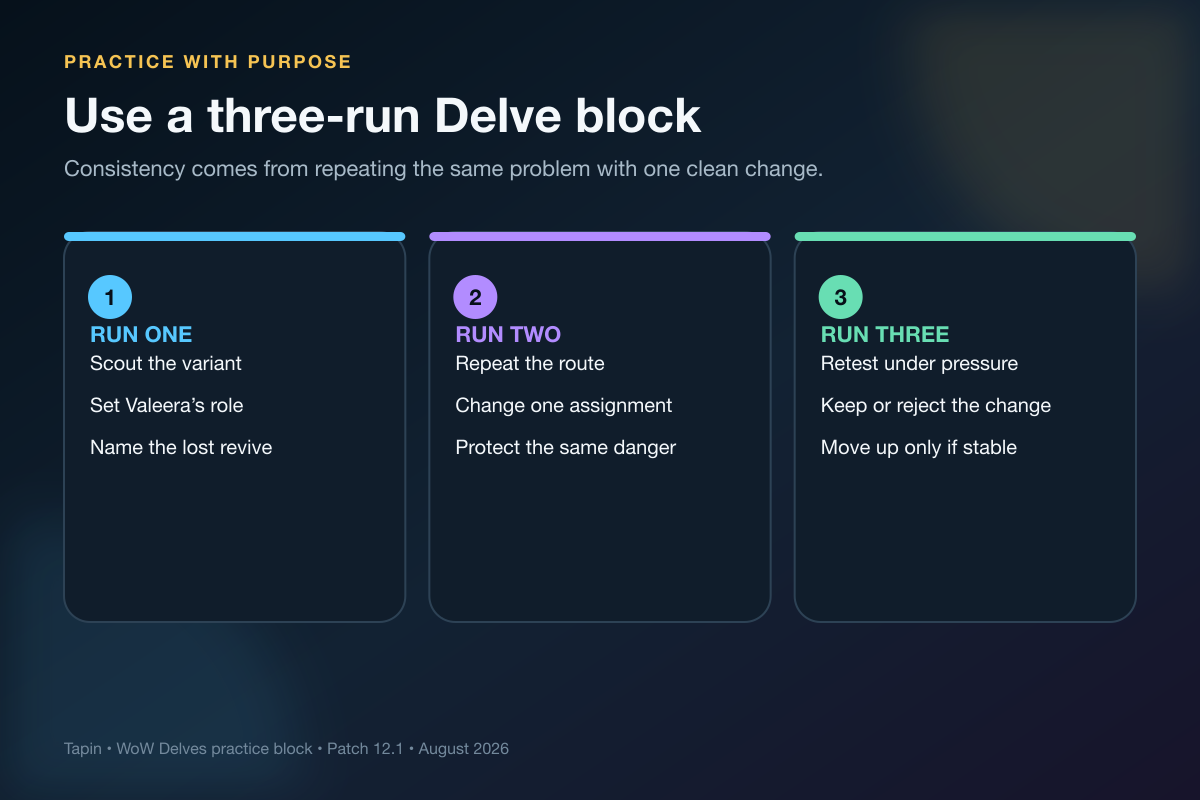
Run one: scout
Confirm the variant, set Valeera’s role, and play the planned tier. Record the first lost revive and the mechanic that caused it.
Run two: change one assignment
Repeat the route or a comparable variant. Move one interrupt, defensive, or target call. Do not rebuild the entire plan.
Run three: retest under pressure
Keep the change if it survives the dangerous section. Reject it if the original problem remains or the fix creates a worse one.
Only move up when the current tier feels controlled. If the group needs every cooldown and all remaining revives to survive an ordinary room, the next tier is not the next lesson.
This same review habit carries into dungeons. Our WoW Mythic+ guide uses a similar three-run loop for route, utility, and recovery practice.
WoW Delves FAQ
Can WoW Delves be completed with a group?
Yes. Midnight Delves can be played solo or with a group of up to five players. A duo often gives enough extra utility without adding full-group communication overhead.
What are the new Midnight Season 2 Delves?
Patch 12.1 added The Ring of Glory, Gnarldor Isle, and the Venomfall Deeps Nemesis Delve on the Coiled Isle.
When did Bountiful Delves open in Season 2?
Bountiful Delves and keys became available with the start of Midnight Season 2 on August 18, 2026.
What Delve tier gives the highest gear rewards?
The current reward tables cap Delve and World-row Great Vault gear scaling at Tier 8. Higher tiers remain useful for challenge and crest goals.
Should I run Delves solo or with a teammate?
Run solo when you want a clean test of your class execution. Use a teammate when another interrupt, recovery tool, or second perspective will help you practice the same tier consistently.
Make the Next Run Cleaner
Delves reward control more than ego. Pick a repeatable tier, scout before risking the key, protect revives, and change one assignment after each failure.
The goal is not to survive one chaotic clear. It is to make the next run feel planned.