

Last Updated: August 2026 — WoW Midnight Patch 12.1, Season 2
WoW LFG can get you into a dungeon in minutes and still waste the whole night. The problem usually isn’t finding bodies. It’s finding four or 19 people who want the same run, know the pace, and don’t disappear after the first wipe.
This guide gives you a cleaner system. You’ll know which Group Finder route fits the activity, how to write or read a listing, what to check before accepting an invite, and how to turn a good pickup group into people you actually want to play with again.
Table of Contents
- WoW LFG starts with the right tool
- Write a listing people can trust
- Read a group before applying
- Item level and fit
- The three-run teammate trial
- Green flags and red flags
- FAQ
WoW LFG Starts With the Right Tool
The current World of Warcraft Group Finder separates Dungeons & Raids, PvP, and Mythic+ tools. That matters because “find me a group” means three very different things inside the same menu.
- Dungeon Finder automatically assembles a five-player party. Use it when speed matters more than screening.
- Raid Finder automatically builds a raid for LFR difficulty. It’s the lowest-friction way to see current raid wings.
- Premade Groups lets leaders choose applicants for a specific activity. This is where expectations, role fit, and experience become part of the decision.
- A regular teammate or guild group removes the screening step from future sessions. The setup takes longer once and saves time every week after.
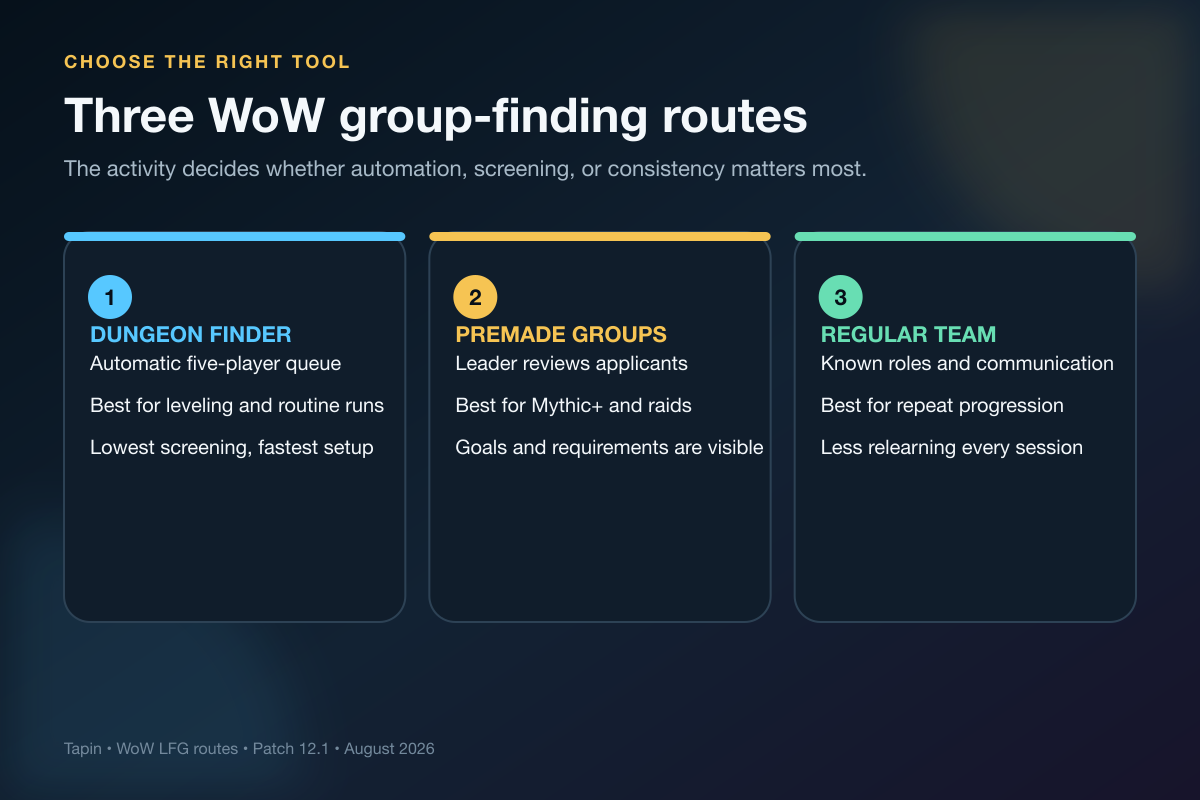
I believe most bad LFG nights begin with using the fastest tool for a goal that needs screening. Random Dungeon Finder is great for routine leveling. A progression key or organized raid needs more context than a role icon and an item level.
If you’re new to the terminology, our guide to what LFG means in gaming covers the basics across games.
How to Write a WoW LFG Listing People Can Trust
“+4 need heals big pumpers” tells an applicant almost nothing. A useful listing answers six questions before anyone joins:
- What activity and difficulty are you running?
- Is the goal completion, practice, timing the key, or farming?
- Which roles or utility are missing?
- What pace should players expect?
- Are voice, pings, or text calls required?
- How long is the group staying together?
The Premade Groups interface supports an activity type, title, details, minimum item level, and voice-chat requirement. Use those fields to set the contract for the run—not to write an ego test.
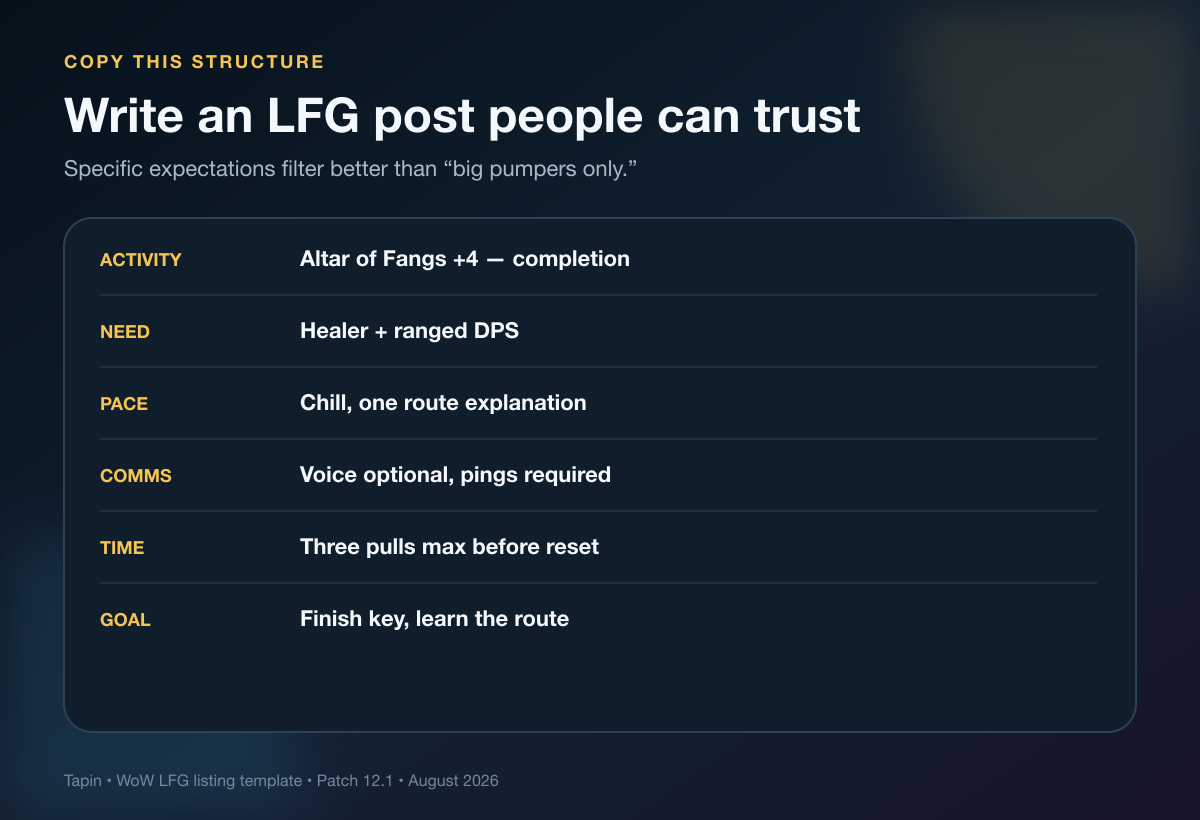
A strong listing might read:
Altar of Fangs +4 — completion. Need healer and ranged DPS. Chill pace, one route explanation before pull. Voice optional; use pings. Three pulls before reset.
That post filters for the night you actually want. Someone chasing a speed clear can skip it. Someone learning the dungeon knows they won’t get flamed for asking one good question.
How to Read an LFG Group Before Applying
You can’t inspect personality from a listing, but you can catch obvious mismatches.
Check the activity first. In Midnight Season 2, the live Mythic+ pool includes Altar of Fangs, Murder Row, Den of Nalorakk, The Blinding Vale, Voidscar Arena, Kings’ Rest, Temple of Sethraliss, and Ruby Life Pools, according to Blizzard’s Season 2 unlock schedule. Make sure the listed dungeon and difficulty match the guide, route, and consumables you prepared.
Then read the goal language:
- Completion means the group should keep going if the timer is gone.
- Push means mistakes and route efficiency matter more.
- Learning should allow explanations and planned resets.
- Farm assumes repeated kills or runs with minimal discussion.
Finally, check whether the listed requirements make sense. A group asking for experience far above its own activity level may be searching for a carry. A leader who clearly names the missing role, pace, and goal is giving you something you can evaluate.
Item Level Is a Door, Not a Personality Test
Item level answers one question: is the character geared enough to enter or plausibly handle the activity? It does not tell you whether the player interrupts, listens, recovers after a wipe, or keeps the agreed schedule.
The new Venomous Abyss raid makes the distinction obvious. Blizzard lists level 90 and item level 273 as the minimum for Raid Finder in its official raid overview. Meeting 273 gets you into the queue. It doesn’t teach the eight encounters or make a raid group communicate.
For organized content, screen for evidence that fits the run:
- Has the player done this dungeon or wing at a nearby difficulty?
- Do they name their main role and a realistic backup?
- Can they explain what they want from the session in one sentence?
- Do they respond normally when you clarify the pace?
That last one matters. A calm answer before the invite is a better signal than a paragraph about parses followed by instant hostility.
Run a Three-Game Trial Before Building a Regular Group
One clean key can hide bad fit. Maybe every pull worked, nobody had to adjust, and the route never tested communication. Use three runs instead.
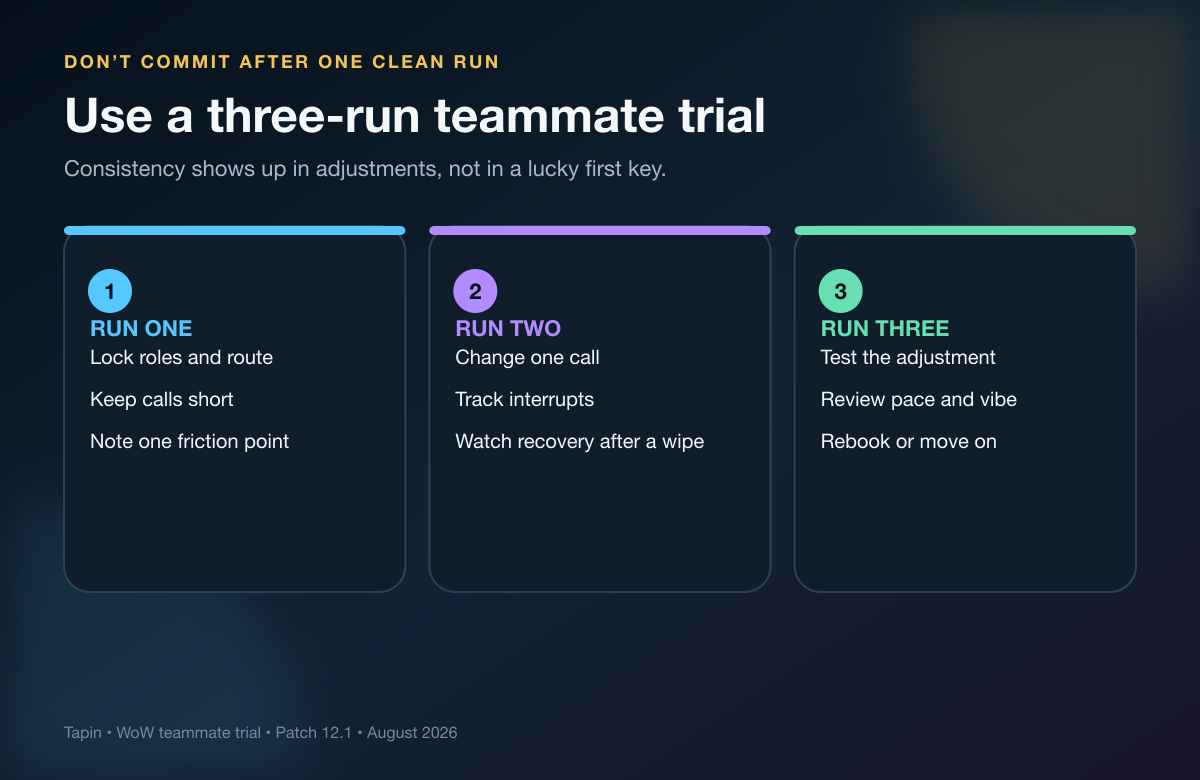
Run one: establish the baseline
Lock roles, agree on the route, and keep calls simple. Note one friction point instead of reviewing every mistake.
Run two: change one thing
Assign one interrupt order, one defensive call, or one movement cue. You’re testing whether the group can adjust—not whether everyone can absorb a lecture during the ready check.
Run three: test consistency
Repeat the adjustment under pressure. After the run, ask three direct questions: Did the roles fit? Did communication help? Would everyone choose another block together?
If the answer is yes, add each other and schedule the next session. If you want a reliable starting point without gambling on another dead Discord post, find a World of Warcraft teammate on Tapin and choose the kind of session you want to run.
WoW LFG Green Flags and Red Flags
A player does not need perfect gear or a flawless history to be a good teammate. They need to make the group more stable.
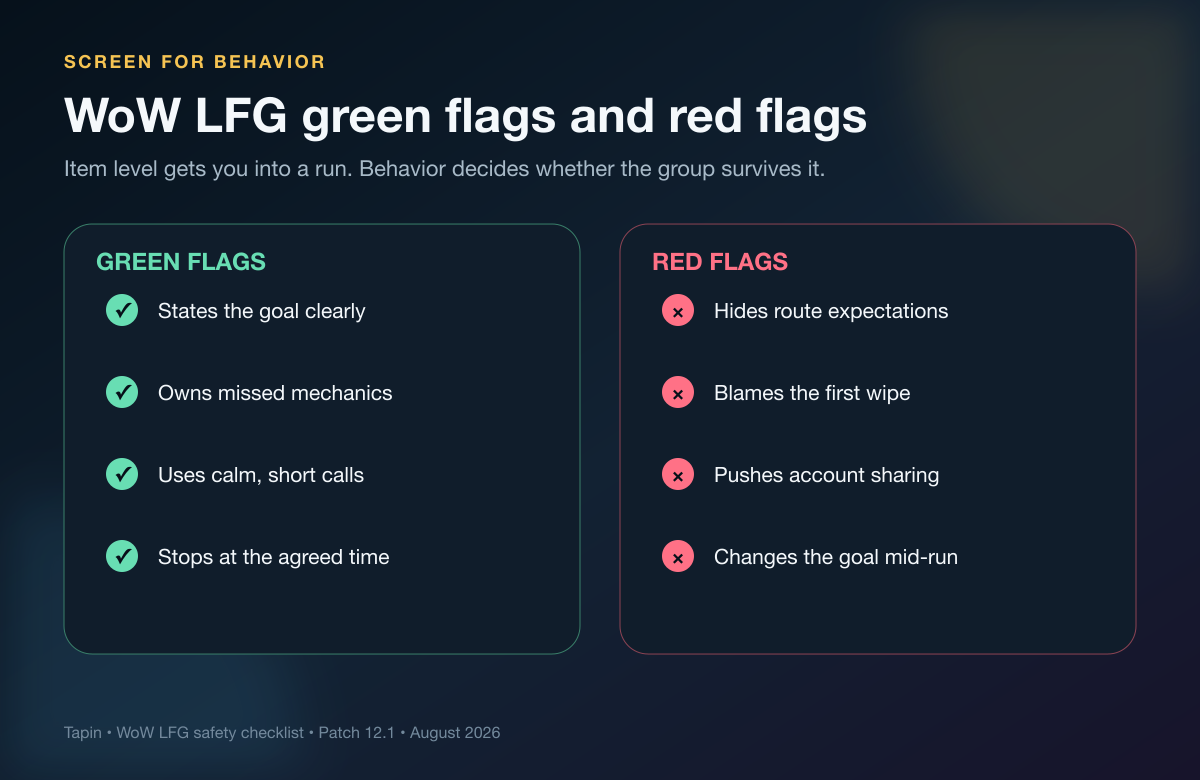
Green flags:
- States the goal without moving it after the group forms.
- Owns a missed mechanic and adjusts on the next pull.
- Uses short calls that leave room for everyone to play.
- Stops at the agreed time instead of pressuring the group.
Red flags:
- Hides route expectations, then punishes people for not guessing.
- Blames the first wipe before checking what happened.
- Pushes cheats, exploits, or account sharing.
- Turns a completion group into an unannounced push group.
Account sharing is especially easy to reject: don’t give another player your login. Play together on separate accounts. A legitimate teammate can tank, heal, DPS, route, and explain without touching your credentials.
LFG for Leveling, Mythic+, and Raids
The screening bar should match the cost of failure.
Leveling dungeons
Keep it light. Confirm role, queue plan, and whether the group is questing between pops. Our WoW leveling guide for the 1–90 route shows where a duo can split navigation and queue management.
Mythic+
Clarify completion versus timer, the route, important utility, and how many attempts the group is giving the key. Short planning before the first pull prevents long arguments after it.
Raids
Confirm difficulty, wing or boss target, lockout expectations, voice requirements, and the planned end time. For the live tier, use our Venomous Abyss raid prep guide before applying.
WoW LFG FAQ
What does LFG mean in World of Warcraft?
LFG means “looking for group.” In WoW, players use the term for automated Dungeon or Raid Finder queues, Premade Group listings, guild recruitment, and community posts seeking teammates.
Is Raid Finder the same as a premade raid?
No. Raid Finder automatically matches eligible players into LFR difficulty. Premade raids are assembled by a leader who reviews applicants for a chosen difficulty and goal.
What should I put in a Mythic+ listing?
Include the dungeon and key level, completion or timer goal, needed roles, expected pace, communication method, and how long the group plans to run.
How do I find a regular WoW teammate?
Start with a short trial block, test one adjustment across multiple runs, and schedule the next session while the fit is clear. You can also use Tapin to find someone for a defined WoW session instead of rebuilding the group from zero.
Should I share my WoW account with a teammate?
No. Keep your login private and play together on separate accounts. Grouping, coaching, callouts, and route practice do not require account access.
Build the Group You Want to Rejoin
The right WoW LFG route is the one that matches the stakes. Auto-queue routine content, screen progression groups, and turn good pickup runs into repeat teammates.
Your goal isn’t to win the applicant screen. It’s to finish the night thinking, “same time next week.”