

Last Updated: August 2026 — WoW Midnight Patch 12.1, Season 2
A WoW Mythic+ guide should help you survive the key you are about to run—not bury you under a universal route that falls apart after one missed interrupt. Midnight Season 2 is live, the dungeon pool changed, and the fastest improvement still comes from keeping the same group long enough to fix the same mistake twice.
This guide gives you a clean system for preparing the eight-dungeon pool, assigning calls, recovering after deaths, and turning three keys into an actual practice block.
Table of Contents
- Midnight Season 2 dungeon pool
- Prepare one dungeon at a time
- Assign team roles before the key
- Use short calls during pulls
- Recover without throwing the key
- Run a three-key practice loop
- FAQ
WoW Mythic+ Season 2 Dungeon Pool
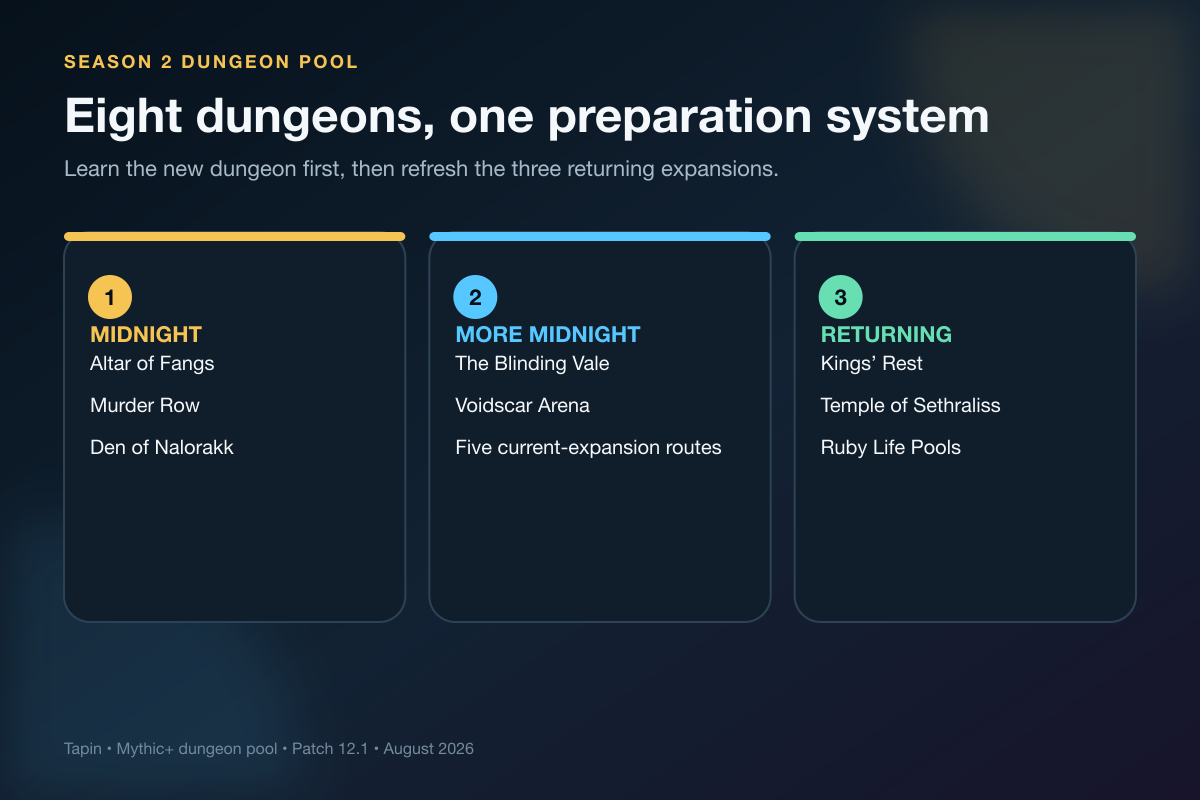
Blizzard’s official Midnight Season 2 schedule lists eight Mythic+ dungeons:
- Altar of Fangs
- Murder Row
- Den of Nalorakk
- The Blinding Vale
- Voidscar Arena
- Kings’ Rest
- Temple of Sethraliss
- Ruby Life Pools
Five are Midnight dungeons. Three return from Battle for Azeroth and Dragonflight. Treat that split as a study plan: learn Altar of Fangs while it is new, refresh the returning routes, then work through the other Midnight layouts.
Do not try to memorize eight complete routes in one sitting. Know the first three pulls, the dangerous cast in each pack, and the recovery point after the first boss. That is enough to make the first run useful.
Prepare One Mythic+ Dungeon at a Time
Build a one-page plan for the next dungeon. It needs five things:
- The opening pull and cooldown plan.
- Two casts that must be kicked or stopped.
- One skip or count decision that can break the route.
- The boss mechanic most likely to kill your role.
- The release or regroup point after a wipe.
I believe route confidence matters more than route complexity for most groups. A simple plan everybody understands beats a perfect route only the tank has seen.
If you are forming through Premade Groups, state whether the goal is completion, practice, or timing. Our WoW LFG guide has a listing template that filters for the session you actually want.
Assign Three Jobs Before the Key Starts
The tank should not be routing, marking, tracking every interrupt, and deciding every recovery while also positioning the pull. Split the work.
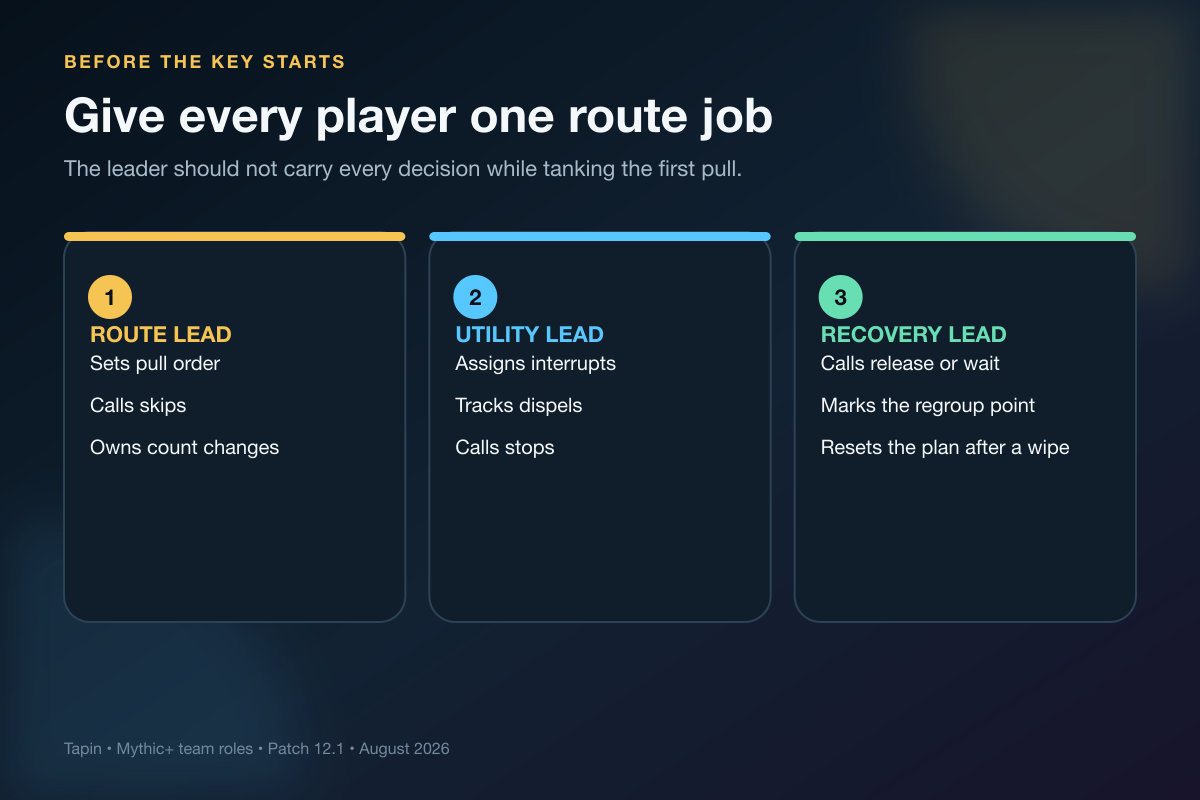
- Route lead: calls pull size, skips, and count changes.
- Utility lead: assigns the first interrupts, dispels, and hard stops.
- Recovery lead: decides release versus wait and marks the regroup point.
These are communication jobs, not permanent authority. The healer can lead recovery. A ranged DPS can own stops. Give the job to the player who can make the call without turning it into a speech.
⚡ Pro Tip: Put the action first. “Kick hex,” “hold damage,” and “release north” land faster than explanations during a pull.
Use Short Mythic+ Calls During Pulls
Five calls cover most emergencies:
- Kick [spell]: the assigned interrupt fires now.
- Stop next: use a stun, knock, silence, or other hard stop on the next dangerous cast.
- Defensive: use a personal cooldown before the damage lands.
- Hold: stop damage or movement until the group regains control.
- Reset: stop salvaging the pull and follow the recovery plan.
Avoid narrating every mechanic. Constant voice traffic hides the one call that matters. Make assignments before the pull, call exceptions during it, and review after combat.
Recover From a Wipe Without Throwing the Key
The first question after deaths is not “whose fault was that?” It is “release or wait?” Answer it immediately.
Then choose one correction:
- Shrink the pull.
- Change one interrupt assignment.
- Move the fight to a cleaner position.
- Save one defensive or crowd-control cooldown.
Do not redesign the whole route after one bad overlap. A five-minute debate costs more time than the original mistake.
⚠️ Watch Out: Never ask a teammate to share their account so somebody else can finish the key. Legitimate help happens in the group, on separate accounts.
Run a Three-Key Practice Loop
One run shows the problem. Three runs show whether the group can fix it.
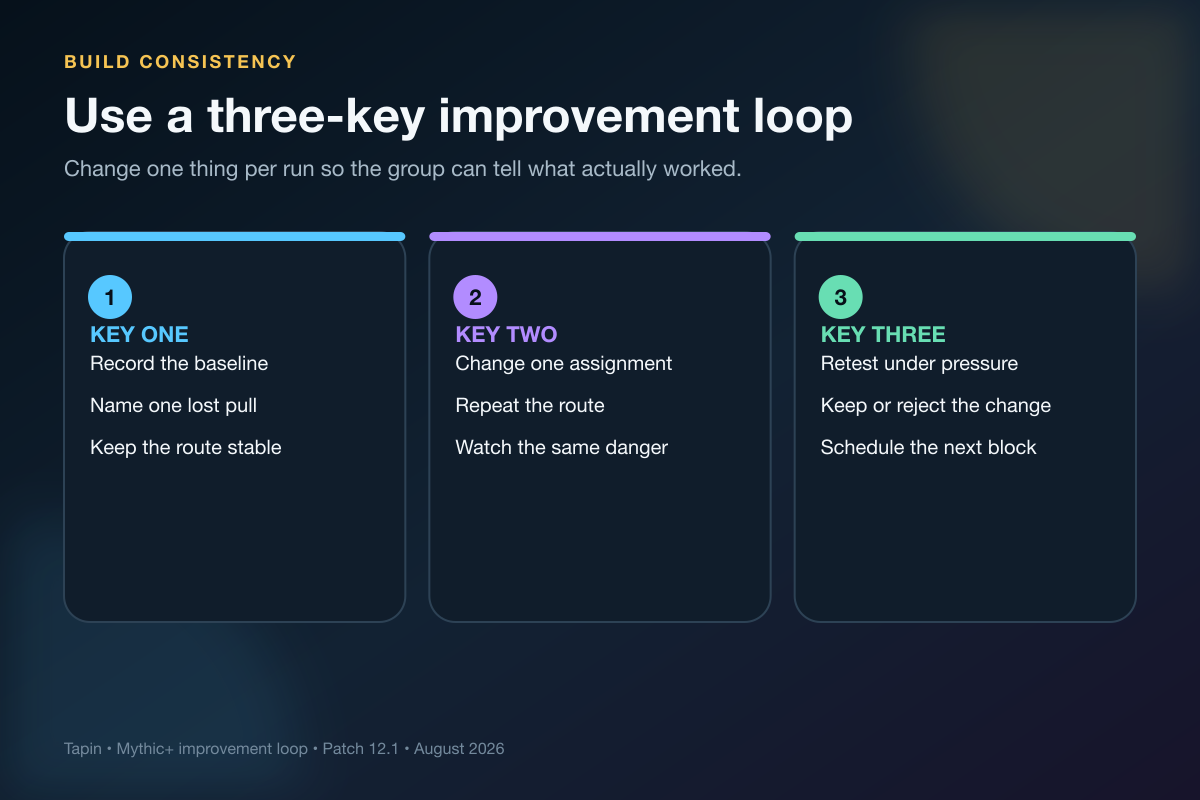
Key one: record the baseline
Keep the route stable. After the run, name one lost pull and one call that arrived too late.
Key two: change one assignment
Repeat the route with one new interrupt, defensive, or recovery job. If you change five things, you will not know which one helped.
Key three: retest under pressure
Run the same danger again. Keep the change if the group executes it cleanly; reject it if the call creates more confusion.
If your friends list is empty when the key block starts, find a World of Warcraft teammate on Tapin. Choose someone who fits the role, pace, and communication style, then schedule the next block before everyone logs off.
Connect Mythic+ to Your Weekly Gear Plan
Mythic+ is one gearing lane, not the whole checklist. Blizzard says Season 2 Great Vault credit began during the pre-season week, with the first Season 2 rewards available August 18. Plan dungeon runs around the slots you need instead of treating every higher item level as an automatic upgrade.
Our WoW gearing guide for Midnight Season 2 turns that into a weekly loop. If you also raid, use the Venomous Abyss prep guide to separate dungeon practice from boss preparation.
Review the Key Without Turning It Into a Trial
A useful review takes five minutes. Start with the timer, deaths, and the pull that changed the run. Then ask each player for one thing that made their role harder.
Use this order:
- What happened? Name the cast, overlap, count error, or recovery delay.
- What was the group’s plan? Confirm whether the assignment existed before the pull.
- What changes next run? Choose one player, one action, and one call.
- Where will you retest it? Name the pack or boss instead of saying “communicate better.”
“We need better comms” is not a fix. “Ranged one kicks the first heal; utility lead calls the second” is a fix everybody can execute.
Keep the review about the group’s system. A missed kick can come from an unclear order, two players interrupting the same cast, a dead assignee, or a player simply missing the button. Those are different problems.
Know when the group fit is wrong
Not every five-player lineup should become a regular team. Move on when a player repeatedly changes the agreed goal, insults people after ordinary mistakes, ignores the stop time, or pushes cheats and account access.
Keep people who make the second attempt calmer than the first. The best repeat teammate is not always the player with the loudest résumé. It is the one who hears an adjustment, applies it, and helps the group recover without making the night miserable.
Schedule the next block while the context is fresh
Do not end with “we should run again sometime.” Name a day, a two- or three-key block, and the first dungeon. That turns a good pickup run into an actual team and lets everyone prepare the same route before logging in.
WoW Mythic+ FAQ
When did Midnight Season 2 Mythic+ start?
Mythic+ Season 2 opened the week of August 18, 2026, according to Blizzard’s official unlock schedule.
Which dungeons are in the Season 2 pool?
The pool contains Altar of Fangs, Murder Row, Den of Nalorakk, The Blinding Vale, Voidscar Arena, Kings’ Rest, Temple of Sethraliss, and Ruby Life Pools.
What should a new Mythic+ group practice first?
Practice the opening pulls, two dangerous casts, and the first recovery point. That gives the group enough structure to learn from a complete run without memorizing every branch.
How do I find a regular Mythic+ teammate?
State the role, key range, completion or timer goal, and communication style. Run a three-key trial, review one change between runs, and schedule the next session while the fit is clear.
Should I share my WoW account for Mythic+ help?
No. Keep your login private. A teammate can route, heal, tank, DPS, and make calls while playing alongside you on their own account.
Build a Team That Gets Better Together
Season 2 will keep moving. Your group does not need a new identity every reset—it needs a route everyone understands, short calls, and enough repeat runs to make one correction stick.
Pick one dungeon, run three keys, and keep the people who make the fourth run easier.